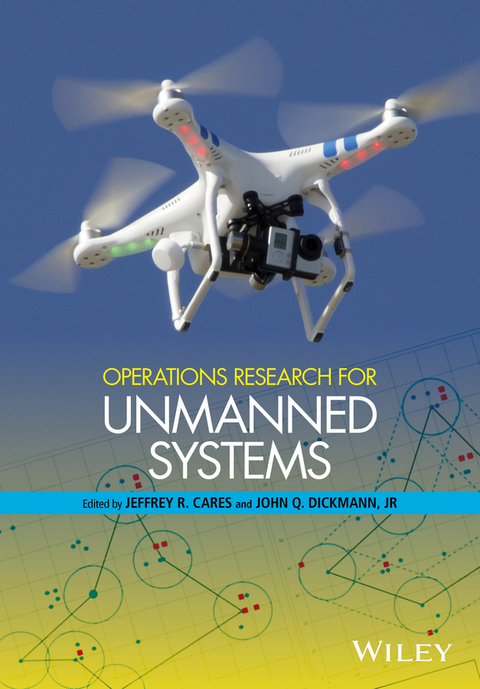

The first edited volume addressing analysis for unmanned vehicles, with focus on operations research rather than engineering
• The editors have a unique combination of extensive operational experience and technical expertise
• Chapters address a wide-ranging set of examples, domains and applications
• Accessible to a general readership and also informative for experts
The first edited volume addressing analysis for unmanned vehicles, with focus on operations research rather than engineering The editors have a unique combination of extensive operational experience and technical expertise Chapters address a wide-ranging set of examples, domains and applications Accessible to a general readership and also informative for experts
Jeffrey Cares is an author, entrepreneur and thought-leader in military innovation. He consults to the most senior levels of the international defense industry and is a leading researcher in collective robotics and networked warfare. He lectures internationally at senior service colleges on the future of combat, and he develops and conducts military and business war games. Harvard Business Review selected Jeff's research to the Top 20 list of "Breakthrough Ideas for 2006," and he has been featured in such Information Age bellwethers as Wired and Fast Company. A combat veteran of the first Gulf War, Jeff's military career included multiple command tours, over a decade of service on four-star staffs, service in the Pentagon and all Fleet Headquarters, and joint and combined operations worldwide. He is a retired Navy Captain. John Dickmann, Jr is a retired U.S. Navy submarine officer. A graduate of the U.S. Naval Academy, he served on active duty for 22 years in both attack and ballistic missile submarines, with shore assignments in both technical and policy organizations. Following his Navy career, he attended the Massachusetts Institute of Technology, earning a Ph.D. in Engineering Systems. His research focuses on architectures of complex socio-technical systems, emphasizing operational flexibility. He has conducted studies and analysis for the Naval Sea Systems Command, DARPA, the Office of the Secretary of Defense and numerous commercial customers.
1. Introduction
Jeffrey R. Cares and John Q. Dickmann
2. The In-Transit Vigilant Covering Tour Problem for Routing Unmanned Ground Vehicles
Huang Teng Tan and Raymond R. Hill
3. Near-Optimal Assignment of UAVs to Targets Using a Market-Based Approach
Elad Kivelevitch, Kelly Cohen and Manish Kumar
4. Considering Mine Countermeasures Exploratory Operations Conducted by Autonomous Underwater Vehicles
Bao Nguyen, David Hopkin, and Handson Yip
5. Optical Search by UAVs: Fauna Detection Case Study
R. Prieto, E. Méndez, J.J. Vales, I. Pino, I.R. Carpintero, L. Granado, G. Montoya, F. Giménez de Azcárate, F. Cáceres and J.M. Moreira
6. A Flight Time Approximation Model for Unmanned Aerial Vehicles: Estimating the Effects of Path Variations and Wind
Matthew J. Henchey, Rajan Batta, Mark Karwan and Agamemnon Crassidis
7. Impacts of Unmanned Ground Vehicles on Combined Arms Team Performance
Fred D. J. Bowden, Richard M. Dexter, Denis R. Shine, Andrew W. Coutts, Luke Finlay and Ben Pietsch
8. Processing, Exploitation and Dissemination: When is Aided/Automated Target Recognition 'Good Enough' for Operational Use?
Patrick Chisan Hew
9. Analyzing a Design Continuum for Automated Military Convoy Operations
David M. Mahalak
10. Experimental Design for Unmanned Aerial Systems Analysis: Bringing Statistical Rigor to UAS Testing
Raymond R. Hill and Brian B. Stone
11. Total Cost of Ownership (TOC): An Approach for Estimating UMAS Costs
Ricardo Valerdi and Thomas R. Ryan, Jr.
12. Logistic Support for Unmanned Systems
Major Keirin Joyce, Australian Army
13. Organizing for Improved Effectiveness in Networked Operations
Sean Deller, Ghaith Rabadi, Andreas Tolk and Shannon R. Bowling
14. An Exploration of Performance Distributions in Collectives
Jeffrey R. Cares
15. Distributed Combat Power: The Application of Salvo Theory to Unmanned Systems
Jeffrey R. Cares
1
Introduction
Jeffrey R. Cares1 and John Q. Dickmann, Jr.2
1 Captain, US Navy (Ret.), Alidade Inc., USA
2 Sonalysts Inc., USA
1.1 Introduction
Given all the attention and investment recently bestowed on unmanned systems, it might seem surprising that this book does not already exist. Even the most cursory internet search on this topic will show professional journal articles, industry symposia proceedings, and technical engineering texts conveying broad interest, substantial investment, and aggressive development in unmanned systems. Yet an internet bookstore or library search for “operations research” combined with “unmanned systems” will come up blank. This book will indeed be the first of its kind.
Historians of military innovation would not be surprised. In fact, they point to a recurring tendency of the study of usage to lag invention. Such a hyper-focus on engineering and production might be perfectly understandable (for program secrecy, to work the “bugs” out of early production models, or simply because of the sheer novelty of radically new devices) but the effect is often the same: a delayed understanding of how operators could use new hardware in new ways. As the preeminent World War II scientist P. M. S. Blackett observed of the innovations of his time, “relatively too much scientific effort has been expended hitherto on the production of new devices and too little in the proper use of what we have got.” [1] It is ironic that a study of usage is one of the best ways to understand how to develop and improve a new technology; but engineering, not usage, gets the most attention early in an innovation cycle.
One does not need to be a student of military innovation to know that the study of usage is not the engineer’s purview. Blackett’s counterparts across the Atlantic, Morse and Kimball, noted that the “the branches … of engineering … are involved in the construction and production of equipment, whereas operations research is involved in its use. The engineer is the consultant to the builder, the producer of equipment, whereas the operations research worker is the consultant to the user of the equipment.” [2] Engineering tells you how to build things and operations research tells you how things should be used. In development of new military hardware, however, engineering nearly always has a head start over operations research.
Three of the many ways that engineering overshadows usage early in unmanned systems development have delayed a book such as this from reaching professional bookshelves. The first is that most engineers have not yet recognized that unmanned systems can be so much more than merely systems without a human onboard. This anthropomorphism – creating in our own image – was the first fertile ground for engineers, and early success with this approach made it seem unnecessary to conceive of unmanned operations as any different than those studied by operations researchers for decades.
The second reason is that since engineers build things, not operations, the engineer’s approach to improving operations is to refine the vehicles. Such engineering-centered solutions have already been observed in existing unmanned programs, driving up vehicle complexity and cost – without regard to how modifying operational schemes might be a better way to increase operational performance.
The third reason is that since humans are the most expensive “total cost of ownership” (TOC) components of modern military systems, the military and defense industries have been content to lean on “manpower cost avoidance” as the overriding value proposition for unmanned systems. For now, unmanned systems are convincingly sold on cost alone – there is no reason for program managers to answer questions about operational value that no one is yet asking. The engineer’s present task is to keep development and production costs lower than equivalent manned systems for a given level of performance – not to explore the performance–cost trade space.
The historian of military innovation would be quick to clarify that usage lags invention mostly in the initial phases of maturation. Engineers and program managers pre-occupied with production can indeed be quite successful. In the case of unmanned vehicle development, second- and third-generation variants have already replaced prototypes and initial production models in the fleet, field, and flightline. Major acquisition programs (such as the Global Hawk and Predator systems) are already out of adolescence. Now that well-engineered platforms are employed on a much larger scale, a growing cadre of operations research analysts are at last being asked to answer operational questions – questions of usage.
While the three reasons cited above are among those that have heretofore preempted this book, they also constitute an initial set of topics for the operations researcher. What we might now call “operations research for unmanned systems” is emerging with three main themes:
- The Benefits of “Unmanning”: While the challenges of removing humans from platforms are still manifold and rightfully deserve our attention, operations researchers are now looking past the low hanging fruit of “unmanning” these systems – such as less risk to humans, longer sortie duration, higher g-force tolerance – to develop entirely new operations for unmanned systems and to discern new ways of measuring effectiveness.
- Improving Operations: The introduction of large numbers of unmanned vehicles into a legacy order of battle may transform warfare in profound ways. Some authors in the defense community have coined the term “Age of Robotics” to refer to this transformation, but from an analytical perspective, this term (like “Network Centric Warfare” and others of their ilk) is still more rubric than operational concept. While a full appreciation of such a new age may remain elusive, operations researchers are approaching the study of unmanned collectives in a more modest way. Through careful study and operational experimentation with smaller groups of vehicles, these analysts are starting to build evidence for claims of increasing returns and show why and how they may be possible (or, just as importantly, not).
- The True Costs of Unmanned Systems: The only “unmanned” part of today’s unmanned systems are the vehicles – the humans have been moved somewhere else in the system. The life-cycle cost savings accrue to the platforms, but is the overall system cheaper? In some systems, centralized human control and cognition may be a much more costly approach, requiring substantially more technological investment, greater manning, and networks with much higher capacity than legacy manned systems. Analyzing this trade space is an area of new growth for operations research.
1.2 Background and Scope
As recent as the late 1990s, unmanned vehicles were still seen as a threat to the legacy defense investments of the world’s leading defense establishments. Even the mildest endorsements of their value to the warfighter for anything but the most mundane military tasks were met with derision, suspicion, and resistance. At the same time, more modest militaries and their indigenous industries – unconstrained by the need to perpetuate big-ticket, long-term acquisition strategies – began to develop first-generation unmanned platforms and capabilities that could no longer be denied by their bigger counterparts.
Concurrently and independently, innovations in secure, distributed networking and high-speed computing – the two most basic building blocks of advanced unmanned systems – began to achieve the commercial successes that made unmanned military vehicles seem more viable as a complement to legacy platforms in the fleet, field, and flight-line. But while the war on terror has seen focused employment of surveillance drones and explosive ordinance disposal robots, defense budget reductions are spurring a more widespread use of unmanned military systems more for the cost savings they provide than for the capabilities they deliver.
The five-year future of unmanned systems is uncertain, except in one respect: every new operational concept or service vision produced by the world’s leading militaries expect that unmanned vehicles will be a major component of future force structures. The details of this expectation – which platforms will garner the most investment, what technological breakthrough will have the most impact or where unmanned systems will have their first, game-changing successes – are the subject of intense speculation. This book will be successful if it helps bring some operational focus to the current debate.
While it is common to assert that increasing returns must surely accrue as more unmanned hardware is connected to a larger “network-enabled” systems of systems, engineers still concentrate on the robotic vehicles, unable to conceive of how unmanned collectives might indeed perform better than merely the sum total of all the vehicles’ individual performance. Without better...
| Erscheint lt. Verlag | 4.3.2016 |
|---|---|
| Sprache | englisch |
| Themenwelt | Technik ► Fahrzeugbau / Schiffbau |
| Technik ► Maschinenbau | |
| Schlagworte | Aeronautic & Aerospace Engineering • Betriebswirtschaft u. Operationsforschung • Business & Management • command and control • Electrical & Electronics Engineering • Elektrotechnik u. Elektronik • Luft- u. Raumfahrttechnik • Management Science/Operational Research • Mars Rover • Maschinenbau • mechanical engineering • Modeling and Simulation • Robotics • Robotik • routing algorithms • UAV • UGVs • unmanned ground systems • unmanned surface vehicles • Unmanned system • unmanned vehicle • unmanned vehicle logistics • unmanned vehicle operation • usvs • Wirtschaft u. Management |
| ISBN-10 | 1-118-91892-4 / 1118918924 |
| ISBN-13 | 978-1-118-91892-0 / 9781118918920 |
| Informationen gemäß Produktsicherheitsverordnung (GPSR) | |
| Haben Sie eine Frage zum Produkt? |
 EPUB (Adobe DRM)
Kopierschutz: Adobe-DRM
Adobe-DRM ist ein Kopierschutz, der das eBook vor Mißbrauch schützen soll. Dabei wird das eBook bereits beim Download auf Ihre persönliche Adobe-ID autorisiert. Lesen können Sie das eBook dann nur auf den Geräten, welche ebenfalls auf Ihre Adobe-ID registriert sind.
Details zum Adobe-DRM
Dateiformat: EPUB (Electronic Publication)
EPUB ist ein offener Standard für eBooks und eignet sich besonders zur Darstellung von Belletristik und Sachbüchern. Der Fließtext wird dynamisch an die Display- und Schriftgröße angepasst. Auch für mobile Lesegeräte ist EPUB daher gut geeignet.
Systemvoraussetzungen:
PC/Mac: Mit einem PC oder Mac können Sie dieses eBook lesen. Sie benötigen eine
eReader: Dieses eBook kann mit (fast) allen eBook-Readern gelesen werden. Mit dem amazon-Kindle ist es aber nicht kompatibel.
Smartphone/Tablet: Egal ob Apple oder Android, dieses eBook können Sie lesen. Sie benötigen eine
Geräteliste und zusätzliche Hinweise
Buying eBooks from abroad
For tax law reasons we can sell eBooks just within Germany and Switzerland. Regrettably we cannot fulfill eBook-orders from other countries.
aus dem Bereich