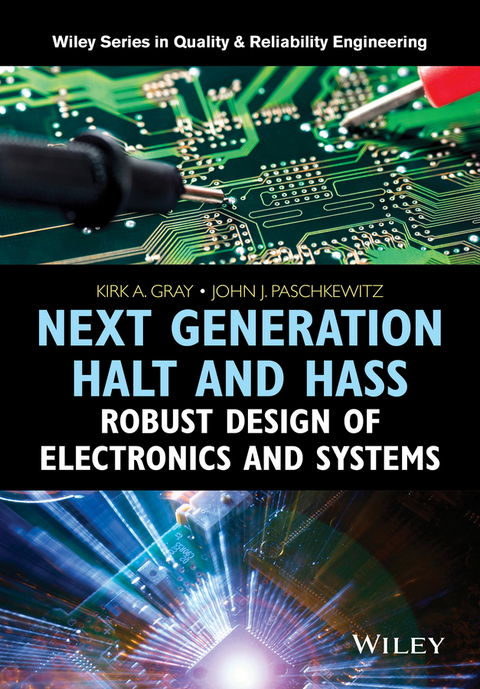
Next Generation HALT and HASS (eBook)
John Wiley & Sons (Verlag)
978-1-118-70021-1 (ISBN)
Next Generation HALT and HASS presents a major paradigm shift from reliability prediction-based methods to discovery of electronic systems reliability risks. This is achieved by integrating highly accelerated life test (HALT) and highly accelerated stress screen (HASS) into a physics-of-failure-based robust product and process development methodology. The new methodologies challenge misleading and sometimes costly mis-application of probabilistic failure prediction methods (FPM) and provide a new deterministic map for reliability development. The authors clearly explain the new approach with a logical progression of problem statement and solutions.
The book helps engineers employ HALT and HASS by illustrating why the misleading assumptions used for FPM are invalid. Next, the application of HALT and HASS empirical discovery methods to quickly find unreliable elements in electronics systems gives readers practical insight to the techniques.
The physics of HALT and HASS methodologies are highlighted, illustrating how they uncover and isolate software failures due to hardware-software interactions in digital systems. The use of empirical operational stress limits for the development of future tools and reliability discriminators is described.
Key features:
* Provides a clear basis for moving from statistical reliability prediction models to practical methods of insuring and improving reliability.
* Challenges existing failure prediction methodologies by highlighting their limitations using real field data.
* Explains a practical approach to why and how HALT and HASS are applied to electronics and electromechanical systems.
* Presents opportunities to develop reliability test discriminators for prognostics using empirical stress limits.
* Guides engineers and managers on the benefits of the deterministic and more efficient methods of HALT and HASS.
* Integrates the empirical limit discovery methods of HALT and HASS into a physics of failure based robust product and process development process.
Kirk Gray has over thirty-three years of experience in the electronics manufacturing industry. He began his career in electronics in semiconductor manufacturing equipment and progressing to validation and reliability testing at the system level. Starting in 1989 he worked closely with Gregg Hobbs Ph.D., the inventor of the methods of Highly Accelerated Life Test (HALT) and Highly Accelerated Stress Screening (HASS) at Storage Technology and later QualMark. He has been teaching, consulting, and applying HALT and HASS since 1992. He holds a Bachelor of Science in Electrical Engineering from the University of Texas at Austin and is a Senior Member of the IEEE. He was a past Chairperson of IEEE/CPMT Technical Committee on Accelerated Stress Testing and is a Senior Collaborator with the CALCE Consortium at The University of Maryland. He is the owner and Principal Consultant at Accelerated Reliability Solutions, LLC
John Paschkewitz has over 40 years' experience in product assurance, testing, reliability and sustaining engineering in several industries. He has been applying HALT and HASS since 1998. He holds a B.S. in Mechanical Engineering from the University of Wisconsin - Madison and a M.A. in Business Management from Central Michigan University. He is a registered Professional Engineer and ASQ Certified Reliability Engineer (CRE), a Senior Member of ASQ and a Member of SAE and ASME. He is now owner and Principal Consultant of Product Assurance Engineering, LLC.
NEXT GENERATION HALT AND HASS ROBUST DESIGN OF ELECTRONICS AND SYSTEMS A NEW APPROACH TO DISCOVERING AND CORRECTING SYSTEMS RELIABILITY RISKS Next Generation HALT and HASS presents a major paradigm shift from reliability prediction-based methods to discovery of electronic systems reliability risks. This is achieved by integrating highly accelerated life test (HALT) and highly accelerated stress screen (HASS) into a physics of failure based robust product and process development methodology. The new methodologies challenge misleading and sometimes costly misapplication of probabilistic failure prediction methods (FPM) and provide a new deterministic map for reliability development. The authors clearly explain the new approach with a logical progression of problem statement and solutions. The book helps engineers employ HALT and HASS by demonstrating why the misleading assumptions used for FPM are invalid. Next, the application of HALT and HASS empirical discovery methods to quickly find unreliable elements in electronics systems gives readers practical insight into the techniques. The physics of HALT and HASS methodologies are highlighted, illustrating how they uncover and isolate software failures due to hardware software interactions in digital systems. The use of empirical operational stress limits for the development of future tools and reliability discriminators is described. Key features: Provides a clear basis for moving from statistical reliability prediction models to practical methods of insuring and improving reliability. Challenges existing failure prediction methodologies by highlighting their limitations using real field data. Explains a practical approach to why and how HALT and HASS are applied to electronics and electromechanical systems. Presents opportunities to develop reliability test discriminators for prognostics using empirical stress limits. Guides engineers and managers on the benefits of the deterministic and more efficient methods of HALT and HASS. Integrates the empirical limit discovery methods of HALT and HASS into a physics of failure based robust product and process development process.
Kirk A. Gray, Accelerated Reliability Solutions, LLC, Colorado, USA John J. Paschkewitz, Product Assurance Engineering, LLC, Missouri, USA
1
Basis and Limitations of Typical Current Reliability Methods and Metrics
Reliability cannot be achieved by adhering to detailed specifications. Reliability cannot be achieved by formula or by analysis. Some of these may help to some extent, but there is only one road to reliability. Build it, test it and fix the things that go wrong. Repeat the process until the desired reliability is achieved. It is a feedback process and there is no other way.
David Packard, 1972
In the field of electronics reliability, it is still very much a Dilbert world as we see in the comic from Scott Adams, Figure 1.1. Reliability Engineers are still making reliability predictions based on dubious assumptions about the future and management not really caring if they are valid. Management just needs a ‘number’ for reliability, regardless of the fact it may have no basis in reality.
Figure 1.1 Dilbert, management and reliability.
Source: DILBERT © 2010 Scott Adams. Reproduced with permission of UNIVERSAL UCLICK
The classical definition of reliability is the probability that a component, subassembly, instrument, or system will perform its specified function for a specified period of time under specified environmental and use conditions. In the history of electronics reliability engineering, a central activity and deliverable from reliability engineers has been to make reliability predictions that provide a quantification of the lifetime of an electronics system.
Even though the assumptions of causes of unreliability used to make reliability predictions have not been shown to be based on data from common causes of field failures, and there has been no data showing a correlation to field failure rates, it still continues for many electronics systems companies due to the sheer momentum of decades of belief. Many traditional reliability engineers argue that even though they do not provide an accurate prediction of life, they can be used for comparisons of alternative designs. Unfortunately, prediction models that are not based on valid causes of field failures, or valid models, cannot provide valid comparisons of reliability predictions.
Of course there is a value if predictions, valid or invalid, are required to retain one’s employment as a reliability engineer, but the benefit for continued employment pales in comparison to the potential misleading assumptions that may result in forcing invalid design changes that may result in higher field failures and warranty costs.
For most electronics systems the specific environments and use conditions are widely distributed. It is very difficult if not impossible to know specific values and distributions of the environmental conditions and use conditions that future electronics systems will be subjected to. Compounding the challenge of not knowing the distribution of stresses in the end - use environments is that the numbers of potential physical interactions and the strength or weaknesses of potential failure mechanisms in systems of hundreds or thousands of components is phenomenologically complex.
Tracing back to the first electronics prediction guide, we find the RCA release of TR-ll00 titled Reliability Stress Analysis for Electronic Equipment, in 1956, which presented models for computing rates of component failures. It was the first of the electronics prediction ‘cookbooks’ that became formalized with the publishing of reliability handbook MIL-HDBK-217A and continued to 1991, with the last version MIL-HDBK-217F released in December of that year. It was formally removed as a government reference document in 1995.
1.1 The Life Cycle Bathtub Curve
A classic diagram used to show the life cycle of electronics devices is the life cycle bathtub curve. The bathtub curve is a graph of time versus the number of units failing.
Just as medical science has done much to extend our lives in the past century, electronic components and assemblies have also had a significant increase in expected life since the beginning of electronics when vacuum tube technologies were used. Vacuum tubes had inherent wear-out failure modes, such as filaments burning out and vacuum seal leakage, that were a significant limiting factor in the life of an electronics system.
Figure 1.2 The life cycle bathtub curve
The life cycle bathtub curve, which is modeled after human life cycle death rates and is shown in Figure 1.2., is actually a combination of two curves. The first curve is the initial declining failure rate, traditionally referred to as the period of ‘infant mortality’, and the second curve is the increasing failure rates from wear-out failures. The intersection of the two curves is a more or less flat area of the curve, which may appear to be a constant failure rate region. It is actually very rare that electronics components fail at a constant rate, and so the ‘flat’ portion of the curve is not really flat but instead a low rate of failure with some peaks and valleys due to variations in use and manufacturing quality.
The electronics life cycle bathtub curve was derived from human the life cycle curves and may have been more relevant back in the day of vacuum tube electronics systems. In human life cycles we have a high rate of death due to the risks of birth and the fragility of life during human infancy. As we age, the rates of death decline to a steady state level until we age and our bodies start to fail. Human infant mortality is defined as the number of deaths in the first year of life. Infant mortality in electronics has been the term used for the failures that occur after shipping or in the first months or first year of use.
The term ‘infant mortality’ applied to the life of electronics is a misnomer. The vast majority of human infant mortality occurs in poorer third world countries, and the main cause is dehydration from diarrhea, which is a preventable disease. There are many other factors that contribute to the rate of infant deaths, such as limit access to health services, education of the mother and access to clean drinking water. The lack of healthcare facilities or skilled health workers is also a contributing factor.
An electronic component or system is not weaker when fabricated; instead, if manufactured correctly, components have the highest inherent life and strength when manufactured, then they decline in strength, or total fatigue life during use.
The term ‘infant mortality’, which is used to describe failures of electronics or systems that occurs in the early part of the use life cycle, seems to imply that the failure of some devices and systems is intrinsic to the manufacturing process and should be expected. Many traditional reliability engineers dismiss these early life failures, or ‘infant mortality’ failures as due to ‘quality control’ and therefore do not see them as the responsibility of the reliability engineering department. Manufacturing quality variations are likely to be the largest cause of early life failures, especially far designs with narrow environmental stress capabilities that could be found in HALT. But it makes little difference to the customer or end-user, they lose use of the product, and the company whose name is on it is ultimately to blame.
So why use the dismissive term infant mortality to describe failures from latent defects in electronics as if they were intrinsic to manufacturing? The time period that is used to define the region of infant mortality in electronics is arbitrary. It could be the first 30 days or the first 18 months or longer. Since the vast majority of latent (hidden) defects are from unintentional process excursions or misapplications, and since they are not controlled, they are likely to have a wide distribution of times to failure. Many times the same failure mechanism in which the weakest distributions may occur within 30 to 90 days will continue for the stronger latent defects to contribute to the failure rate throughout the entire period of use before technological obsolescence.
1.1.1 Real Electronics Life Cycle Curves
Of course the life cycle bathtub curves are represented as idealistic and simplistic smooth curves. In reality, monitoring the field reliability would result in a dynamically changing curve with many variations in the failure rates for each type of electronics system over time as shown in Figure 1.3. As failing units are removed from the population, the remaining field population failure rate decreases and may appear to reach a low steady state or appear as a constant or steady state failure rate in a large population.
Figure 1.3 Realistic field life cycle bathtub curve
In the real tracking of failure rates, the peaks and valleys of the curve extend to the wear-out portion of the life cycle curve. For most electronics, the wear-out portion of the curve extends well beyond technological obsolescence and will be never actually significantly contribute to unreliability of the product.
Without detailed root cause analysis of failures that make up the peaks of the middle portion of the bathtub curve, or what is termed the useful life period, any increase in failure rates can be mistaken as the intrinsic wear-out phase of a system’s life cycle. It may be discovered in failure analysis that what at first appears to be an wear out mode in a component, is actually due to it being overstressed from a...
| Erscheint lt. Verlag | 11.3.2016 |
|---|---|
| Reihe/Serie | Quality and Reliability Engineering Series |
| Wiley Series in Quality and Reliability Engineering | Wiley Series in Quality and Reliability Engineering |
| Sprache | englisch |
| Themenwelt | Technik ► Elektrotechnik / Energietechnik |
| Technik ► Maschinenbau | |
| Wirtschaft ► Betriebswirtschaft / Management | |
| Schlagworte | Belastungstest • Components & Devices • Electrical & Electronics Engineering • elektronic • Elektrotechnik u. Elektronik • Komponenten u. Bauelemente • Lebensdauerprüfung • Lebensdauerprüfung • Leistungselektronik • Power Electronics • Qualität u. Zuverlässigkeit • Qualität u. Zuverlässigkeit • Quality & Reliability |
| ISBN-10 | 1-118-70021-X / 111870021X |
| ISBN-13 | 978-1-118-70021-1 / 9781118700211 |
| Informationen gemäß Produktsicherheitsverordnung (GPSR) | |
| Haben Sie eine Frage zum Produkt? |
 EPUB (Adobe DRM)
Kopierschutz: Adobe-DRM
Adobe-DRM ist ein Kopierschutz, der das eBook vor Mißbrauch schützen soll. Dabei wird das eBook bereits beim Download auf Ihre persönliche Adobe-ID autorisiert. Lesen können Sie das eBook dann nur auf den Geräten, welche ebenfalls auf Ihre Adobe-ID registriert sind.
Details zum Adobe-DRM
Dateiformat: EPUB (Electronic Publication)
EPUB ist ein offener Standard für eBooks und eignet sich besonders zur Darstellung von Belletristik und Sachbüchern. Der Fließtext wird dynamisch an die Display- und Schriftgröße angepasst. Auch für mobile Lesegeräte ist EPUB daher gut geeignet.
Systemvoraussetzungen:
PC/Mac: Mit einem PC oder Mac können Sie dieses eBook lesen. Sie benötigen eine
eReader: Dieses eBook kann mit (fast) allen eBook-Readern gelesen werden. Mit dem amazon-Kindle ist es aber nicht kompatibel.
Smartphone/Tablet: Egal ob Apple oder Android, dieses eBook können Sie lesen. Sie benötigen eine
Geräteliste und zusätzliche Hinweise
Buying eBooks from abroad
For tax law reasons we can sell eBooks just within Germany and Switzerland. Regrettably we cannot fulfill eBook-orders from other countries.
aus dem Bereich