
Problem-Based Learning in Communication Systems Using MATLAB and Simulink (eBook)
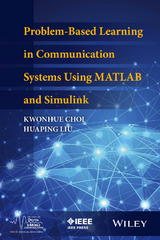
Designed to help teach and understand communication systems using a classroom-tested, active learning approach.
- Discusses communication concepts and algorithms, which are explained using simulation projects, accompanied by MATLAB and Simulink
- Provides step-by-step code exercises and instructions to implement execution sequences
- Includes a companion website that has MATLAB and Simulink model samples and templates
Designed to help teach and understand communication systems using a classroom-tested, active learning approach. Discusses communication concepts and algorithms, which are explained using simulation projects, accompanied by MATLAB and Simulink Provides step-by-step code exercises and instructions to implement execution sequences Includes a companion website that has MATLAB and Simulink model samples and templates (password: matlab)
Kwonhue Choi is a Professor in the Department of Information and Communication Engineering and the Principal Director of Broadband Wireless Communication (BWC) Laboratory at Yeungnam University, Korea. His research areas include efficient multiple access, diversity schemes, and cooperative communications for Fifth-Generation (5G) and beyond systems. He is the inventor of FADAC-OFDM and PSW (Properly scrambled Walsh) codes. Huaping Liu is a Professor with the School of Electrical Engineering and Computer Science at Oregon State University, USA. He was formerly a cellular network radio frequency systems engineer specializing on modeling, simulating, optimizing, and testing various digital communication systems. Dr. Liu received his PhD in Electrical Engineering at New Jersey Institute of Technology, USA.
| Erscheint lt. Verlag | 10.2.2016 |
|---|---|
| Reihe/Serie | IEEE Press Series on Digital & Mobile Communication |
| IEEE Press Series on Digital & Mobile Communication | IEEE Series on Digital & Mobile Communication |
| Sprache | englisch |
| Themenwelt | Technik ► Elektrotechnik / Energietechnik |
| Technik ► Nachrichtentechnik | |
| Schlagworte | Communication Systems • communication systems code exercise • Communication systems textbook • digital comm textbook • Digital Communications • Drahtlose Kommunikation • Electrical & Electronics Engineering • Elektrotechnik u. Elektronik • Experiment • IEEE • ieee book • ieee series • ieee textbook • Kommunikationssystem • lab exercise • MATLAB • matlab basics • matlab for engineers • MATLAB Functions • matlab introduction • MATLAB/Simulink • matlab textbook • Mobile & Wireless Communications • practice communication systems code • QPSK • Simulation • SIMULINK • simulink basics • simulink files • simulink for digital communication • simulink for engineers • simulink introduction • simulink textbook |
| ISBN-13 | 9781119060277 / 9781119060277 |
| Informationen gemäß Produktsicherheitsverordnung (GPSR) | |
| Haben Sie eine Frage zum Produkt? |
 PDF (Adobe DRM)
Kopierschutz: Adobe-DRM
Adobe-DRM ist ein Kopierschutz, der das eBook vor Mißbrauch schützen soll. Dabei wird das eBook bereits beim Download auf Ihre persönliche Adobe-ID autorisiert. Lesen können Sie das eBook dann nur auf den Geräten, welche ebenfalls auf Ihre Adobe-ID registriert sind.
Details zum Adobe-DRM
Dateiformat: PDF (Portable Document Format)
Mit einem festen Seitenlayout eignet sich die PDF besonders für Fachbücher mit Spalten, Tabellen und Abbildungen. Eine PDF kann auf fast allen Geräten angezeigt werden, ist aber für kleine Displays (Smartphone, eReader) nur eingeschränkt geeignet.
Systemvoraussetzungen:
PC/Mac: Mit einem PC oder Mac können Sie dieses eBook lesen. Sie benötigen eine
eReader: Dieses eBook kann mit (fast) allen eBook-Readern gelesen werden. Mit dem amazon-Kindle ist es aber nicht kompatibel.
Smartphone/Tablet: Egal ob Apple oder Android, dieses eBook können Sie lesen. Sie benötigen eine
Geräteliste und zusätzliche Hinweise
Buying eBooks from abroad
For tax law reasons we can sell eBooks just within Germany and Switzerland. Regrettably we cannot fulfill eBook-orders from other countries.
aus dem Bereich