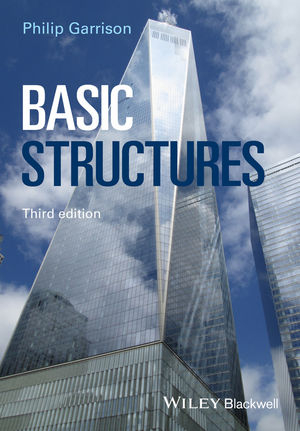
Basic Structures (eBook)
John Wiley & Sons (Verlag)
978-1-118-95085-2 (ISBN)
Philip Garrison BSc MBA CEng MICE MIStructE MIHT is a Chartered Civil and Structural Engineer and Senior Lecturer in Structural Design in the Civil Engineering Departmentat Leeds Beckett University
Basic Structures provides the student with a clear explanation of structural concepts, using many analogies and examples. Real examples and case studies show the concepts in use, and the book is well illustrated with full colour photographs and many line illustrations, giving the student a thorough grounding in the fundamentals and a 'feel' for the way buildings behave structurally. With many worked examples and tutorial questions, the book serves as an ideal introduction to the subject.
Philip Garrison BSc MBA CEng MICE MIStructE MIHT is a Chartered Civil and Structural Engineer and Senior Lecturer in Structural Design in the Civil Engineering Departmentat Leeds Beckett University
Acknowledgements ix
Introduction x
1 What is structural engineering? 1
2 Learn the language: a simple explanation of terms used by structural engineers 8
3 How do structures (and parts of structures) behave? 11
4 Force, mass and weight 26
5 Loading - dead or alive 32
6 Equilibrium - a balanced approach 38
7 More about forces: resultants and components 43
8 Moments 54
9 Reactions 67
10 Different types of support - and what's a pin? 73
11 A few words about stability 81
12 Introduction to the analysis of pin-jointed frames 93
13 Method of resolution at joints 98
14 Method of sections 119
15 Graphical method 127
16 Shear force and bending moments 137
17 This thing called stress 168
18 Direct (and shear) stress 173
19 Bending stress 184
20 Combined bending and axial stress 205
21 Structural materials: concrete, steel, timber and masonry 218
22 More on materials 229
23 How far can I span? 235
24 Calculating those loads 242
25 An introduction to structural design 252
26 More on structural types and forms 291
27 An introduction to deflection 310
28 Shear stress 324
29 Buckling and torsion 333
30 Frames and three-pinned arches 344
31 Virtual work 356
32 Squares and circles of stress: An introduction to Mohr's Circle 363
33 Trusses (no numbers) 380
34 Plastic analysis 388
Further reading 402
Appendix 1: Weights of common building materials 403
Appendix 2: Conversions and relationships between units 405
Appendix 3: Mathematics associated with right-angled triangles 407
Appendix 4: Symbols 409
Appendix 5: A checklist for architects 410
Appendix 6: Getting more out of civil engineering 411
Index 413
Introduction
When I was 16 years I had a Saturday job as a shelf-stacker at a local supermarket. One day, during a tea break, a co-worker asked me what I did the rest of the week. I explained that I had just done O levels and was going on to do A levels. I told him how many and in which subjects. He then asked me about my career aspirations (not his exact words). I explained that I wanted to become an engineer. His aghast response was: ‘What! With all those qualifications?’
Engineers suffer from a lack of public perception of what their profession entails – many people think we spend our days in the suburbs, mending washing machines and televisions. Architects are more fortunate in this respect – the public have a better grasp of their profession: ‘They design buildings, don’t they?’
Public perceptions aside, careers in both civil engineering and architecture can be extremely rewarding. There are few other careers where individuals can be truly creative, often on a massive scale. The civil engineering profession offers a variety of working environments and a large number of specialisms within civil engineering. Civil engineers have opportunities to work all over the world, on projects large and small, and could come into contact with a wide variety of people, from the lowest worker on a construction site to government officials and heads of state.
In the 21st century there is a huge demand for civil engineers and many young people (and some not so young!) are realising that this is a profession well worth entering.
Traditionally, students embarking on university courses in civil engineering would have A levels in subjects such as mathematics, physics and chemistry. However, for a variety of reasons, many of today’s potential students have A levels (or similar) in non-numerate and non-scientific subjects. Moreover, a sizeable number of ‘mature’ people are entering the profession following a first career in something completely different. As a university admissions tutor, I speak to such people everyday. It is possible, depending on the specialism eventually chosen, to enjoy a successful career in civil engineering without an in-depth mathematical knowledge. However, it is extremely difficult to obtain a degree or Higher National Diploma (HND) in civil engineering without some mathematical proficiency.
Turning to architects – these are creative people! Every building they design has a structure, without which the building would not stand up. Architects, like civil engineers, have to understand the mechanisms which lead to successful structures.
This book is about Structures. Structures is a subject studied as part of all civil engineering degree, HND and Ordinary National Diploma (OND) courses, as well as architecture degree courses, and also on some degree courses in related subjects (e.g. quantity surveying, building surveying, construction management and architecture).
The purpose of this book
I have taught structures to undergraduate civil engineers and architects since 1992. During that time I have noticed that many students find the basic concept of structures difficult to grasp and apply.
This book aims to do the following:
- to explain structural concepts clearly, using analogies and examples to illustrate the points
- to express the mathematical aspects of the subject in a straightforward manner that can be understood by mathematically weak students and placed in context with the concepts involved
- to maintain reader interest by incorporating into the text real-life examples and case histories to underline the relevance of the material that the student is learning.
This book presumes no previous knowledge of structures on the part of the reader. It does, however, presume that the reader has a good general education and a mathematical ability up to at least GCSE standard.
The intended readership
This book is aimed at:
- Ordinary National Certificate (ONC), Ordinary National Diploma (OND), Higher National Certificate (HNC), Higher National Diploma (HND) or first-year degree (BSc, BEng or MEng) students on a civil engineering (or similar) course, who will study a module called structures, structural mechanics, mechanics or structural analysis
- students on a BA degree course in architecture.
The following will also find this book useful:
- students on courses in subjects related to civil engineering and architecture – e.g. quantity surveying, building surveying, construction management or architectural technology – who have to do a structures module as part of their studies
- those studying technology at GCE A level, GNVQ or similar
- people working in the construction industry in any capacity.
The following will find the book a useful revision tool:
- a second (or subsequent)-year student on a civil engineering or architecture degree
- a professional in the civil engineering or building industry, and practising architects.
A word about computers
Computer packages are available for every specialism, and structural engineering is no exception. Certainly, some of the problems in this book could be solved more quickly using computer software. However, I do not mention specific computer packages in this book and where I mention computers at all, it is in general terms. There are two reasons for this.
- The purpose of this book is to acquaint the reader with the basic principles of structures. Whereas a computer is a useful tool for solving specific problems, it is no substitute for a thorough grounding in the basics of the subject.
- Computer software is being improved and updated all the time. The most popular and up-to-date computer package for structural engineering as I write these words may be dated (at best) or obsolete (at worst) by the time you read this. If you are interested in the latest software, look at specialist computer magazines or articles and advertisements in the civil and structural engineering and architecture press, or if you are a student, consult your lecturers.
I have set my students assignments where they have to solve a structural problem by hand then check their results by analysing the same problem using appropriate computer software. If the answers obtained by the two approaches differ, it is always instructive to find out whether the error is in the student’s hand calculations (most frequently the case) or in the computer analysis (occurs less frequently, but does happen sometimes when the student has input incorrect or incomplete data – the old ‘rubbish in, rubbish out’!).
The website
You will find worked solutions to some of the problems in this book at a website maintained by the publishers: www.blackwellpublishing.com/garrison. In addition, all readers can contact me via the website – your suggestions, comments and criticisms are welcome.
An overview of this book
If you are a student studying a module called structures, structural mechanics or similar, the chapter headings in this book will tie in – more or less – with the lecture topics presented by your lecturer or tutor. I suggest that you read each chapter of this book soon after the relevant lecture or class to reinforce your knowledge and skills in the topic concerned. I advise all readers to have a pen and paper beside them to jot down notes as they go through the book – particularly the numerical examples. In my experience, this greatly aids understanding.
- Chapters 1–5 introduce the fundamental concepts, terms and language of structures.
- Chapters 6–10 build on the basic concepts and show how they can be used, mathematically, to solve simple structural problems.
- Chapter 11 deals with the very important concept of stability and discusses how to ensure structures are stable – and recognise when they’re not!
- Chapters 12–15 deal with the analysis of pin-jointed frames, a topic that some students find difficult.
- Chapter 16 covers shear force and bending moment diagrams – an extremely important topic.
- Chapters 17–20 deal with stress in its various guises.
- Structural materials are dealt with more fully in other texts, but Chapter 21 provides an introduction to this topic.
- Chapter 22 has more on materials, and a word on design standards.
- Chapters 23 and 24 deal, respectively, with the conceptual design of structures and the calculation of loads.
- Chapter 25 is a descriptive introduction to structural design, which should be read before embarking on a structural design module.
- Chapter 26 discusses more unusual types of structures.
- Chapter 27 deals with deflection, and outlines a method whereby deflections can be calculated.
- Chapters 28–34 serve as an easy introduction to several slightly harder topics that students will encounter on the second or third year of a civil engineering degree course.
How to use this book
It is not necessary for all readers to read this book from cover to cover. However, the book has been designed to follow the...
| Erscheint lt. Verlag | 3.2.2016 |
|---|---|
| Sprache | englisch |
| Themenwelt | Technik ► Architektur |
| Technik ► Bauwesen | |
| Schlagworte | Architecture • Architektur • Bauingenieur- u. Bauwesen • Bridges • buildings • Built Environment • Civil Engineering • Civil Engineering & Construction • Construction • explanation of structural concepts • <p>Architecture • Structural & Building Engineering • structural concepts • structural design • Structural engineering • Structural forces</p> • Structures • Tief- u. Hochbau / Massivbau • Tragwerk • Tragwerke |
| ISBN-10 | 1-118-95085-2 / 1118950852 |
| ISBN-13 | 978-1-118-95085-2 / 9781118950852 |
| Informationen gemäß Produktsicherheitsverordnung (GPSR) | |
| Haben Sie eine Frage zum Produkt? |
 EPUB (Adobe DRM)
Kopierschutz: Adobe-DRM
Adobe-DRM ist ein Kopierschutz, der das eBook vor Mißbrauch schützen soll. Dabei wird das eBook bereits beim Download auf Ihre persönliche Adobe-ID autorisiert. Lesen können Sie das eBook dann nur auf den Geräten, welche ebenfalls auf Ihre Adobe-ID registriert sind.
Details zum Adobe-DRM
Dateiformat: EPUB (Electronic Publication)
EPUB ist ein offener Standard für eBooks und eignet sich besonders zur Darstellung von Belletristik und Sachbüchern. Der Fließtext wird dynamisch an die Display- und Schriftgröße angepasst. Auch für mobile Lesegeräte ist EPUB daher gut geeignet.
Systemvoraussetzungen:
PC/Mac: Mit einem PC oder Mac können Sie dieses eBook lesen. Sie benötigen eine
eReader: Dieses eBook kann mit (fast) allen eBook-Readern gelesen werden. Mit dem amazon-Kindle ist es aber nicht kompatibel.
Smartphone/Tablet: Egal ob Apple oder Android, dieses eBook können Sie lesen. Sie benötigen eine
Geräteliste und zusätzliche Hinweise
Buying eBooks from abroad
For tax law reasons we can sell eBooks just within Germany and Switzerland. Regrettably we cannot fulfill eBook-orders from other countries.
aus dem Bereich