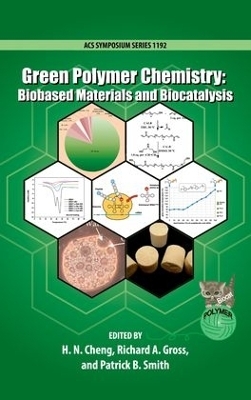
Green Polymer Chemistry
Oxford University Press Inc (Verlag)
978-0-8412-3065-1 (ISBN)
- Keine Verlagsinformationen verfügbar
- Artikel merken
advances include new uses of biobased feedstock, green reactions, green processing methodologies, and green polymeric products.
A current feature of green polymer chemistry is that it is both global and multidisciplinary. Thus, publications in this field are spread out over different journals in different countries. Moreover, a successful research effort may involve collaborations of people in various disciplines, such as organic chemistry, polymer chemistry, material science, chemical engineering, biochemistry, molecular biology, microbiology, enzymology, toxicology, environmental science, and analytical chemistry.
This book combines the major interdisciplinary research in this field and is targeted for scientists, engineers, and students, who are involved or interested in green polymer chemistry. These may include chemists, biochemists, material scientists, chemical engineers, microbiologists, molecular biologists, enzymologists, toxicologists, environmental scientists, and analytical chemists. It can be a textbook for a course on green chemistry and also a reference book for people who need information
on specific topics involving biocatalysis and biobased materials.
H. N. Cheng (Ph.D., University of Illinois) is currently a research chemist at the Southern Regional Research Center of the U.S. Department of Agriculture in New Orleans, where he works on projects involving improved utilization of commodity agricultural materials, green chemistry, and polymer reactions. Over the years, his research interests have included green polymer chemistry, biocatalysis and enzymatic reactions, pulp and paper chemistry, functional foods, polymer characterization, and NMR spectroscopy. He is an ACS Fellow and a POLY Fellow and has authored or co-authored 192 papers, 25 patent publications, coedited 11 books, and organized or co-organized 25 symposia at national ACS meetings since 2003. Richard A. Gross (Ph.D., Polytechnic University) holds the Constellation Chaired Professorship at Rensselaer Polytechnic Institute (RPI) and is also a member of RPI's Departments of Chemistry and Biology as well as Biomedical Engineering. Previously, he was on the faculty of University of Massachusetts (Lowell) (1988?1998) and occupied the Herman F. Mark Chair Professorship at Polytechnic University (1998-2013). He has over 400 publications in peer-reviewed journals with approximately 7,000 citations, has edited six books, and has been granted or filed 26 patents. He has received numerous awards, including the Presidential Green Chemistry Award in the academic category (2003). He also founded SyntheZyme, LLC, (where he serves as Chief Technology Officer) in 2009 to commercialize technologies developed in his laboratory. Patrick B. Smith (Ph.D, Michigan State University) currently serves as a research scientist at Michigan Molecular Institute. He had a productive and distinguished career at The Dow Chemical Company, rising to the rank of Fellow prior to his retirement in 2007. He was elected as an ACS Fellow in 2013. He has co-authored nearly 500 Dow technical reports, over 75 publications, and has been granted two patents.
Preface
1. Green Polymer Chemistry: Some Recent Developments and Examples
Enzymatic and Chemo-enzymatic Approaches
2. Green Polymer Chemistry: Enzyme-Catalyzed Polymer Functionalization
3. Chemoenzymatic Synthesis and Characterization of Polyester-Urethanes Bearing Amino-Acids Moieties
4. Chemo-enzymatic Synthesis, Derivatizations, and Polymerizations of Renewable Phenolic Monomers Derived from Ferulic Acid and Biobased Polyols: An Access to Sustainable Copolyesters, Poly(ester-urethane)s, and Poly(ester-alkenamer)s
5. Emerging Enzyme-Based Technologies for Wastewater Treatment
6. Enzymatic Synthesis of Non-Natural Oligo- and Polysaccharides by Phosphorylase-Catalyzed Glycosylations Using Analogue Substrates
7. Water-Insoluble Glucans from Sucrose via Glucansucrases. Factors Influencing Structures and Yields
8. Biosynthesis, Properties, and Biodegradation of Lactate-Based Polymers
Other Catalysts and Functional Peptides
9. Combining Sustainable Polymerization Routes for the Preparation of Polyesters, Polycarbonates, and Copolymers
10. Aluminum Salen and Salan Polymerization Catalysts: From Monomer Scope to Macrostructure Control
11. Creation of Functional Peptides by Evolutionary Engineering with Bioorthogonal Incorporation of Artificial Components
Biobased Materials from Triglyceride Feedstock
12. Thermoplastic Elastomers from Vegetable Oils via Reversible Addition-Fragmentation Chain Transfer Polymerization
13. From Biorefinery to Performance Technology: Transforming Renewable Olefinic Building Blocks into Lubricants and Other High-Value Products
14. Polyacids from Corn Oil as Curing Agents for Epoxy Resins
15. Modifications of Plant Oils for Value-Added Uses
16. Soy-Based Building Blocks for Advanced Photocure Coating Systems
17. Solid Lipid Nanoparticle - Functional Template of Meso-Macrostructured Silica Materials
Biobased Materials from Carbohydrate Feedstock
18. In Situ Metal-Free Synthesis of Polylactide Enantiomers Grafted from Nanoclays of High Thermostability
19. A Novel Renewable Thermoplastic Polyacetal by Polymerization of Glycolaldehyde Dimer, a Major Product of the Fast Pyrolysis of Cellulosic Feedstock
20. Development of Cardanol-Bonded Cellulose Resin with Nonfood Plant Resources: Low Energy Heterogeneous Synthesis Process
21. Phosphorus Flame Retardants from Esters of Isosorbide and 10-Undecenoic Acid
Materials from Other Biobased Resources
22. Bio-Based Epoxy Resins from Diphenolate Esters--Replacing the Diglycidyl Ether of Bisphenol A
23. Influence of Furanyl Building Blocks on the Cure Kinetics of a Renewable Epoxy-Amine System
24. Polyesters from Bio-Aromatics
25. Development and Characterization of Pressure-Sensitive Adhesives from Dimer Acid and Epoxides
26. Structure-Property Relationships for Polycyanurate Networks Derived from Renewable Resources
27. Bio-Based Sources for Terephthalic Acid
28. Green Polymer Aerogels
| Erscheinungsdatum | 07.07.2016 |
|---|---|
| Reihe/Serie | ACS Symposium Series |
| Zusatzinfo | 249 |
| Verlagsort | New York |
| Sprache | englisch |
| Maße | 161 x 231 mm |
| Gewicht | 822 g |
| Themenwelt | Naturwissenschaften ► Biologie ► Mikrobiologie / Immunologie |
| Naturwissenschaften ► Chemie ► Organische Chemie | |
| Naturwissenschaften ► Chemie ► Technische Chemie | |
| Technik ► Umwelttechnik / Biotechnologie | |
| ISBN-10 | 0-8412-3065-X / 084123065X |
| ISBN-13 | 978-0-8412-3065-1 / 9780841230651 |
| Zustand | Neuware |
| Informationen gemäß Produktsicherheitsverordnung (GPSR) | |
| Haben Sie eine Frage zum Produkt? |
aus dem Bereich