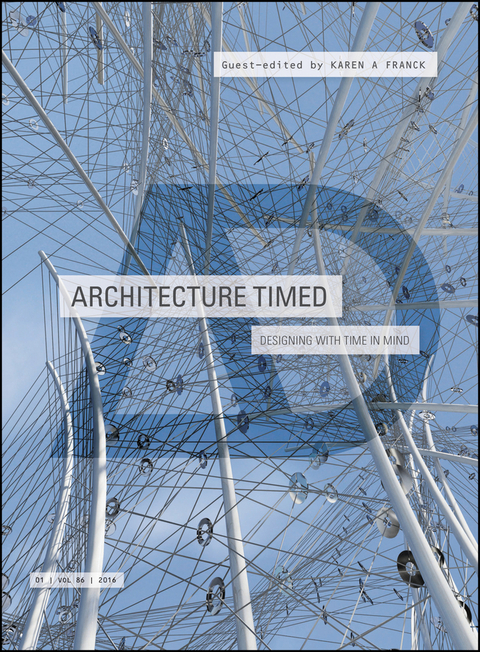
Architecture Timed (eBook)
John Wiley & Sons (Verlag)
978-1-118-91068-9 (ISBN)
The traditional veneration of architecture for its monumental and enduring qualities seems to be changing. Architects and other designers are moving away from seeking permanence towards a more open, creative use of what time has to offer. This is revealed in new approaches to historic preservation, the proliferation of temporary structures, concerns regarding sustainability, and the employment of time-efficient processes. Architecture Timed explores the role of ideas about time in the design inclinations and choices of contemporary designers of the environment. Contributors consider how the new can be incorporated into the old; how designing for the very short term has significant advantages; how what is temporary can be re-used; and how the design of materials, buildings and landscapes can improve sustainability and enhance experiences of time passing. Many designers have replaced the ideal of 'timelessness' and the view of time as a series of singular, static moments with an enriched and more nuanced perspective, treating time as a source of inspiration to be embraced, not a condition to be defended against.
Contributors include: Juhani Pallasmaa, Brian McGrath, Federica Goffi, Jill Stoner, Richard Garber and Eric Parry.
Designers featured include: Agence Ter, Shigeru Ban, BanG Studio, Diller Scofidio + Renfro, EMF Landscape Architects, Gluck+, GRO Architects, Interboro Partners, Toyo Ito, Kengo Kuma, Enric Miralles, Eric Parry Architects, Carlo Scarpa, Taylor Cullity Lethlean, UNStudio and Peter Zumthor.
Karen A Franck is a professor in the College of Architecture and Design at the New Jersey Institute of Technology where she also serves as Director of the Joint PhD Program in Urban Systems and advises PhD students.?She has written about a wide range of topics, often related to social aspects of design. Her books include: Design through Dialogue: A Guide for Architects and Clients (Wiley, 2009), Architecture from the Inside Out (Wiley, 2007) and Loose Space: Possibility and Diversity in Urban Space (Routledge, 2006). She has guest-edited two issues of AD: Food + Architecture (2002) and Food + City (2005). In recent years she has been researching the design and use of public memorials. This work is to be published by Routledge in the 2014 book Memorials as Spaces of Engagement: Memorial Design, Use and Meaning, coauthored with Quentin Stevens.
The traditional veneration of architecture for its monumental and enduring qualities seems to be changing. Architects and other designers are moving away from seeking permanence towards a more open, creative use of what time has to offer. This is revealed in new approaches to historic preservation, the proliferation of temporary structures, concerns regarding sustainability, and the employment of time-efficient processes. Architecture Timed explores the role of ideas about time in the design inclinations and choices of contemporary designers of the environment. Contributors consider how the new can be incorporated into the old; how designing for the very short term has significant advantages; how what is temporary can be re-used; and how the design of materials, buildings and landscapes can improve sustainability and enhance experiences of time passing. Many designers have replaced the ideal of timelessness and the view of time as a series of singular, static moments with an enriched and more nuanced perspective, treating time as a source of inspiration to be embraced, not a condition to be defended against. Contributors include: Juhani Pallasmaa, Brian McGrath, Federica Goffi, Jill Stoner, Richard Garber and Eric Parry. Designers featured include: Agence Ter, Shigeru Ban, BanG Studio, Diller Scofidio + Renfro, EMF Landscape Architects, Gluck+, GRO Architects, Interboro Partners, Toyo Ito, Kengo Kuma, Enric Miralles, Eric Parry Architects, Carlo Scarpa, Taylor Cullity Lethlean, UNStudio and Peter Zumthor.
Karen A Franck is a professor in the College of Architecture and Design at the New Jersey Institute of Technology where she also serves as Director of the Joint PhD Program in Urban Systems and advises PhD students.?She has written about a wide range of topics, often related to social aspects of design. Her books include: Design through Dialogue: A Guide for Architects and Clients (Wiley, 2009), Architecture from the Inside Out (Wiley, 2007) and Loose Space: Possibility and Diversity in Urban Space (Routledge, 2006). She has guest-edited two issues of AD: Food + Architecture (2002) and Food + City (2005). In recent years she has been researching the design and use of public memorials. This work is to be published by Routledge in the 2014 book Memorials as Spaces of Engagement: Memorial Design, Use and Meaning, coauthored with Quentin Stevens.
Editorial 05
Helen Castle
About the Guest-Editor 06
Karen A. Franck
Introduction: Designing with Time in Mind 08
Karen A Franck
The Nine Lives of Building 18
Jill Stoner
Built Conservation and the Unfinished Fabrics of Time 24
Federica Goffi
Juxtaposing the New and the Old 34
Eric Parry
Time Matters: Transition and Transformation in Architecture 42
Mark Taylor
Inhabiting Time 50
Juhani Pallasmaa
Time as a Medium: Early Work of Enric Miralles 60
Philip Speranza
The Presence of the Weather 66
Kevin Nute
Knowingly Unfinished: Exploiting the Temporality of Landscapes 74
SueAnne Ware
Matter Timed 82
Martina Decker
Drawing Time 88
Brian McGrath
Drawing in Time: Processes of Design and Fabrication 98
Babak Bryan and Henry Grosman
Architecture Takes Time 108
Tobias Armborst, Daniel D'Oca and Georgeen Theodore
Ever Faster But Still Very Good 114
Jonathan Mallie
No More Stopping 120
Richard Garber
Visiting Karsten Harries and Revisiting his 'Building and the Terror of Time' 128
Karen A. Franck
Counterpoint: Finding Time 136
Tim Makower
Contributors 142
| Erscheint lt. Verlag | 8.1.2016 |
|---|---|
| Reihe/Serie | Architectural Design |
| Architectural Design | Architectural Design |
| Mitarbeit |
Gast Herausgeber: Karen A. Franck |
| Sprache | englisch |
| Themenwelt | Technik ► Architektur |
| Schlagworte | APPROACHES • Architects • architectural theory • Architecture • Architektur • Architekturtheorie • Architektur / Theorie • Bauentwurf • Building Design • Concerns • Creative • Designers • Employment • Historic • Monumental • New • Open • Permanence • Preservation • Proliferation • qualities • Seeking • Structures • temporary • Time • timeefficient • Traditional • use • veneration |
| ISBN-10 | 1-118-91068-0 / 1118910680 |
| ISBN-13 | 978-1-118-91068-9 / 9781118910689 |
| Informationen gemäß Produktsicherheitsverordnung (GPSR) | |
| Haben Sie eine Frage zum Produkt? |
 PDF (Adobe DRM)
Kopierschutz: Adobe-DRM
Adobe-DRM ist ein Kopierschutz, der das eBook vor Mißbrauch schützen soll. Dabei wird das eBook bereits beim Download auf Ihre persönliche Adobe-ID autorisiert. Lesen können Sie das eBook dann nur auf den Geräten, welche ebenfalls auf Ihre Adobe-ID registriert sind.
Details zum Adobe-DRM
Dateiformat: PDF (Portable Document Format)
Mit einem festen Seitenlayout eignet sich die PDF besonders für Fachbücher mit Spalten, Tabellen und Abbildungen. Eine PDF kann auf fast allen Geräten angezeigt werden, ist aber für kleine Displays (Smartphone, eReader) nur eingeschränkt geeignet.
Systemvoraussetzungen:
PC/Mac: Mit einem PC oder Mac können Sie dieses eBook lesen. Sie benötigen eine
eReader: Dieses eBook kann mit (fast) allen eBook-Readern gelesen werden. Mit dem amazon-Kindle ist es aber nicht kompatibel.
Smartphone/Tablet: Egal ob Apple oder Android, dieses eBook können Sie lesen. Sie benötigen eine
Geräteliste und zusätzliche Hinweise
Buying eBooks from abroad
For tax law reasons we can sell eBooks just within Germany and Switzerland. Regrettably we cannot fulfill eBook-orders from other countries.
aus dem Bereich