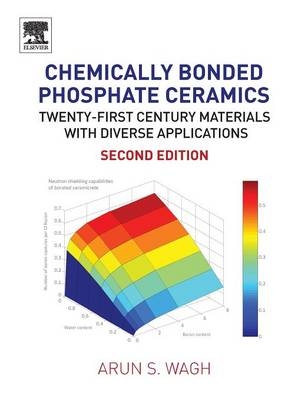
Chemically Bonded Phosphate Ceramics
Elsevier / The Lancet (Verlag)
978-0-08-100380-0 (ISBN)
Dr. Arun S. Wagh worked as a full time scientist in Argonne National Laboratory and is currently an adviser on nuclear materials for Argonne. His main research project concerns development of chemically bonded phosphate ceramics for the U.S. Department of Energy for immobilization of radioactive waste and also as nuclear shielding materials. In these efforts he collaborated with several Russian nuclear centers including the Russian Academy of Sciences and P.R. Mayak. Recently, he also collaborated with Kharkov Institute of Physics Technology in Ukraine perfecting chemically bonded phosphate ceramics for nuclear applications. While leading these projects, he found a wide range of commercial applications of these materials. He has received several awards for his work including two R & D awards, two Federal Laboratories Consortium awwards, Scientist of the Year award by Chicago Intellectual Properties Lawyers' Association, and Agronne's Pacesetter Award. He is a fellow of American Ceramic Society. To promote commercial applications, currently he has formed his company, Inorganic Polymer Solutions, Inc., and is advising various industries.
1. Introduction to Chemically Bonded Ceramics
2. Chemically Bonded Phosphate Ceramics
3. Raw Materials
4. Phosphate Chemistry
5. Dissolution Characteristics of Metal Oxides and Kinetics of Ceramic Formation
6. Thermodynamic Basis of CBPC Formation
7. Oxidation and Reduction Mechanisms
8. Mineralogy of Orthophosphates
9. Magnesium Phosphate Ceramics
10. Zinc Phosphate Ceramics
11. Aluminum Phosphate Ceramics
12. Iron Phosphate Ceramics
13. Calcium Phosphate Cements
14. Chemically Bonded Phosphate Cements and Ceramic Matrix Composites
15. Phosphate Performance Coatings
16. Chemically Bonded Phosphate Ceramics in Oil and Gas Industry
17. Applications of CBPCs to Hazardous Waste Stabilization
18. Radioactive and Hazardous Wastes Stabilization
19. Chemically Bonded Phosphate Ceramic Nuclear Shields
20. Dental Cements and Bioceramics
21. Environmental Implications of the Chemically Bonded Phosphate Ceramic Products
Appendix
A. Thermodynamic Properties of Selected Materials
B. Solubility Product Constants
C. List of Minerals and their Formulae
| Erscheinungsdatum | 25.05.2016 |
|---|---|
| Verlagsort | London |
| Sprache | englisch |
| Maße | 191 x 235 mm |
| Gewicht | 770 g |
| Themenwelt | Technik ► Maschinenbau |
| Technik ► Umwelttechnik / Biotechnologie | |
| ISBN-10 | 0-08-100380-3 / 0081003803 |
| ISBN-13 | 978-0-08-100380-0 / 9780081003800 |
| Zustand | Neuware |
| Informationen gemäß Produktsicherheitsverordnung (GPSR) | |
| Haben Sie eine Frage zum Produkt? |
aus dem Bereich