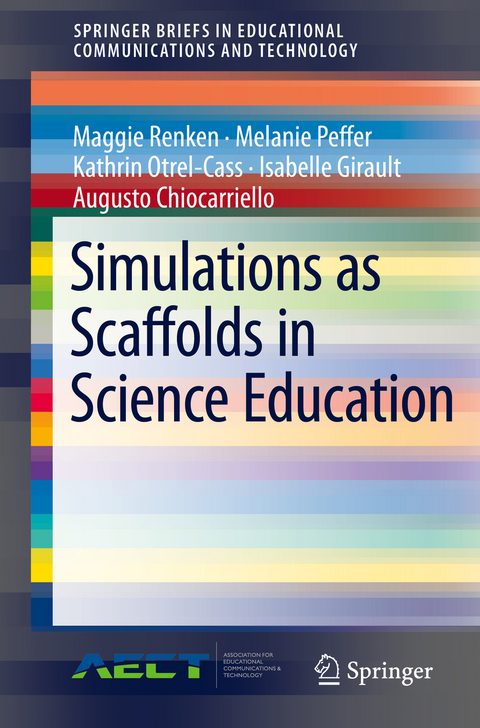
Simulations as Scaffolds in Science Education (eBook)
VIII, 39 Seiten
Springer International Publishing (Verlag)
978-3-319-24615-4 (ISBN)
Maggie Renken is an Assistant Professor in the Educational Psychology program at Georgia State University. Broadly, her research focuses on scientific thinking and the acquisition of science knowledge. Her work has considered how adolescents and young adults learn and alter inaccurate prior beliefs through various media, including computer simulations, text, and hands-on experimentation. This research is intended to inform approaches for assessing and improving reasoning and thinking skills. Melanie Peffer has a PhD in molecular biology and is a postdoctoral associate in the Educational Psychology department at Georgia State University. Melanie's research program integrates her training in molecular biology and the learning sciences to create a synergistic program of study. Her work examines student learning during authentic inquiry. Kathrin Otrel-Cass is an Associate Professor in Science Education. She leads the techno-anthropology video lab and is the co-leader of the techno-anthropology research group. Kathrin is interested in ICT and its role in mediating learning and practices in science and technology and in science education. Kathrin also is interested in culturally responsive pedagogy and the nature of interactions in science and technology. Kathrin is an experienced classroom-based researcher and has published on assessment for learning, culture in science education and classroom-based research methods. She has lived and researched internationally in Austria and New Zealand before coming to Denmark. Isabelle Girault is an Associate Professor at the University of Grenoble-Alpes (France). Her research concerns Chemistry Education and learning sciences through a scientific inquiry process with the use of ICT. This research focuses on how a computer environment can scaffold the activity of experimental design and more precisely the elaboration of protocols by students through automatic feedbacks. Augusto Chiocarriello is a Researcher at the Italian National Research Council's Institute for Educational Technology. He obtained his Physics degree (magna cum laude) in 1980 at the University of Naples. From 1982 to 1986, he worked in physics education at the Educational Technology Center, UC Irvine, initially as a National Research Council research fellow and subsequently as project manager. In 1986, he joined the Institute for Educational Technology as a researcher and he worked on exploiting multimedia technology in design and development of learning systems in several EC DELTA projects. Since 1995, he has collaborated with Reggio Emilia infant schools, exploring the use of computational construction kits as learning tools for early childhood education. More recently, he has coordinated the Institute's participation in the IST-WebLabs project.
Maggie Renken is an Assistant Professor in the Educational Psychology program at Georgia State University. Broadly, her research focuses on scientific thinking and the acquisition of science knowledge. Her work has considered how adolescents and young adults learn and alter inaccurate prior beliefs through various media, including computer simulations, text, and hands-on experimentation. This research is intended to inform approaches for assessing and improving reasoning and thinking skills. Melanie Peffer has a PhD in molecular biology and is a postdoctoral associate in the Educational Psychology department at Georgia State University. Melanie’s research program integrates her training in molecular biology and the learning sciences to create a synergistic program of study. Her work examines student learning during authentic inquiry. Kathrin Otrel-Cass is an Associate Professor in Science Education. She leads the techno-anthropology video lab and is the co-leader of the techno-anthropology research group. Kathrin is interested in ICT and its role in mediating learning and practices in science and technology and in science education. Kathrin also is interested in culturally responsive pedagogy and the nature of interactions in science and technology. Kathrin is an experienced classroom-based researcher and has published on assessment for learning, culture in science education and classroom-based research methods. She has lived and researched internationally in Austria and New Zealand before coming to Denmark. Isabelle Girault is an Associate Professor at the University of Grenoble-Alpes (France). Her research concerns Chemistry Education and learning sciences through a scientific inquiry process with the use of ICT. This research focuses on how a computer environment can scaffold the activity of experimental design and more precisely the elaboration of protocols by students through automatic feedbacks. Augusto Chiocarriello is a Researcher at the Italian National Research Council’s Institute for Educational Technology. He obtained his Physics degree (magna cum laude) in 1980 at the University of Naples. From 1982 to 1986, he worked in physics education at the Educational Technology Center, UC Irvine, initially as a National Research Council research fellow and subsequently as project manager. In 1986, he joined the Institute for Educational Technology as a researcher and he worked on exploiting multimedia technology in design and development of learning systems in several EC DELTA projects. Since 1995, he has collaborated with Reggio Emilia infant schools, exploring the use of computational construction kits as learning tools for early childhood education. More recently, he has coordinated the Institute’s participation in the IST-WebLabs project.
An Introduction to Simulations as Scaffolds in Science Education.- Computer Simulations on a Multidimensional Continuum: A Definition and Examples.- Distinctions between Computer Simulations and Other Technologies for Science Education.- Inquiry-based Science Education and Problem Based Learning: Motivations, Objectives, and Challenges Relevant to Computer Simulations.- Scaffolding Science Learning: Promoting Disciplinary Knowledge, Science Process Skills, and Epistemic Processes.- Considerations for Integrating Simulations in the Science Classroom.
| Erscheint lt. Verlag | 24.11.2015 |
|---|---|
| Reihe/Serie | SpringerBriefs in Educational Communications and Technology | SpringerBriefs in Educational Communications and Technology |
| Zusatzinfo | VIII, 39 p. 162 illus., 107 illus. in color. |
| Verlagsort | Cham |
| Sprache | englisch |
| Themenwelt | Geisteswissenschaften |
| Sozialwissenschaften ► Pädagogik ► Schulpädagogik / Grundschule | |
| Technik | |
| Schlagworte | computers and learning • computers and the classroom • Computer simulations • computer simulations and learning • inquiry-based science education • Learning and Instruction • scaffolding via computer simulations |
| ISBN-10 | 3-319-24615-1 / 3319246151 |
| ISBN-13 | 978-3-319-24615-4 / 9783319246154 |
| Informationen gemäß Produktsicherheitsverordnung (GPSR) | |
| Haben Sie eine Frage zum Produkt? |
 PDF (Wasserzeichen)
DRM: Digitales Wasserzeichen
Dieses eBook enthält ein digitales Wasserzeichen und ist damit für Sie personalisiert. Bei einer missbräuchlichen Weitergabe des eBooks an Dritte ist eine Rückverfolgung an die Quelle möglich.
Dateiformat: PDF (Portable Document Format)
Mit einem festen Seitenlayout eignet sich die PDF besonders für Fachbücher mit Spalten, Tabellen und Abbildungen. Eine PDF kann auf fast allen Geräten angezeigt werden, ist aber für kleine Displays (Smartphone, eReader) nur eingeschränkt geeignet.
Systemvoraussetzungen:
PC/Mac: Mit einem PC oder Mac können Sie dieses eBook lesen. Sie benötigen dafür einen PDF-Viewer - z.B. den Adobe Reader oder Adobe Digital Editions.
eReader: Dieses eBook kann mit (fast) allen eBook-Readern gelesen werden. Mit dem amazon-Kindle ist es aber nicht kompatibel.
Smartphone/Tablet: Egal ob Apple oder Android, dieses eBook können Sie lesen. Sie benötigen dafür einen PDF-Viewer - z.B. die kostenlose Adobe Digital Editions-App.
Buying eBooks from abroad
For tax law reasons we can sell eBooks just within Germany and Switzerland. Regrettably we cannot fulfill eBook-orders from other countries.
aus dem Bereich