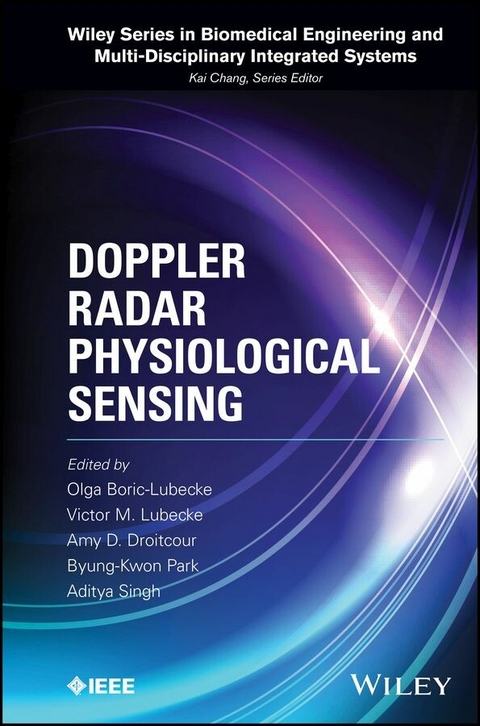
Doppler Radar Physiological Sensing (eBook)
John Wiley & Sons (Verlag)
978-1-119-07843-2 (ISBN)
Presents a comprehensive description of the theory and practical implementation of Doppler radar-based physiological monitoring
This book includes an overview of current physiological monitoring techniques and explains the fundamental technology used in remote non-contact monitoring methods. Basic radio wave propagation and radar principles are introduced along with the fundamentals of physiological motion and measurement. Specific design and implementation considerations for physiological monitoring radar systems are then discussed in detail. The authors address current research and commercial development of Doppler radar based physiological monitoring for healthcare and other applications.
- Explains pros and cons of different Doppler radar architectures, including CW, FMCW, and pulsed Doppler radar
- Discusses nonlinear demodulation methods, explaining dc offset, dc information, center tracking, and demodulation enabled by dc cancellation
- Reviews advanced system architectures that address issues of dc offset, spectrum folding, motion interference, and range resolution
- Covers Doppler radar physiological measurements demonstrated to date, from basic cardiopulmonary rate extractions to more involved volume assessments
Doppler Radar Physiological Sensing serves as a fundamental reference for radar, biomedical, and microwave engineers as well as healthcare professionals interested in remote physiological monitoring methods.
Olga Boric-Lubecke, PhD, is a Professor of Electrical Engineering at the University of Hawaii at Manoa, and an IEEE Fellow. She is widely recognized as a pioneer and leader in microwave radar technologies for non-contact cardiopulmonary monitoring, and in the design of integrated circuits for biomedical applications.
Victor M. Lubecke, PhD, is a Professor of Electrical Engineering at the University of Hawaii at Manoa. He is an emeritus IEEE Distinguished Microwave Lecturer and has over 25 years of experience in research and development of devices and methods for radio-based remote sensing systems.
Amy Droitcour, PhD, has spent ten years developing radar-based vital signs measurement technology through her dissertation research and leading product development as CTO of Kai Medical. She currently serves as Senior Vice President of R&D at Wave 80 Biosciences.
Byung-Kwon-Park, PhD, is a senior research engineer at the Mechatronics R&D Center in Korea.
Aditya Singh, PhD, is currently a postdoctoral researcher at the University of Hawaii Neuroscience and MRI research Program.
Presents a comprehensive description of the theory and practical implementation of Doppler radar-based physiological monitoring This book includes an overview of current physiological monitoring techniques and explains the fundamental technology used in remote non-contact monitoring methods. Basic radio wave propagation and radar principles are introduced along with the fundamentals of physiological motion and measurement. Specific design and implementation considerations for physiological monitoring radar systems are then discussed in detail. The authors address current research and commercial development of Doppler radar based physiological monitoring for healthcare and other applications. Explains pros and cons of different Doppler radar architectures, including CW, FMCW, and pulsed Doppler radar Discusses nonlinear demodulation methods, explaining dc offset, dc information, center tracking, and demodulation enabled by dc cancellation Reviews advanced system architectures that address issues of dc offset, spectrum folding, motion interference, and range resolution Covers Doppler radar physiological measurements demonstrated to date, from basic cardiopulmonary rate extractions to more involved volume assessments Doppler Radar Physiological Sensing serves as a fundamental reference for radar, biomedical, and microwave engineers as well as healthcare professionals interested in remote physiological monitoring methods.
Olga Boric-Lubecke, PhD, is a Professor of Electrical Engineering at the University of Hawaii at Manoa, and an IEEE Fellow. She is widely recognized as a pioneer and leader in microwave radar technologies for non-contact cardiopulmonary monitoring, and in the design of integrated circuits for biomedical applications. Victor M. Lubecke, PhD, is a Professor of Electrical Engineering at the University of Hawaii at Manoa. He is an emeritus IEEE Distinguished Microwave Lecturer and has over 25 years of experience in research and development of devices and methods for radio-based remote sensing systems. Amy Droitcour, PhD, has spent ten years developing radar-based vital signs measurement technology through her dissertation research and leading product development as CTO of Kai Medical. She currently serves as Senior Vice President of R&D at Wave 80 Biosciences. Byung-Kwon-Park, PhD, is a senior research engineer at the Mechatronics R&D Center in Korea. Aditya Singh, PhD, is currently a postdoctoral researcher at the University of Hawaii Neuroscience and MRI research Program.
Cover 1
Title Page 5
Copyright 6
Contents 7
List of Contributors 13
Chapter 1 Introduction 15
1.1 Current Methods of Physiological Monitoring 16
1.2 Need for Noncontact Physiological Monitoring 17
1.2.1 Patients with Compromised Skin 17
1.2.2 Sleep Monitoring 18
1.2.3 Elderly Monitoring 19
1.3 Doppler Radar Potential for Physiological Monitoring 19
1.3.1 Principle of Operation and Power Budget 20
1.3.2 History of Doppler Radar in Physiological Monitoring 22
References 30
Chapter 2 Radar Principles 35
2.1 Brief History of Radar 35
2.2 Radar Principle of Operation 36
2.2.1 Electromagnetic Wave Propagation and Reflection 37
2.2.2 Radar Cross Section 38
2.2.3 Radar Equation 39
2.3 Doppler Radar 42
2.3.1 Doppler Effect 42
2.3.2 Doppler Radar Waveforms: CW, FMCW, Pulsed 43
2.4 Monostatic and Bistatic Radar 46
2.5 Radar Applications 49
References 50
Chapter 3 Physiological Motion and Measurement 53
3.1 Respiratory System Motion 53
3.1.1 Introduction to the Respiratory System 53
3.1.2 Respiratory Motion 54
3.1.3 Chest Wall Motion Associated with Breathing 57
3.1.4 Breathing Patterns in Disease and Disorder 57
3.2 Heart System Motion 58
3.2.1 Location and Gross Anatomy of the Heart 59
3.2.2 Electrical and Mechanical Events of the Heart 60
3.2.3 Chest Surface Motion Due to Heart Function 62
3.2.4 Quantitative Measurement of Chest Wall Motion Due to Heartbeat 64
3.3 Circulatory System Motion 67
3.3.1 Location and Structure of the Major Arteries and Veins 68
3.3.2 Blood Flow Through Arteries and Veins 69
3.3.3 Surface Motion from Blood Flow 70
3.3.4 Circulatory System Motion: Variation with Age 71
3.4 Interaction of Respiratory, Heart, and Circulatory Motion at the Skin Surface 72
3.5 Measurement of Heart and Respiratory Surface Motion 72
3.5.1 Radar Measurement of Physiological Motion 73
3.5.2 Surface Motion Measurement of Respiration Rate 73
3.5.3 Surface Motion Measurement of Heart/Pulse Rate 75
References 77
Chapter 4 Physiological Doppler Radar Overview 83
4.1 RF Front End 84
4.1.1 Quadrature Receiver 87
4.1.2 Phase Coherence and Range Correlation 91
4.1.3 Frequency Choice 93
4.1.4 Antenna Considerations 94
4.1.5 Power Budget 94
4.2 Baseband Module 97
4.2.1 Analog Signal Conditioning and Coupling Methods 97
4.2.2 Data Acquisition 99
4.3 Signal Processing 100
4.3.1 Phase Demodulation 100
4.3.2 Demodulated Phase Processing 101
4.4 Noise Sources 104
4.4.1 Electrical Noise 104
4.4.2 Mechanical Noise 106
4.5 Conclusions 106
References 107
Chapter 5 CW Homodyne Transceiver Challenges 109
5.1 RF Front End 109
5.1.1 Single-Channel Limitations 110
5.1.2 LO Leakage Cancellation 117
5.1.3 IQ Imbalance Assessment 123
5.2 Baseband Module 127
5.2.1 AC and DC Coupling 127
5.2.2 DC Canceller 128
5.3 Signal Demodulation 132
5.3.1 DC Offset and DC Information 132
5.3.2 Center Tracking 139
5.3.3 DC Cancellation Results 144
References 148
Chapter 6 Sources of Noise and Signal-to-Noise Ratio 151
6.1 Signal Power, Radar Equation, and Radar Cross Section 152
6.1.1 Radar Equation 152
6.1.2 Radar Cross Section 154
6.1.3 Reflection and Absorption 155
6.1.4 Phase-to-Amplitude Conversion 155
6.2 Oscillator Phase Noise, Range Correlation and Residual Phase Noise 157
6.2.1 Oscillator Phase Noise 157
6.2.2 Range Correlation and Residual Phase Noise 161
6.3 Contributions of Various Noise Sources 165
6.3.1 Phase Noise 165
6.3.2 Baseband 1/f Noise 168
6.3.3 RF Additive White Gaussian Noise 168
6.4 Signal-to-Noise Ratio 169
6.5 Validation of Range Correlation 171
6.6 Human Testing Validation 172
References 182
Chapter 7 Doppler Radar Physiological Assessments 185
7.1 Actigraphy 186
7.2 Respiratory Rate 190
7.3 Tidal Volume 193
7.4 Heart Rates 198
7.5 Heart Rate Variability 199
7.6 Respiratory Sinus Arrhythmia 204
7.7 RCs and Subject Orientation 210
References 218
Chapter 8 Advanced Performance Architectures 221
8.1 DC Offset and Spectrum Folding 222
8.1.1 Single-Channel Homodyne System with Phase Tuning 222
8.1.2 Heterodyne System with Frequency Tuning 227
8.1.3 Low-IF Architecture 234
8.2 Motion Interference Suppression 238
8.2.1 Interference Cancellation 240
8.2.2 Bistatic Radar: Sensor Nodes 245
8.2.3 Passive RF Tags 254
8.3 Range Detection 264
8.3.1 Physiological Monitoring with FMCW Radar 264
8.3.2 Physiological Monitoring with UWB Radar 265
References 280
Chapter 9 Applications and Future Research 283
9.1 Commercial Development 283
9.1.1 Healthcare 283
9.1.2 Defense 286
9.2 Recent Research Areas 286
9.2.1 Sleep Study 286
9.2.2 Range 289
9.2.3 Multiple Subject Detection 290
9.2.4 Animal Monitoring 293
9.3 Conclusion 296
References 296
Index 299
EULA 303
| Erscheint lt. Verlag | 15.12.2015 |
|---|---|
| Reihe/Serie | Wiley Series in Biomedical Engineering |
| Wiley Series in Biomedical Engineering | Wiley Series in Biomedical Engineering and Multi-Disciplinary Integrated Systems |
| Sprache | englisch |
| Themenwelt | Medizin / Pharmazie ► Gesundheitsfachberufe |
| Medizin / Pharmazie ► Medizinische Fachgebiete | |
| Medizin / Pharmazie ► Pflege | |
| Medizin / Pharmazie ► Physiotherapie / Ergotherapie ► Orthopädie | |
| Technik ► Nachrichtentechnik | |
| Technik ► Umwelttechnik / Biotechnologie | |
| Schlagworte | Apparatetechnik u. Biosensoren • Bioinstrumentation & Biosensors • biomedical engineering • Biomedizintechnik • Biosignal processing • Biosignalverarbeitung • Circulatory System Motion • CW Homodyne Transceiver • Doppler Effect • doppler radar • Doppler Radar Waveforms • Electrical & Electronics Engineering • Elektrotechnik u. Elektronik • Heart System Motion • Mikrowellen- u. Hochfrequenztechnik u. Theorie • Physiological Doppler Radar • Physiological Monitoring • Remote Sensing • Respiratory System Motion • RF / Microwave Theory & Techniques • Signal Processing • Wirtschaft |
| ISBN-10 | 1-119-07843-1 / 1119078431 |
| ISBN-13 | 978-1-119-07843-2 / 9781119078432 |
| Informationen gemäß Produktsicherheitsverordnung (GPSR) | |
| Haben Sie eine Frage zum Produkt? |
 PDF (Adobe DRM)
Größe: 10,2 MB
Kopierschutz: Adobe-DRM
Adobe-DRM ist ein Kopierschutz, der das eBook vor Mißbrauch schützen soll. Dabei wird das eBook bereits beim Download auf Ihre persönliche Adobe-ID autorisiert. Lesen können Sie das eBook dann nur auf den Geräten, welche ebenfalls auf Ihre Adobe-ID registriert sind.
Details zum Adobe-DRM
Dateiformat: PDF (Portable Document Format)
Mit einem festen Seitenlayout eignet sich die PDF besonders für Fachbücher mit Spalten, Tabellen und Abbildungen. Eine PDF kann auf fast allen Geräten angezeigt werden, ist aber für kleine Displays (Smartphone, eReader) nur eingeschränkt geeignet.
Systemvoraussetzungen:
PC/Mac: Mit einem PC oder Mac können Sie dieses eBook lesen. Sie benötigen eine
eReader: Dieses eBook kann mit (fast) allen eBook-Readern gelesen werden. Mit dem amazon-Kindle ist es aber nicht kompatibel.
Smartphone/Tablet: Egal ob Apple oder Android, dieses eBook können Sie lesen. Sie benötigen eine
Geräteliste und zusätzliche Hinweise
Zusätzliches Feature: Online Lesen
Dieses eBook können Sie zusätzlich zum Download auch online im Webbrowser lesen.
Buying eBooks from abroad
For tax law reasons we can sell eBooks just within Germany and Switzerland. Regrettably we cannot fulfill eBook-orders from other countries.
 EPUB (Adobe DRM)
Kopierschutz: Adobe-DRM
Adobe-DRM ist ein Kopierschutz, der das eBook vor Mißbrauch schützen soll. Dabei wird das eBook bereits beim Download auf Ihre persönliche Adobe-ID autorisiert. Lesen können Sie das eBook dann nur auf den Geräten, welche ebenfalls auf Ihre Adobe-ID registriert sind.
Details zum Adobe-DRM
Dateiformat: EPUB (Electronic Publication)
EPUB ist ein offener Standard für eBooks und eignet sich besonders zur Darstellung von Belletristik und Sachbüchern. Der Fließtext wird dynamisch an die Display- und Schriftgröße angepasst. Auch für mobile Lesegeräte ist EPUB daher gut geeignet.
Systemvoraussetzungen:
PC/Mac: Mit einem PC oder Mac können Sie dieses eBook lesen. Sie benötigen eine
eReader: Dieses eBook kann mit (fast) allen eBook-Readern gelesen werden. Mit dem amazon-Kindle ist es aber nicht kompatibel.
Smartphone/Tablet: Egal ob Apple oder Android, dieses eBook können Sie lesen. Sie benötigen eine
Geräteliste und zusätzliche Hinweise
Buying eBooks from abroad
For tax law reasons we can sell eBooks just within Germany and Switzerland. Regrettably we cannot fulfill eBook-orders from other countries.
aus dem Bereich