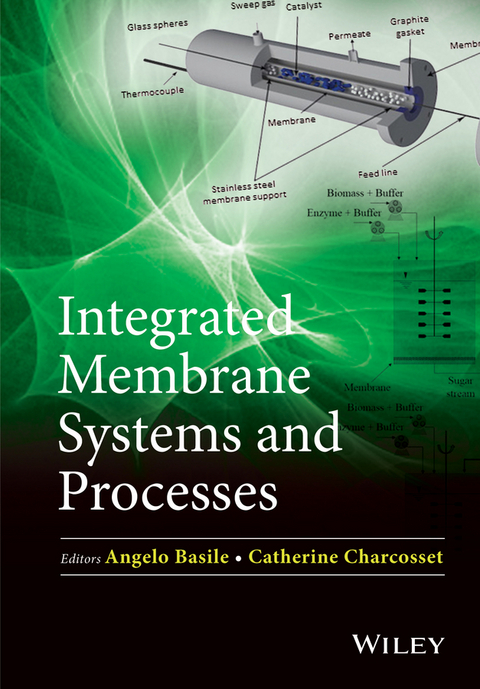
Integrated Membrane Systems and Processes (eBook)
John Wiley & Sons (Verlag)
978-1-118-73915-0 (ISBN)
Angelo Basile is a senior researcher at the Institute on Membrane Technology (ITM) of the Italian National Research Council (CNR). His research is focussed onultra-pure hydrogen production and CO2 capture using inorganic membrane reactors as well as on the polymeric membranes (preparation and characterization) to be used for gas separation. Angelo has published more than 100 papers in the field of membrane technology, has written over 50 book chapters and edited or co-edited 8 books. He is also Associate Editor for the International Journal of Hydrogen Energy for Elsevier. Catherine Charcosset is Research Director at the Laboratoire d'Automatique et de Génie des Procédés, part of the CNRS (Centre National de la Recherche Scientifique), based at the University of Lyon, France. Her research includes work on the characterization of membranes by confocal microscopy, ultrafiltration and microfiltration, membrane chromatography, preparation of emulsions and particles, and membrane crystallization for biotechnological, pharmaceutical and environmental applications. Catherine has published extensively in these fields especially filtration and membrane chromatography, both as articles and book chapters.
1
Ultrafiltration, Microfiltration, Nanofiltration and Reverse Osmosis in Integrated Membrane Processes
Catherine Charcosset
Laboratoire d'Automatique et de Génie des Procédés, CNRS, Université Lyon 1, Villeurbanne Cedex, France
1.1 Introduction
Membrane science and technology have known an impressive growth since the early 1960s when Loeb and Sourirajan discovered an effective method for the preparation of asymmetric cellulose acetate membranes with increased permeation flux without significant changes in selectivity. Pressure-driven separation techniques such as microfiltration (MF), ultrafiltration (UF), nanofiltration (NF) and reverse osmosis (RO) have then been extensively studied and developed in industries including desalination and wastewater treatment, biotechnology and pharmaceutics, chemical and food industries. Other membrane processes have been developed and found industrial applications such as gas separation and pervaporation, membrane distillation (MD), electrodialysis (ED), membrane bioreactor (MBRs), and membrane contactors. Membrane technology is usually recognized for the following advantages: operational simplicity, low energetic requirements, good stability under a wide range of operative conditions, high eco-compatibility, easy control and scale-up, large flexibility [1].
With the increasing understanding and development of membrane techniques, it became possible to integrate various membrane operations in the same process with the purpose to improve performance in terms of product quality, plant compactness, environmental impact, and energy use. The concept of integrated membrane processes appears clearly at the end of the 1990s [1] when several applications were reported such as hybrid process NF–ED for treatment of pulp bleaching effluents [2], multistages UF, NF and RO for removal of contaminants from wastewater effluents [3] and RO–MD for seawater desalination [4]. In the following years, it became more and more obvious that other combinations could have significant impact [5], such as MBR–RO for wastewater treatment [6], pressure-driven membrane processes–MD for the treatment of wastewaters [7], and multistages pressure-driven membrane processes for high-resolution separations of biomolecules from food and biotechnology feeds [8].
In this chapter, some general backgrounds on membrane processes are first recalled including pressure-driven processes (MF, UF, NF, RO), and MD, ED and MBRs. Examples of membrane integrated processes are then given such as multistages pressure driven membrane processes and pressure-driven membrane processes associated to MD, ED or MBRs. Applications concern seawater desalination, wastewater treatment, separation in biotechnology and food industries and chemical production. These hybrid membrane techniques are further detailed in the following chapters of the book as well as other integrated membrane processes. Integrated membrane processes including gas and vapour separation and catalytic membrane reactors are considered in the second part of this book. Another important aspect of integrated membrane processes concern their association with processes other than membranes. This is also considered in the following chapters.
1.2 Membrane Processes
Various membrane operations are available for a wide range of industrial applications. Pressure-driven membrane processes include MF, UF, NF and RO. Other membrane unit operations include MD, ED and MBRs.
1.2.1 Ultrafiltration, Microfiltration and Nanofiltration
UF is a size exclusion pressure-driven separation process which came into use in the 1960s when Loeb and Sourirajan discovered the preparation of asymmetric cellulose acetate membranes [9]. UF membranes typically have pore sizes in the range of 10–1000 Å and are capable of retaining species in the molecular weight range of 300–1,000,000 Da. Operating pressures are usually in the range of 0.2–4 bar. Typical rejected species include biomolecules, polymers and colloidal particles, as well as emulsions and micelles. UF is found in a very large range of industries such as food, biotechnology and pharmaceutics, chemicals and water production.
MF is a pressure-driven separation process similar to UF with membranes typically having nominal pore sizes on the order of 0.1–1.0 μm [9]. MF applications include concentrating, purifying or separating macromolecules, colloids and suspended particles from solution. MF processing is widely used, for example, in the food industry for applications such as wine, juice and beer clarification, for wastewater treatment, and plasma separation from blood for therapeutic and commercial uses.
NF dates back to the 1970s when RO membranes with a relatively high water flux operating at relatively low pressures were developed [10, 11]. Such low-pressure RO membranes were termed NF membranes. NF is a pressure-driven membrane process, involving pressures between 5 and 20 bar, used to separate ions and molecules in the molecular weight range of 200–2000 g mol−1. NF membranes have relatively high charge and are typically characterized by lower rejection of monovalent ions than that of RO membranes, but maintaining high rejection of divalent ions. Applications include pretreatment before desalination, water treatment, food industry, chemical processing industry, pulp and paper industry, metal and acid recovery, etc.
1.2.2 Reverse Osmosis
RO became commercially viable in the 1960s when Loeb and Sourirajan discovered asymmetric membranes. RO is a pressure-driven process that separated two solutions with different concentrations across a semi-permeable membrane [12]. In RO, the pressure difference Δp between the concentrated side and the dilute side is larger than a certain value that depends upon the difference of the respective concentrations and is called the osmotic pressure difference Δπ. The direction of flow is reversed as observed in osmosis and water flows from the concentrate to the dilute side. The rate at which water crosses the membrane is then proportional to the pressure differential that exceeds Δπ. In order to overcome the feed side osmotic pressure, fairly high feed pressure is required. In seawater desalination it commonly ranges from 55 to 70 bar. Operating pressures for the purification of brackish water are lower due to the lower osmotic pressure caused by lower feed water salinity. The most commonly used applications of RO are desalination, brackish water and wastewater treatment and concentrating food and biotechnological preparations.
1.2.3 Membrane Distillation
MD is a thermally driven membrane process in which a hydrophobic microporous membrane separates a hot and cold stream of water [13]. The hydrophobic nature of the membrane prevents the passage of liquid water through the pores while allowing the passage of water vapour (Figure 1.1). The temperature difference produces a vapour pressure gradient which causes water vapour to pass through the membrane and condense on the colder surface. The result is a distillate of very high purity. MD has been developed into four different configurations, differing by the method employed to impose the vapour pressure difference across the membrane. The permeate side of the membrane may consist of a condensing fluid in direct contact with the membrane, a condensing surface separated from the membrane by an air gap, a sweeping gas, or a vacuum. MD has been applied for water desalination, waste treatment, and food processing like milk and juice concentration, biomedical applications such as water removal from blood and treatment of protein solutions [14]. In desalination by MD, the heated seawater is in direct contact with one side of the membrane. Salts and organic matter stay in the feed while pure water diffuses through the membrane.
Figure 1.1 Schematic diagram illustrating the principle of membrane distillation.
Osmotic distillation (OD) is a variant of MD for which the driving force is a difference in concentration. OD uses the hydrophobic microporous membrane to separate two aqueous solutions having different solute concentrations: a dilute solution on one side and a hypertonic salt solution (concentrated brine stripper) on the opposite side [15]. The hydrophobic nature of the membrane prevents penetration of the pores by aqueous solutions, creating air gaps within the membrane. The water vapour pressure gradient across the membrane determines a transfer of vapour across the pores from the high vapour pressure phase to the low one. This migration of water vapour results in the concentration of the feed and dilution of the osmotic agent solution. OD can proceed at ambient temperature and is an attractive process for the concentration of solutions containing thermo-sensitive compounds such as fruit juices and pharmaceuticals.
Membrane crystallization (MCr) [16] has been proposed as an extension of MD: solutions, concentrated above their saturation limit by solvent evaporation through microporous hydrophobic membranes, reach a supersaturated state in which crystals nucleate and grow. The crystallizing solution flows along the membrane fibres. The driving force of the process is a vapour pressure gradient between both sides of the membrane which may be activated by heating the feed solution. MCr is mainly applied at...
| Erscheint lt. Verlag | 7.12.2015 |
|---|---|
| Sprache | englisch |
| Themenwelt | Naturwissenschaften ► Chemie ► Technische Chemie |
| Technik ► Umwelttechnik / Biotechnologie | |
| Schlagworte | Bioseparation • chemical engineering • Chemie • Chemische Verfahrenstechnik • Chemistry • Environmental Chemistry • food production • Gas Separation • Hybrid Membrane Processes • Integrated systems • Membran • Membrane Reactors • Membranes • Microfiltratrion • Nachhaltige u. Grüne Chemie • Nachhaltige u. Grüne Chemie • Nanofiltration • Pervaporation • Process Engineering • Prozesssteuerung • Sustainable Chemistry & Green Chemistry • Ultrafiltration • Umweltchemie • Water Treatment |
| ISBN-10 | 1-118-73915-9 / 1118739159 |
| ISBN-13 | 978-1-118-73915-0 / 9781118739150 |
| Informationen gemäß Produktsicherheitsverordnung (GPSR) | |
| Haben Sie eine Frage zum Produkt? |
 EPUB (Adobe DRM)
Kopierschutz: Adobe-DRM
Adobe-DRM ist ein Kopierschutz, der das eBook vor Mißbrauch schützen soll. Dabei wird das eBook bereits beim Download auf Ihre persönliche Adobe-ID autorisiert. Lesen können Sie das eBook dann nur auf den Geräten, welche ebenfalls auf Ihre Adobe-ID registriert sind.
Details zum Adobe-DRM
Dateiformat: EPUB (Electronic Publication)
EPUB ist ein offener Standard für eBooks und eignet sich besonders zur Darstellung von Belletristik und Sachbüchern. Der Fließtext wird dynamisch an die Display- und Schriftgröße angepasst. Auch für mobile Lesegeräte ist EPUB daher gut geeignet.
Systemvoraussetzungen:
PC/Mac: Mit einem PC oder Mac können Sie dieses eBook lesen. Sie benötigen eine
eReader: Dieses eBook kann mit (fast) allen eBook-Readern gelesen werden. Mit dem amazon-Kindle ist es aber nicht kompatibel.
Smartphone/Tablet: Egal ob Apple oder Android, dieses eBook können Sie lesen. Sie benötigen eine
Geräteliste und zusätzliche Hinweise
Buying eBooks from abroad
For tax law reasons we can sell eBooks just within Germany and Switzerland. Regrettably we cannot fulfill eBook-orders from other countries.
aus dem Bereich