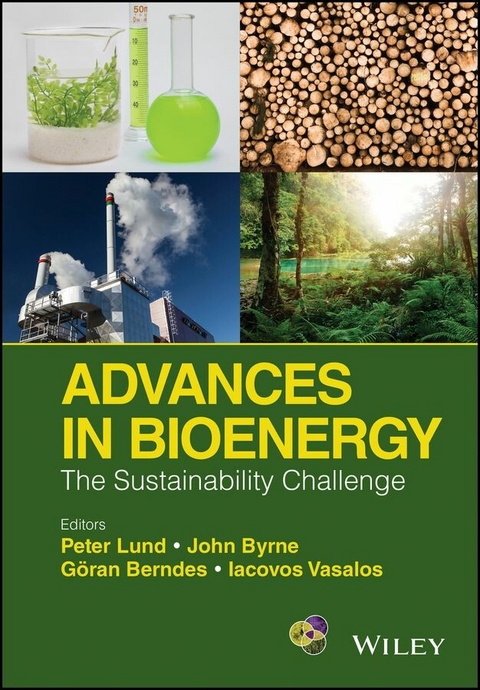
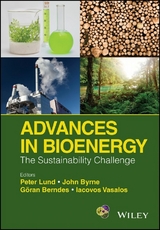
The increasing deployment of bioenergy frequently raises issues regarding the use of land and raw materials, infrastructure and logistics. In light of these sometimes conflicting interests Advances in Bioenergy provides an objective and wide-ranging overview of the technology, economics and policy of bioenergy.
Offering an authoritative multidisciplinary summary of the opportunities and challenges associated with bioenergy utilization, with international researchers give up-to-date and detailed information on key issues for biomass production and conversion to energy.
Key features:
*Discusses different bioenergy uses such as transportation fuels, electricity and heat production.
*Assesses emerging fields such as bio-based chemicals and bio-refineries.
*Debates conditions for the mobilization of sustainable bioenergy supply chains and outlines governance systems to support this mobilization.
* Dedicated chapters to sustainability governance and emerging tools such as certification systems and standards supporting growth of a sustainable bioenergy industry.
*Considers the political, environmental, social and cultural context related to the demand for energy resources, the impact of this demand on the world around us, and the choices and behaviours of consumers.
This book will be a vital reference to engineers, researchers and students that need an accessible overview of the bioenergy area. It will also be of high value for politicians, policymakers and industry leaders that need to stay up to date with the state-of-the-art science and technology in this area.
Peter D. Lund is Professor in Advanced Energy Systems at Aalto University (Helsinki) where he chairs the multidisciplinary Energy Science Initiative. He is also a Visiting Professor in Wuhan, China. His primary interest is in sustainable energy systems, innovations, and policies.
Dr. Lund is active in senior roles with EU initiatives in energy: he chaired the Advisory Group Energy of E.C. 2002-06, he chairs the Energy Steering Panel of European Academies Science Advisory Council (EASAC) and is a steering committee member of Euro-CASE energy platform. He has served in advisory role in many energy programmes world wide, including IEA, EIT, Baltic and Russia cooperation. Dr. Lund is Editor-in-Chief for Interdisciplinary Reviews: Energy and Environment and European Editor for International Journal of Energy Research (Wiley). Peter Lund has given numerous invited talks and written over 500 research papers on energy.
John Byrne is Director of the Center for Energy and Environmental Policy (CEEP) and Distinguished Professor of Energy and Climate Policy at the University of Delaware. He has contributed to Working Group III of the United Nations-sponsored Intergovernmental Panel on Climate Change (IPCC) since 1992 and shares the 2007 Nobel Peace Prize with the Panel's authors and review editors. He holds several senior academic, advisory and policy advisor positions, among others in South Korea, China, India and the USA. His work in the US includes service as an advisor to the National Council for Science and the Environment (US) and the Interagency Working Group on Environmental Justice, coordinated by the US EPA. Dr Byrne created the first undergraduate and graduate degrees in the United States in the combined area of energy and environmental policy and a recent external review conducted by a committee of internationally respected scholars rated the CEEP graduate program among the three best in the field. He has published 17 books and over 150 research articles.
Göran Berndes is Associate Professor in Energy and Environment at Chalmers University of Technology in Sweden. He is also Associate of the International Institute for Sustainability Analysis and Strategy (IINAS) and Stockholm International Water Institute (SIWI). His research integrates land use and energy systems at scales ranging from local case studies to the global context, addressing technology, ecology as well as governance issues. Dr. Berndes has contributed as Expert Reviewer and Author to Working Group III of the IPCC and has served as international Task leader in IEA Bioenergy since 2007. He was awarded the Nordic Council of Ministers' Bioenergy prize in 2010. He currently chairs the Activity Group on Bioenergy and Water within the Global Bioenergy Partnership (GBEP) and is manager for the profile area Energy in a Circular Economy within Chalmers Energy Area of Advance. Dr. Berndes is Associate Editor for Interdisciplinary Reviews: Energy and Environment and Consultant Editor for Biofuels, Bioproducts and Biorefining (Wiley).
Iacovos A. Vasalos was a Professor at Aristotle University of Thessaloniki, Department of Chemical Engineering from 1979 to 2005. He is currently Emeritus Researcher at the Chemical Process and Energy Resources Institute (CPERI), Centre for Research and Technology Hellas (CERTH). He started his career in the Amoco Research Center in Naperville, Illinois, where he worked for 10 years from 1969 to 1979, as a research engineer, project manager, process specialist in catalytic cracking, research supervisor, and as a consultant until 1999. He is the author or coauthor of 132 scientific publications and 43 international patents many of which have been successfully applied in refineries. He was instrumental in founding and organizing CPERI and CERTH. He was also actively involved in a series of EU-funded projects in areas such as clean fossil fuels, syngas production, biofuels, environmental catalysis with emphasis on catalytic reaction engineering and modelling coupled with overall process simulation.
The increasing deployment of bioenergy frequently raises issues regarding the use of land and raw materials, infrastructure and logistics. In light of these sometimes conflicting interests Advances in Bioenergy provides an objective and wide-ranging overview of the technology, economics and policy of bioenergy. Offering an authoritative multidisciplinary summary of the opportunities and challenges associated with bioenergy utilization, with international researchers give up-to-date and detailed information on key issues for biomass production and conversion to energy. Key features: *Discusses different bioenergy uses such as transportation fuels, electricity and heat production. *Assesses emerging fields such as bio-based chemicals and bio-refineries. *Debates conditions for the mobilization of sustainable bioenergy supply chains and outlines governance systems to support this mobilization. * Dedicated chapters to sustainability governance and emerging tools such as certification systems and standards supporting growth of a sustainable bioenergy industry. *Considers the political, environmental, social and cultural context related to the demand for energy resources, the impact of this demand on the world around us, and the choices and behaviours of consumers. This book will be a vital reference to engineers, researchers and students that need an accessible overview of the bioenergy area. It will also be of high value for politicians, policymakers and industry leaders that need to stay up to date with the state-of-the-art science and technology in this area.
Professor Peter Lund Research interests: Energy systems and innovations. Science, technology, business and policy issues related to large-scale schemes of new and renewable energy; nanotechnology for energy applications; solar cells and fuel cells; distributed energy generation systems; sustainable energy for urban areas; energy system modelling; commercialization and innovation strategies; green energy economy; market penetration and technology diffusion. Professor John Byrne Director of the Center for Energy and Environmental Policy (CEEP) and Distinguished Professor of Energy and Climate Policy at the University of Delaware. He has contributed to Working Group III of the United Nations-sponsored Intergovernmental Panel on Climate Change (IPCC) since 1992 and shares the 2007 Nobel Peace Prize with the Panel's authors and review editors. He is chairman of the board of the Foundation for Renewable Energy and Environment (FREE), an international organization established to promote a better future based on energy, water and materials conservation, renewable energy use, environmental resilience, and sustainable livelihoods.
About the editors
List of contributors
Preface
I. Promising Innovation in Biomass Conversion
1. WENE-5 Metabolic engineering: Enabling technology for biofuels production
2. WENE-49 Hydrolysis and fermentation for cellulosic ethanol production
3. WENE-29 Lipid-based liquid biofuels from autotrophic microalgae: energetic and environmental performance
4. WENE-16 Catalytic pyrolysis of biomass for transportation fuels
5. WENE-119 Integrated biomass hydropyrolysis and hydrotreating: a brief review
6. WENE-74 Transportation fuels from biomass via fast pyrolysis and hydroprocessing
7. WENE-97 Biomass gasification for synthesis gas production and applications of the syngas
8. WENE-111 Hydrogen generation from biomass materials: challenges and opportunities
9. WENE-93 Production of renewable hydrogen by reformation of biofuels
10. WENE-69 Fischer-Tropsch conversion of biomass derived synthetic gas to liquids
11. WENE-28 Critical factors for high temperature processing of biomass from agriculture and energy crops to biofuels and bioenergy
12. WENE-59 Second-generation biofuels: why they are taking so long
13. WENE-73 Separation technologies for current and future biorefineries--status and potential of membrane-based separation
14. WENE-361 Catalysis at room temperature: perspectives for future Green Chemical processes
15. WENE-100 Co-firing of biomass with coal in thermal power plants: technology schemes, impacts and future perspectives
II. Challenges and solutions for biomass supply
16. WENE-41 Bioenergy and land use change - state of the art
17. WENE-24 Forest energy procurement: state of the art in Finland and Sweden
18. WENE-25 Options for increasing biomass output from long rotation forestry
19. WENE-157 Recovery rate of harvest residues for bioenergy in boreal and temperate forests: A review
20. WENE-26 Forest Bioenergy Feedstock Harvesting Effects on Water Supply
21. WENE-77 Best management practices for forest bioenergy programs
22. WENE-3 Principles of nutrient management for sustainable forest bioenergy production
23. WENE-88 Crop coefficients of Jatropha (Jatropha curcas) and Pongamia (Pongamia pinnata) using water balance approach
24. WENE-87 Brazilian sugarcane ethanol: developments so far and challenges for the future
25. WENE-17 The climate benefit of Swedish ethanol: present and prospective performance
26. WENE-107 Performance of small-scale straw-to-heat supply chains in Norway
27. WENE-84 Transport sector in Ireland: can 2020 national policy targets drive indigenous biofuel production to success?
28. WENE-138 Prospects for domestic biofuels for transport in Sweden 2030 based on current production and future plans
29. WENE-55 Land and the food-fuel competition: insights from modeling
30. WENE-155 The impact of biofuel demand on agricultural commodity prices: a systematic review
31. WENE-118 How do sustainability standards consider biodiversity?
32. WENE-166 A global survey of stakeholder views and experiences for systems needed to effectively and efficiently govern sustainability of bioenergy
Index
| Erscheint lt. Verlag | 7.12.2015 |
|---|---|
| Sprache | englisch |
| Themenwelt | Naturwissenschaften ► Physik / Astronomie |
| Technik ► Elektrotechnik / Energietechnik | |
| Schlagworte | Bioenergie • bioenergy • Bioenergy resources • Biofuels • climate change • Energie • Energy • Environment • Erneuerbare Energien • Green economy • land use • renewable energy • sustainability |
| ISBN-10 | 1-118-95786-5 / 1118957865 |
| ISBN-13 | 978-1-118-95786-8 / 9781118957868 |
| Informationen gemäß Produktsicherheitsverordnung (GPSR) | |
| Haben Sie eine Frage zum Produkt? |
 PDF (Adobe DRM)
Kopierschutz: Adobe-DRM
Adobe-DRM ist ein Kopierschutz, der das eBook vor Mißbrauch schützen soll. Dabei wird das eBook bereits beim Download auf Ihre persönliche Adobe-ID autorisiert. Lesen können Sie das eBook dann nur auf den Geräten, welche ebenfalls auf Ihre Adobe-ID registriert sind.
Details zum Adobe-DRM
Dateiformat: PDF (Portable Document Format)
Mit einem festen Seitenlayout eignet sich die PDF besonders für Fachbücher mit Spalten, Tabellen und Abbildungen. Eine PDF kann auf fast allen Geräten angezeigt werden, ist aber für kleine Displays (Smartphone, eReader) nur eingeschränkt geeignet.
Systemvoraussetzungen:
PC/Mac: Mit einem PC oder Mac können Sie dieses eBook lesen. Sie benötigen eine
eReader: Dieses eBook kann mit (fast) allen eBook-Readern gelesen werden. Mit dem amazon-Kindle ist es aber nicht kompatibel.
Smartphone/Tablet: Egal ob Apple oder Android, dieses eBook können Sie lesen. Sie benötigen eine
Geräteliste und zusätzliche Hinweise
Buying eBooks from abroad
For tax law reasons we can sell eBooks just within Germany and Switzerland. Regrettably we cannot fulfill eBook-orders from other countries.
aus dem Bereich