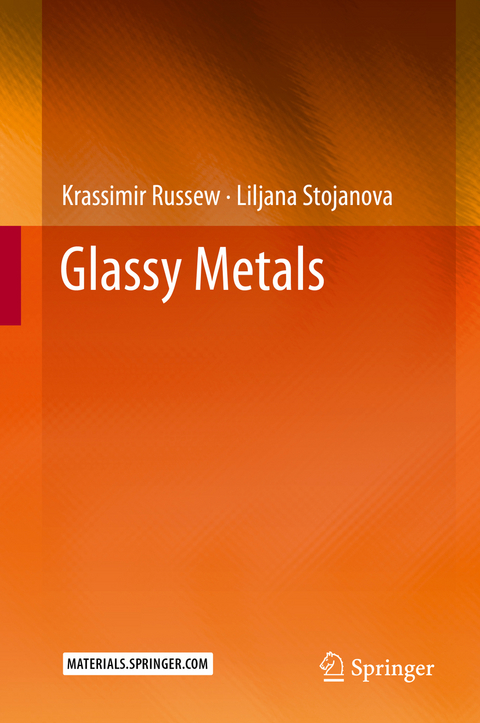
Glassy Metals (eBook)
XIII, 262 Seiten
Springer Berlin (Verlag)
978-3-662-47882-0 (ISBN)
The topics discussed in this book focus on fundamental problems concerning the structural relaxation of amorphous metallic alloys, above all the possibility of studying it on the basis of viscous flow behavior and its relation to rheological anomalies, such as bend stress relaxation, thermal expansion, specific heat, density changes, and crystallization. Most relaxation studies deal with the relaxation changes of a single definite material property, and not with a wider spectrum of physical properties integrated into a common framework. This book shows that it is possible to describe these property changes on the basis of a more comprehensive theoretical understanding of their mechanism.
Abbreviations 8
Contents 10
1 Production, Properties and Applications of Glassy Metals 15
Introduction 15
References 19
2 Most Important Methods for Production of Amorphous Metallic Alloys 22
The Chill Block Melt Spinning (CBMS) Method 26
Influence of the Production Parameters upon the Geometric Characteristics of the Amorphous Ribbons by the CBMS Method 27
Planar Flow Casting (PFC) Method 30
Relation Between the Production Conditions and the Geometric Characteristics of Wide Amorphous Ribbons by the PFC Method 31
Production of Bulk Amorphous Metallic Alloys by Rapid Cooling from the Melt and Study of Their Structure 36
References 40
3 Experimental Methods for Determination of the Magnitude and Temperature Dependence of the Viscosity of Amorphous Metallic Al... 43
Experimental Methods for Viscosity Determination of Amorphous Metallic Alloys Under Isothermal and Nonisothermal Conditions 46
Experimental Techniques for Viscosity Study of Metallic Glasses Under Nonisothermal Conditions 50
Analysis of the Overall Deformation Curves Obtained Under Continuous Heating Conditions and Viscosity Calculations 54
Estimation of the Critical Melt Cooling Rate for Obtaining the Alloy in Glassy State 56
References 62
4 Viscous Flow Behavior of Amorphous Ribbonlike Metallic Alloys Depending on Different Factors 64
Influence of Chemical Composition Upon the Viscous Flow Behavior and Thermal Stability of Some Binary Glassy Metals 65
Binary Ni100-xZrx Glassy Metals 65
The System Ni100-xPx 70
The System Fe100-xPx 75
Viscous Flow Behavior of Ternary Fe82-xTMxB18 (TM=V, Cr) Amorphous Metallic Alloys 78
Influence of Vanadium Alloying Additions 79
Influence of Chromium Alloying Additions 80
Viscous Flow Behavior of Quaternary Al85Ni5Co2RE8 (RE=Ce, Gd, U) Amorphous Metallic Alloys 82
Influence of Thermal Prehistory on the Viscous Flow Behavior of Amorphous Metallic Alloys 84
The Amorphous Pd82Si18 Alloy 84
The Amorphous Fe40Ni40B20 Alloy 87
Influence of Technological Production Parameters Upon the Viscous Flow of the Amorphous Metallic Alloy Fe40Ni40Si6B14 90
References 94
5 Basic Concepts of the Free Volume Model: Structural Relaxation and Viscosity in the Framework of the Model 96
Basic Ideas of the Free Volume Model 96
Structural Relaxation and Atomic Free Volume 98
Viscosity Temperature Dependence of Amorphous Metallic Alloys in the Framework of the Free Volume Model 99
The Influence of Structural Relaxation Upon Viscosity: Useful Tool for the Study of the Mechanism and Kinetics of Free Volume ... 101
Viscosity and Relaxation Under Isothermal Conditions 101
Viscosity and Relaxation Under Nonisothermal Conditions 104
References 108
6 Glass Forming Ability, Crystallization, and Viscosity of Rapidly Solidified Amorphous C100-xZrx and Cu100-xZrx Alloys 109
Glass Forming Ability (GFA) and Melt Fragility Number. Equation of Angell and Moynihan Interpretation 109
Crystallization, Viscosity, and Glass Forming Ability of Rapidly Solidified Amorphous C100-xZrx Alloys 112
Crystallization, Viscosity, and Glass Forming Ability of Rapidly Solidified Amorphous Cu100-xZrx Alloys 118
References 125
7 Bend Stress Relaxation of Amorphous Metallic Alloys Under Isothermal and Nonisothermal Heating Conditions 127
Relaxation of Bend Stresses in Ribbonlike Amorphous Metallic Alloys: Model Considerations 128
Structural Relaxation in Fe40Ni40Si6B14 Glassy Alloy 134
Direct Measurement of the High-Temperature Viscous Creep Under Nonisothermal Conditions 134
Study upon the Relaxation of Bend Stresses via Isothermal and Nonisothermal Measurements 135
Isothermal Bend Stress Relaxation Measurements 135
Nonisothermal Bend Stress Relaxation Measurements 140
References 146
8 Structural Relaxation in Various Amorphous Metallic Alloys Studied via Direct Viscosity and Bend Stress Relaxation Measureme... 147
The Amorphous Metallic Alloy Pd77.5Cu6Si16.5 148
Direct Viscosity Measurements Under Nonisothermal Conditions 148
Bend Stress Relaxation Study Under Isothermal Conditions 148
The Amorphous Metallic Alloy Al7.5Cu17.5Ni10Zr65 152
Direct Viscosity Determination Under Nonisothermal Conditions 152
Study of Bend Stress Relaxation Under Isothermal and Nonisothermal Conditions 152
Isothermal Bend Stress Relaxation Measurements 152
Nonisothermal Bend Stress Relaxation Measurements 154
The Amorphous Metallic Alloy l25La50Ni25 157
Direct Viscosity Measurements Under Nonisothermal Conditions 159
Bend Stress Relaxation Studies Under Isothermal and Nonisothermal Conditions 159
Isothermal Bend Stress Relaxation Measurements 160
Nonisothermal Bend Stress Relaxation Measurements 160
Physical Significance of the FVM Model Parameters 165
References 168
9 Thermal Expansion and Heat Capacity of Amorphous Metallic Alloys: Interpretation of Their Anomalous Behavior in the Framewor... 170
Anomalies in Thermal Expansion of Amorphous Metallic Alloys: Model Consideration 170
Viscous Flow and Thermal Expansion of Amorphous Metallic Alloys Pd82Si18 and Fe25Zr75 173
Conclusions 176
Specific Heat Anomalies of Amorphous Metallic Alloys: Model Interpretation 176
Viscous Flow and Specific Heat of Amorphous Metallic Alloy Fe25Zr75 Under Different Constant Heating Rates 178
Viscous Flow, Thermal Expansion, and Specific Heat of l25La50Ni25 Amorphous Alloy 180
Conclusions 184
References 185
10 Relation Between the Density Changes and Thermal Expansion Anomalies in the Amorphous Metallic Alloys 186
Relaxation Changes of Density of Amorphous Metallic Alloys: Free Volume Model Description 188
Relaxation Changes of Density of Amorphous Metallic Alloys: Experimental Proof 189
Free Volume Model Calculations 193
Conclusions 196
References 196
11 Crystallization Kinetics of Bulk Amorphous Metallic Alloys and Its Relation to the Forgoing Relaxation Processes 197
Experimental Approach 199
Crystal Growth and Viscous Flow Behavior of Amorphous Pd40Cu30Ni10P20 Metallic Alloy 200
Crystal Growth Rate Kinetics 200
Relation Between Crystal Growth and Viscous Flow Behavior 203
Overall Volume Transformation Kinetics of Bulk Amorphous Pd40Cu30Ni10P20 Alloy 207
Conclusions 212
Crystal Growth Rate Kinetics 212
Overall Volume Crystallization Kinetics 212
References 212
12 Mechanical Properties of Amorphous Metallic Alloys and Their Relation to the Viscosity Characteristic Parameters 214
Unified Equation of Yang 215
Viscous Flow and Mechanical Properties of Co100-x Zrx and Cu100-xZrx Glassy Alloys 217
References 222
13 Properties and Applications of Amorphous Metallic Alloys 223
Amorphous Metallic Alloys Produced in the USA 224
Amorphous Metallic Alloys Produced in Europe 227
Amorphous Metallic Alloys Produced in Russia 231
Invar-Type Amorphous Metallic Alloys Produced in Russia 233
Classification of Amorphous Metallic Alloys with Respect to Their Application as Soft Magnetic Materials 234
Amorphous Metallic Alloys on Fe Basis for Application in Electrotechnics at Frequencies of 50-60Hz 235
Power Transformers Working at Frequencies of 400Hz 236
Applications in Electromotors 236
Application of Amorphous Metallic Alloys on Fe-Ni Basis with Improved High-Frequency Properties: Transformers for Pulse Power ... 237
Application of Amorphous Metallic Alloys on Co Basis of Zero Magnetostriction and Good High-Frequency Properties 238
Application of Amorphous Metallic Alloys for the Production of Sensors 239
Sensors for Magnetic Fields 239
Magnetoelastic Sensors 241
Amorphous Metallic Alloys Used for Sensor Based on Other Measurement Principles 242
Sensors Based on the Change of Electrical Resistance as a Result of Elastic Deformation of the Material 242
Brazing Amorphous Metallic Alloys 242
Prospects 245
References 246
14 Quick Reference to the Viscous Flow Behaviour of Glassy Alloys at a Heating Rate of 20 K/min 248
Viscous Flow Behavior of Binary Amorphous Alloys at Heating Rate of 20K/min 249
Viscous Flow Behavior of Ternary Amorphous Alloys at Heating Rate of 20K/min 250
Viscous Flow Behavior of Quaternary Amorphous Alloys at Heating Rate of 20K/min 251
Appendix 1: Quick Reference to Most Frequently Used Important FVM Related Equations 252
Chapter 3 252
Chapter 4 253
Chapter 5 253
Chapter 6 256
Chapter 7 257
Chapter 9 260
Chapter 10 262
Chapter 11 263
Chapter 12 264
Appendix 2: Concluding Remarks 266
| Erscheint lt. Verlag | 5.1.2016 |
|---|---|
| Zusatzinfo | XIII, 262 p. 129 illus., 16 illus. in color. |
| Verlagsort | Berlin |
| Sprache | englisch |
| Themenwelt | Technik ► Maschinenbau |
| Schlagworte | Amorphous • Free Volume Model • glassy metals • Relaxation • viscosity |
| ISBN-10 | 3-662-47882-X / 366247882X |
| ISBN-13 | 978-3-662-47882-0 / 9783662478820 |
| Informationen gemäß Produktsicherheitsverordnung (GPSR) | |
| Haben Sie eine Frage zum Produkt? |
 PDF (Wasserzeichen)
DRM: Digitales Wasserzeichen
Dieses eBook enthält ein digitales Wasserzeichen und ist damit für Sie personalisiert. Bei einer missbräuchlichen Weitergabe des eBooks an Dritte ist eine Rückverfolgung an die Quelle möglich.
Dateiformat: PDF (Portable Document Format)
Mit einem festen Seitenlayout eignet sich die PDF besonders für Fachbücher mit Spalten, Tabellen und Abbildungen. Eine PDF kann auf fast allen Geräten angezeigt werden, ist aber für kleine Displays (Smartphone, eReader) nur eingeschränkt geeignet.
Systemvoraussetzungen:
PC/Mac: Mit einem PC oder Mac können Sie dieses eBook lesen. Sie benötigen dafür einen PDF-Viewer - z.B. den Adobe Reader oder Adobe Digital Editions.
eReader: Dieses eBook kann mit (fast) allen eBook-Readern gelesen werden. Mit dem amazon-Kindle ist es aber nicht kompatibel.
Smartphone/Tablet: Egal ob Apple oder Android, dieses eBook können Sie lesen. Sie benötigen dafür einen PDF-Viewer - z.B. die kostenlose Adobe Digital Editions-App.
Buying eBooks from abroad
For tax law reasons we can sell eBooks just within Germany and Switzerland. Regrettably we cannot fulfill eBook-orders from other countries.
aus dem Bereich