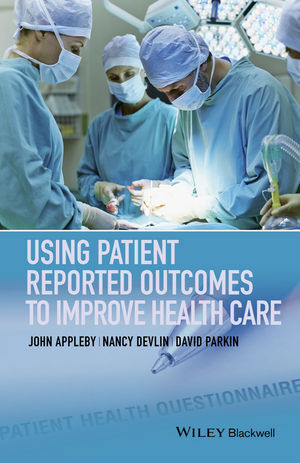
Using Patient Reported Outcomes to Improve Health Care (eBook)
John Wiley & Sons (Verlag)
978-1-118-94858-3 (ISBN)
- Only title to exclusively introduce, explain and show how PROs can be best used to improve healthcare and patient outcomes
- Includes real life examples and case studies of PROs in practice
- Assesses the growing evidence base for PROs in practice
- Editor team from Office of Health Economics (OHE), The King's Fund and King’s College London with contributions from practising clinicians, GPs and other healthcare professionals
Professor John Appleby is chief economist at the King’s Fund. He has worked in the National Health Service in Birmingham and London, and as senior lecturer at the universities of Birmingham and East Anglia. He is a regular contributor to the British Medical Journal on health and economic issues and has acted as an adviser to the UK government and parliament in various capacities. Professor Appleby is also a Visiting Professor at the Department of Economics at City University, London and at the Institute of Global Health Innovation, Imperial College London.
Professor Nancy Devlin’s principal areas of research expertise are the measurement and valuation of patient reported health outcomes; the cost effectiveness thresholds used in making judgments about value for money in health care; priority setting in health care; production, performance and efficiency of hospitals; and the determinants of patient choice. Professor Devlin holds honorary chairs at the Centre for Health Economics, University of York; Cass Business School, London; and in the Economics Department at City University, London. She is the elected Chair of the EuroQol Group, a European-based international network of researchers that developed the EQ-5D.
Professor David Parkin is Professor of Health Economics at King’s College London. He has held academic appointments at the Universities of Manchester, Aberdeen and Newcastle and at City University London, and was formerly Chief Economist at NHS South East Coast. He is co-author of a popular Health Economics textbook Economic Analysis in Health Care (Wiley, 2012), contributor to other health economics books including Econometric Analysis of Health Data (Wiley, 2002) and is author of many published papers. He has been a member of the EuroQol group, the developer and owner of the EQ-5D, since 1998.
A practical, introductory guide to the best use of Patient Reported Outcomes (PROs) to improve the quality of health care and patient health. Only title to exclusively introduce, explain and show how PROs can be best used to improve healthcare and patient outcomes Includes real life examples and case studies of PROs in practice Assesses the growing evidence base for PROs in practice Editor team from Office of Health Economics (OHE), The King's Fund and King s College London with contributions from practising clinicians, GPs and other healthcare professionals
Professor John Appleby is chief economist at the King's Fund. He has worked in the National Health Service in Birmingham and London, and as senior lecturer at the universities of Birmingham and East Anglia. He is a regular contributor to the British Medical Journal on health and economic issues and has acted as an adviser to the UK government and parliament in various capacities. Professor Appleby is also a Visiting Professor at the Department of Economics at City University, London and at the Institute of Global Health Innovation, Imperial College London. Professor Nancy Devlin's principal areas of research expertise are the measurement and valuation of patient reported health outcomes; the cost effectiveness thresholds used in making judgments about value for money in health care; priority setting in health care; production, performance and efficiency of hospitals; and the determinants of patient choice. Professor Devlin holds honorary chairs at the Centre for Health Economics, University of York; Cass Business School, London; and in the Economics Department at City University, London. She is the elected Chair of the EuroQol Group, a European-based international network of researchers that developed the EQ-5D. Professor David Parkin is Professor of Health Economics at King's College London. He has held academic appointments at the Universities of Manchester, Aberdeen and Newcastle and at City University London, and was formerly Chief Economist at NHS South East Coast. He is co-author of a popular Health Economics textbook Economic Analysis in Health Care (Wiley, 2012), contributor to other health economics books including Econometric Analysis of Health Data (Wiley, 2002) and is author of many published papers. He has been a member of the EuroQol group, the developer and owner of the EQ-5D, since 1998.
Foreword, Sir Bruce Keogh, vi
Foreword, An international perspective, Professor Kalipso Chalkidou,vii
Acknowledgements, ix
1 Introduction, 1
2 A primer on patient reported outcomes, 9
3 Patients: information and choice, 27
4 Clinicians: clinical decision making, 41
5 Hospitals: managing clinical quality, 51
6 Commissioners: quality, value for money and fairness, 70
7 Regulation, value for money and productivity, 75
8 Where next for patient reported outcomes?, 88
Appendix 1 PROM questionnaire that is currently completed by patients after undergoing varicose vein surgery, 91
Appendix 2 The EQ-5D-5L, 101
Appendix 3 Dr Tim Hughes' shared decision-making aid for patients, 103
Index, 107
CHAPTER 1
Introduction
The ultimate measure by which to judge the quality of a medical effort is whether it helps patients (and their families) as they see it. Anything done in health care that does not help a patient or family is, by definition, waste, whether or not the professions and their associations traditionally hallow it.
(Berwick, 1997: Reproduced with permission of BMJ Publishing Group Ltd.)
The goal of most health care is to improve patients’ health and there is a strong argument that patients themselves are the people best placed to judge how their state of health affects them. There is a growing recognition throughout the world’s health care systems that the patient’s perspective on health and health care is highly relevant to – and indeed, needs to be at the heart of – efforts to improve the quality and effectiveness of health care.
Information provided by patients about their health does not replace clinical measures of health and illness. But it can provide valuable, complementary information about how health problems and the effects of health care interventions are experienced by patients. These data, carefully collected and appropriately analysed, can provide crucial insights about the patients view on health, and the quality of health care, that would otherwise be missed.
There has been a considerable investment of resources by academics and clinicians, spanning the last three decades, to develop systematic, robust and valid ways of collecting self-reported health data from patients. These efforts have resulted in the availability of Patient Reported Outcomes questionnaires (PROs).
In broad terms, PROs comprise a series of structured questions that ask patients about their health from their point of view. There are now literally thousands of questionnaires available for measuring patient reported outcomes. Carefully collected PRO data from patients are likely to become a key part of how all health care is funded, provided and managed in the future.
PRO questionnaires are already very widely used in clinical trials and observational studies, alongside clinical end-points, and those data are widely recognised as providing a vital part of the evidence required in decisions to approve and make pricing and reimbursement decisions about new health care technologies. Well-established Health Technology Appraisal (HTA) bodies, charged with a responsibility to judge the effectiveness and value for money of new treatments, such as the UK’s National Institute for Health and Care Excellence (NICE), require PRO evidence to be submitted as part of their deliberations (NICE, 2013). In that context, PRO data are often used to estimate the Quality Adjusted Life Years (QALYs)1 gained by patients receiving new therapies.
PROs have also long been included in population health surveys, as a means of measuring population health and morbidity (see Szende et al., 2014) The population norms provided by such surveys help policy makers understand what ‘normal’ health means, from the perspective of people of various socio-demographic backgrounds, in local communities. That provides a baseline for understanding the burden of disease from illnesses, and is used to inform priorities for resource allocation decisions.
However, the use of PROs, until very recently, tended to be limited to one-off studies of general or patient populations. The use of PROs in the real world context of health care delivery settings is relatively new.
The possibility of routinely collecting and using these data alongside the delivery of care was first recognised by the private sector in the UK. Bupa, the UK’s biggest private health insurer and (at that time) owner of a network of private hospital, asked its patients to complete PRO questionnaires before and after a number of elective surgical procedures. The data were used to monitor and benchmark the quality of care by its surgical teams. The routine use of patient reported outcomes was introduced into the English National Health Service (NHS) in 2009. Known as the PROMs (Patient Reported Outcome Measures) programme, it was a landmark development in the use of PROs across an entire whole health care system. The move has attracted considerable interest elsewhere, and other health care systems are now following suit.
The economic context
Health care accounts for a substantial and growing proportion of both overall economic activity and government spending in developed economies. In 2012, for example, total (public and private) spending on health care accounted for 9.3% of the aggregate GDP for the 34 countries comprising the OECD. In the US, around one dollar in six of the entire economy is now devoted to health care. In the Netherlands, around one Euro in eight and in France and Germany, one Euro in ten. Since the 1960s, most OECD countries have seen the proportion of GDP devoted to health care more or less double. Health care also absorbs a significant proportion of government spending – especially in countries such as the UK that have predominantly tax-funded health care systems and where the NHS accounts for nearly a fifth of all government.
But what is produced from health care spending? What value does expenditure on health services generate for patients and for economies? While most other sectors of the economy generate outputs that can readily be measured and valued – quantities of goods and services, and the prices at which they are bought and sold – in contrast, health services have traditionally posed considerable challenges for the measurement of output and productivity (Office of Health Economics, 2008). For example, following the historically unprecedented increases in real spending on the NHS in the years following 2000, commentators reasonably asked: where did the money go? What was achieved by the massive increase in spending?
In stark contrast, the current economic environment in which the English NHS and other health care systems operate has changed dramatically as a result of the financial crisis and recession of 2008–2009 (Appleby et al., 2014). Since that time, the NHS has had to adjust to zero or small real increases in spending (Appleby et al., 2009a), against a backdrop of constantly rising demand. Notwithstanding the changed economic context, the questions remain essentially the same:
- Can we be sure that public spending on health care is justified by the outputs that it produces?
- Are scarce public sector resources being used in a way that maximises their value to patients and society?
- How do different sorts of health care services, that we could spend our money on, compare in terms of their effectiveness and value for money in improving patient health?
- How do different providers of health care compare in terms of their performance in improving patient health?
Special issues with measuring and valuing health
Assessing the output and productivity of health care poses special problems. Health care services or products themselves are easy to record and count: the number of hospital admissions, doctors’ visits, surgical procedures undertaken, tooth cavities filled, prescriptions issued, and so on. But these cannot simply be added up to give an indication of what is produced overall. More importantly, they are intermediate outputs. Most health services are not valued in their own right, but rather because of the effects they have on something much more fundamental: health. Health is the true final output of health care.
Yet efforts to measure the health produced by health care systems such as the English NHS have been fairly rudimentary. Traditional measures have tended to focus on the prevalence of adverse outcomes, such as post-surgical mortality, hospital-acquired infections and readmission rates. It is, of course, important to know about these bad things, and they do need to be minimised. But such incidents are also relatively rare and shed little light on the great majority of health service interventions for most patients.
As a basis for assessing the value of the vast resources devoted to health care in the world’s health care systems, however, these measures are hopelessly inadequate.
The purpose of a health care system is not just to minimise the harm caused by its activity, but also (and arguably, principally) to produce health and social benefits for patients and society. Despite a century of developments in medical technology, and vast improvements in the ability of medical science to prevent, diagnose and treat disease and ill health, attempts to measure the outputs of health care in terms of their impact on patients’ health have barely progressed beyond Florence Nightingale’s time. More than 100 years ago, she suggested a simple three-point health-related outcome measure for her patients: relieved; unrelieved; and dead (Appleby and Devlin, 2004).
Clinicians have, of course developed measures to guide and inform their clinical practice. These provide important and relevant information about the impact of health care interventions on clinically defined variables, but, while useful, they typically fail to inform wider questions crucial to measuring the overall output and quality of health care services.
Moreover, the many different clinical indicators used in medical practice do not always distinguish the aspects of health that patients consider important, or their relative value to patients. The observation that ‘the operation was a success, but the patient died’ might...
| Erscheint lt. Verlag | 1.12.2015 |
|---|---|
| Sprache | englisch |
| Themenwelt | Medizin / Pharmazie ► Allgemeines / Lexika |
| Medizin / Pharmazie ► Gesundheitswesen | |
| Medizin / Pharmazie ► Medizinische Fachgebiete | |
| Medizin / Pharmazie ► Pflege | |
| Studium ► Querschnittsbereiche ► Prävention / Gesundheitsförderung | |
| Technik ► Medizintechnik | |
| Schlagworte | Evidence-based Health Care • Evidenzbasierte Forschung im Gesundheitswesen • Gesundheitspolitik • Gesundheitspolitik, Risiken, Sicherheit des Patienten • Gesundheitswesen • Health Policy, Health Risk & Patient Safety • <p>John Appleby</p> <p>Nancy Devlin</p> <p>David Parkin</p> <p>Kalipso Chalkidou</p> <p>Bruce Keogh</p> <p>Patient reported outcomes</p> <p>PROs</p> <p>PROMs</p> <p>Patient</p> <p>Shared decision-making</p> <p>Care</p> <p>Health care</p> <p>Hospital</p> <p>Information</p> <p>Clinical decision making</p> <p>Clinical quality</p> <p>Commissioners</p> <p>Commissioning</p> <p>Regulation</p> <p>Value for money</p> • Medical Professional Development • Medical Science • Medizin • Perspektiven in medizinischen Berufen |
| ISBN-10 | 1-118-94858-0 / 1118948580 |
| ISBN-13 | 978-1-118-94858-3 / 9781118948583 |
| Informationen gemäß Produktsicherheitsverordnung (GPSR) | |
| Haben Sie eine Frage zum Produkt? |
 EPUB (Adobe DRM)
Kopierschutz: Adobe-DRM
Adobe-DRM ist ein Kopierschutz, der das eBook vor Mißbrauch schützen soll. Dabei wird das eBook bereits beim Download auf Ihre persönliche Adobe-ID autorisiert. Lesen können Sie das eBook dann nur auf den Geräten, welche ebenfalls auf Ihre Adobe-ID registriert sind.
Details zum Adobe-DRM
Dateiformat: EPUB (Electronic Publication)
EPUB ist ein offener Standard für eBooks und eignet sich besonders zur Darstellung von Belletristik und Sachbüchern. Der Fließtext wird dynamisch an die Display- und Schriftgröße angepasst. Auch für mobile Lesegeräte ist EPUB daher gut geeignet.
Systemvoraussetzungen:
PC/Mac: Mit einem PC oder Mac können Sie dieses eBook lesen. Sie benötigen eine
eReader: Dieses eBook kann mit (fast) allen eBook-Readern gelesen werden. Mit dem amazon-Kindle ist es aber nicht kompatibel.
Smartphone/Tablet: Egal ob Apple oder Android, dieses eBook können Sie lesen. Sie benötigen eine
Geräteliste und zusätzliche Hinweise
Buying eBooks from abroad
For tax law reasons we can sell eBooks just within Germany and Switzerland. Regrettably we cannot fulfill eBook-orders from other countries.
aus dem Bereich