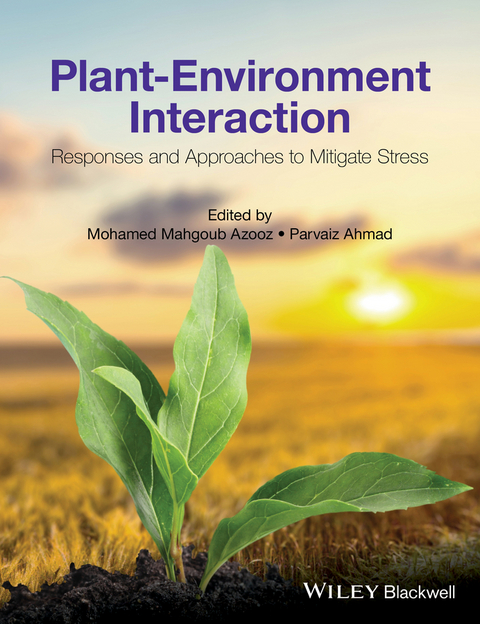
Plant-Environment Interaction (eBook)
John Wiley & Sons (Verlag)
978-1-119-08102-9 (ISBN)
The increase in global population, urbanization and industrialization is resulting in the conversion of cultivated land into wasteland. Providing food from these limited resources to an ever-increasing population is one of the biggest challenges that present agriculturalists and plant scientists are facing. Environmental stresses make this situation even graver. Plants on which mankind is directly or indirectly dependent exhibit various mechanisms for their survival. Adaptability of the plants to changing environment is a matter of concern for plant biologists trying to reach the goal of food security. Despite the induction of several tolerance mechanisms, sensitive plants often fail to withstand these environmental extremes. Using new technological approaches has become essential and imperative.
Plant-Environment Interaction: Responses and Approaches to Mitigate Stress throws light on the changing environment and the sustainability of plants under these conditions. It contains the most up-to-date research and comprehensive detailed discussions in plant physiology, climate change, agronomy and forestry, sometimes from a molecular point of view, to convey in-depth understanding of the effects of environmental stress in plants, their responses to the environment, how to mitigate the negative effects and improve yield under stress.
This edited volume is written by expert plant biologists from around the world, providing invaluable knowledge to graduate and undergraduate students in plant biochemistry, food chemistry, plant physiology, molecular biology, plant biotechnology, and environmental sciences. This book updates scientists and researchers with the very latest information and sustainable methods used for stress tolerance, which will also be of considerable interest to plant based companies and institutions concerned with the campaign of food security.
Professor Mohamed Mahgoub Azooz, Department of Botany, Faculty of Science, South Valley University, Quena, Egypt
Dr Parvaiz Ahmad. Department of Botany, S.P. College, Jammu and Kashmir, India
Professor Mohamed Mahgoub Azooz, Department of Botany, Faculty of Science, South Valley University, Quena, Egypt Dr Parvaiz Ahmad. Department of Botany, S.P. College, Jammu and Kashmir, India
List of contributors, vii
Preface, x
About the editors, xii
1 Biotechnological applications to improve salinity stress in wheat, 1
Sami ullah Jan, Ghulam Kubra, Mehreen Naz, Ifrah Shafqat, Muhammad Asif Shahzad, Fakiha Afzal and
Alvina Gul Kazi
2 Soybean under abiotic stress: Proteomic approach, 28
Arafat Abdel Hamed Abdel Latef, Sumaira Jan, Elsayed Fathi Abd?-Allah, Bushra Rashid, Riffat John and Parvaiz Ahmad
3 Proteomic analysis of food crops under abiotic stresses in the context of climate change, 43
P. S. Sha Valli Khan, P. Osman Basha, G. Vijaya Lakshmi, M. Muniraja, K. Sergeant and J. F. Hausman
4 Transcriptome modulation in rice under abiotic stress, 70
Smita Kumar and Prabodh Kumar Trivedi
5 Sulphur: Role in alleviation of environmental stress in crop plants, 84
Dagmar Prochazkova, Daniela Pavlikova and Milan Pavlik
6 Proline and glycine betaine modulate cadmium?]induced oxidative stress tolerance in plants: Possible biochemical and molecular mechanisms, 97
Mohammad Anwar Hossain, David J. Burritt and Masayuki Fujita
7 Enhancement of vegetables and fruits growth and yield by application of brassinosteroids under abiotic
stresses: A review, 124
Bojjam Vidya Vardhini
8 Physiological mechanisms of salt stress tolerance in plants: An overview, 141
Hadi Pirasteh?-Anosheh, Gholamhassan Ranjbar, Hassan Pakniyat and Yahya Emam
9 Heat stress in wheat and interdisciplinary approaches for yield maximization, 161
Sajjad Hussain, Muhammad Jamil, Abdul Aziz Napar, Rida Rahman, Asghari Bano, Fakiha Afzal, Alvina Gul
Kazi and Abdul Mujeeb?-Kazi
10 Effect of elevated CO2 and temperature stress on cereal crops, 184
Ashutosh Tripathi, Devendra Kumar Chauhan, Gopal S. Singh and Niraj Kumar
11 Lipid metabolism and oxidation in plants subjected to abiotic stresses, 205
Adriano Sofo, Antonio Scopa, Abeer Hashem and Elsayed Fathi Abd?-Allah
12 Physiological response of mycorrhizal symbiosis to soil pollutants, 214
Mercedes Garcia?-Sanchez, I. Garcia?-Romera, J. A. Ocampo and E. Aranda
13 Microbially derived phytohormones in plant adaptation against abiotic stress, 234
Dilfuza Egamberdieva
14 Synergistic interactions among root?]associated bacteria, rhizobia and chickpea under stress
conditions, 250
Dilfuza Egamberdieva, Anvar Abdiev and Botir Khaitov
15 Plant secondary metabolites: From molecular biology to health products, 263
L. F. De Filippis
16 Medicinal plants under abiotic stress: An overview, 300
Sameen Ruqia Imadi, Alvina Gul Kazi, Abeer Hashem, Elsayed Fathi Abd?]Allah, A. A. Alqarawi and Parvaiz Ahmad
17 Signalling roles of methylglyoxal and the involvement of the glyoxalase system in plant abiotic stress responses and tolerance, 311
Tahsina Sharmin Hoque, Mohammad Anwar Hossain, Mohammad Golam Mostofa, David J. Burritt and
Masayuki Fujita
18 Role of sedges (Cyperaceae) in wetlands, environmental cleaning and as food material: Possibilities and future perspectives, 327
Sanjay Mishra, Ashutosh Tripathi, Durgesh Kumar Tripathi and Devendra Kumar Chauhan
Index, 339
CHAPTER 1
Biotechnological applications to improve salinity stress in wheat
Sami ullah Jan1, Ghulam Kubra1, Mehreen Naz2, Ifrah Shafqat2, Muhammad Asif Shahzad1, Fakiha Afzal1 and Alvina Gul Kazi1
1 Atta-ur-Rahman School of Applied Biosciences (ASAB), National University of Sciences and Technology (NUST), Islamabad, Pakistan
2 Department of Bioinformatics and Biotechnology, International Islamic University, Islamabad, Pakistan
1.1 Introduction
For food, humans rely on approximately 275 crops (Tilman et al., 2011). Out of these, three crops, wheat, maize and rice, are significant cereal crops that contribute to major dietary requirements as staple foods for humans – a reason why they are collectively termed the ‘big three cereal crops' (Shewry, 2009). Comparatively, wheat is the most important cereal crop that contributes a major portion of the daily diet for humans (Slade et al., 2012). It is estimated that wheat is a source for one-fifth of total calories utilized by humans globally (Waines & Ehdaie, 2007). Wheat grains contain vital constituents such as carbohydrates, including 60–70% starch (Slade et al., 2012) and 8–15% protein such as glutenin (Shewry et al., 1995) and gliadin (D’Ovidio & Masci, 2004). From the total wheat grain produced globally, 65% is utilized as food by humans while the remaining 35% is distributed among livestock feed (21%), seed material (8%) and raw material (6%) in industries such as the production of vitamins and antibiotics, manufacturing of paper; it is also used as a fermentation substrate or as adhesives in various products (Shewry & Jones, 2005).
1.1.1 History of wheat: from domestication to revolutions
In ancient times, wheat was a product of the activities of hunter-gatherers but about 10,000 years ago, the Neolithic Revolution laid the basis for domestication of various crops (Waines & Ehdaie, 2007). This domestication process focused mainly upon cereal crops, and wheat is considered the originator of domesticated crops (Peleg et al., 2011). With the passing of time, problems arising in the domestication process compelled scientists to analyse and study various concerns such as local conditions, yield maximization, development of improved cultivars and storage techniques (Cavanagh et al., 2013). Eventually, these findings resulted in major events such as the Agricultural Revolution in the 19th century (Godfray et al., 2010) and the Green Revolution in the 20th century (Waines & Ehdaie, 2007).
Wheat domestication followed by major revolutions and scientific achievements contributed to speciation and initiation of new varieties (Shewry, 2009). The factors involved in such speciation primarily include adaptations to the ecology of an area as soon as wild-type wheat cultivars were moved for domestication purposes (Chaudhary, 2013). These adaptations under the influence of epigenetics offered the opportunity to select the desired traits in wheat such as yield, grain quality, grain size and many other phenotypic attributes (Burger et al., 2008). Thus, wheat evolved into many varieties in response to human cultivation practices, selection procedures and the phenomena of epigenetics (Fuller, 2007).
Since the Green Revolution, technologies have been incorporated into crop improvement practices, specifically wheat, in various ways (Schmidhuber & Tubiello, 2007). These include successful development of hybrids with enhanced desired traits, development of pathogen-resistant plants, enhanced yield, improved nutrient contents, affordable fertilizer requirements and improved irrigation systems (Godfray et al., 2010). The consequences of all aspects of the Green Revolution increased yield to fulfil the world’s food requirements (Tilman et al., 2011).
1.1.2 Wheat genome
Modern wheat includes six sets of genomes, called hexaploidy, and is a result of domestication and scientific processes practised by man. Polyploid genomes of wheat cultivars evolved after crossing or hybridization, selection procedures and cultivation practices in domestication. The wild wheat ancestor Triticum turgidum sp. dicoccoides is considered as the first domesticated wheat species in the Near East region (Maier, 1996). This wheat species was spread across Europe and gave rise to new varieties like Triticum turgidum sp. dicoccum and Triticum turgidum sp. durum (Buckler et al., 2001). Durum wheat is still widely grown in the Near East crescent around the Mediterranean Sea (Thuillet et al., 2005).
In reference to common bread wheat, this is an allopolyploid consisting of three genomes designated as A, B and D originating from wild wheat grasses of the genera Triticum and Aegilops (Zohary et al., 1969). Modern wheat is hexaploid, existing in three sets, A-Genome, B-Genome and D-Genome. The ancestor of A-genome wheat Triticum urartu contained 14 chromosomes in two sets, and was crossed with Aegilops speltoides (B-genome) that resulted in a hybrid which contained both genomes (AB) which after doubling yielded a viable tetraploid containing 28 chromosomes (AABB). This hybrid, known as wild emmer (Chen et al., 2013), upon further crossing with Aegilops squarrosa (a diploid grass), produced a new hybrid with 21 chromosomes (42 chromosomes in diploid form). The later hybrid produced is the hexaploid wheat utilized today and contains genomes from three ancestors (AABBDD) (Levy & Feldman, 2002).
1.1.3 Wheat production and concerns
During the past 50 years, research and technological applications in the cultivation of wheat have increased its yield to a rate of 41 kg per hectare (Ewert et al., 2005). But the world’s population is increasing all the time (Godfray et al., 2010). If this continues, by the mid-century, the world’s population is estimated to be 9–10 billion (DeLong et al., 2010). Simultaneously, demands for more food and energy resources will also be raised such that, by the middle of the century, necessary food production will be double that of the present (Ray et al., 2013). Numerically, the required rate of increase in food production by the year 2050 is 100–110% compared to the current rate of production (Tilman et al., 2001). About 600 million metric tons of wheat is produced per year worldwide but with the increment in population, by 2020 we would require an estimated yield of 1 billion metric tons (Shewry, 2009). In 2005, calculated yield per hectare of wheat was 2.5 tons which was forecasted to reach a figure of 4.0 t/ha by 2020 (Rajaram, 2005).
Despite these important facts, only 3 billion hectares of land out of 13.4 billion hectares is available for crop cultivation (Smith et al., 2010). One solution to overcoming the world’s food requirements is to turn more land over to arable in order to increase wheat global production (Gregory et al., 2002). It has been estimated that by utilizing only 20% of untilled land, we could increase crop yields up to 67% (Bruinsma, 2003). In 2007, total yield of cereal crop was 3.23 tons per hectare which could be increased to 4.34 tons per hectare by increasing land under cultivation to 25% (Bruinsma, 2009). The actual figure for per capita arable land is continuously decreasing due to industrialization, housing and deforestation as well as some environmental concerns (Gregory & George, 2011). However, environmental concerns are among the major problems that cause the loss of yield such that only 50–80% yields are achieved (Lobell et al., 2009). Various scientific communities contribute to minimize the gap between actual and potential yields (Jaggard et al., 2010) but the problems remain the same and the environmental concerns are important, such as abiotic (salinity, drought, temperature) and biotic stresses (Atkinson & Urwin, 2012).
1.2 Salinity stress is a striking environmental threat to plants
Agricultural production all over the world is constrained by salinity stress and it is becoming a growing universal issue that affects almost 20% of cultivated land globally (Flowers & Yeo, 1995). From the agricultural point of view, salinity is the aggregation of dissolved salts within soil or agricultural water to an extent which adversely affects plant growth (Gorham, 1992). High salinity influences the physiological mechanism that adversely affects plant growth and development which necessitates detailed investigation of tolerance mechanisms in salinity (Abogadallah, 2010).
Salinity-induced stress increases the accumulation of salts in plant roots (Zhang et al., 2014). Such hyperaccumulation of salts in roots restricts water absorption from the soil surface and thus also causes water stress, in spite of available water at the root zone. Water absorption from saline soils requires extra energy expenditure. Thus, higher salinity will always lead to decreased levels of water as well as inducing analogous stresses like water and osmotic stress (Bauder & Brock, 1992).
1.2.1 Statistics of salinity stress-affected land
Saline soils are widespread in arid and semiarid regions, especially in areas where heavy irrigation or overfertilization is common (Reynolds et al., 2005). It is estimated that 800–930 million...
| Erscheint lt. Verlag | 30.11.2015 |
|---|---|
| Sprache | englisch |
| Themenwelt | Naturwissenschaften ► Biologie ► Botanik |
| Naturwissenschaften ► Biologie ► Ökologie / Naturschutz | |
| Technik | |
| Weitere Fachgebiete ► Land- / Forstwirtschaft / Fischerei | |
| Schlagworte | Agriculture • Agriculture & Ecology • Biowissenschaften • Botanik • Botanik / Physiologie • Landwirtschaft • Landwirtschaft u. Ãkologie • Landwirtschaft u. Ökologie • Life Sciences • Pflanzenstress • Plant Physiology • stress tolerance, plant adaptation, climate change, abiotic stress, Proteomic Approach, Microbial phytohormones, Medicinal Plants, Bioprotection effect, crassulacean acid metabolism, sulfur, Osmolytes, Reactive oxygen species, Antioxidants, Proteomics, Phytohormones, Lipid metabolism, Methylglyoxal signaling |
| ISBN-10 | 1-119-08102-5 / 1119081025 |
| ISBN-13 | 978-1-119-08102-9 / 9781119081029 |
| Informationen gemäß Produktsicherheitsverordnung (GPSR) | |
| Haben Sie eine Frage zum Produkt? |
 EPUB (Adobe DRM)
Kopierschutz: Adobe-DRM
Adobe-DRM ist ein Kopierschutz, der das eBook vor Mißbrauch schützen soll. Dabei wird das eBook bereits beim Download auf Ihre persönliche Adobe-ID autorisiert. Lesen können Sie das eBook dann nur auf den Geräten, welche ebenfalls auf Ihre Adobe-ID registriert sind.
Details zum Adobe-DRM
Dateiformat: EPUB (Electronic Publication)
EPUB ist ein offener Standard für eBooks und eignet sich besonders zur Darstellung von Belletristik und Sachbüchern. Der Fließtext wird dynamisch an die Display- und Schriftgröße angepasst. Auch für mobile Lesegeräte ist EPUB daher gut geeignet.
Systemvoraussetzungen:
PC/Mac: Mit einem PC oder Mac können Sie dieses eBook lesen. Sie benötigen eine
eReader: Dieses eBook kann mit (fast) allen eBook-Readern gelesen werden. Mit dem amazon-Kindle ist es aber nicht kompatibel.
Smartphone/Tablet: Egal ob Apple oder Android, dieses eBook können Sie lesen. Sie benötigen eine
Geräteliste und zusätzliche Hinweise
Buying eBooks from abroad
For tax law reasons we can sell eBooks just within Germany and Switzerland. Regrettably we cannot fulfill eBook-orders from other countries.
aus dem Bereich