Smart Cities (eBook)
John Wiley & Sons (Verlag)
978-1-119-07562-2 (ISBN)
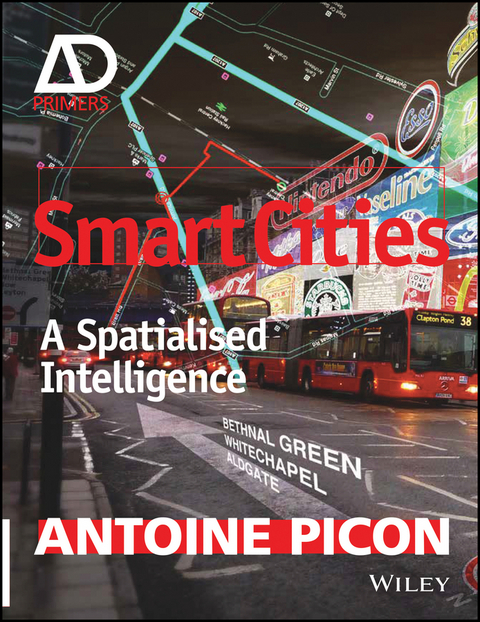
As cities compete globally, the Smart City has been touted as the important new strategic driver for regeneration and growth. Smart Cities are employing information and communication technologies in the quest for sustainable economic development and the fostering of new forms of collective life. This has made the Smart City an essential focus for engineers, architects, urban designers, urban planners, and politicians, as well as businesses such as CISCO, IBM and Siemens. Despite its broad appeal, few comprehensive books have been devoted to the subject so far, and even fewer have tried to relate it to cultural issues and to assume a truly critical stance by trying to decipher its consequences on urban space and experience. This cultural and critical lens is all the more important as the Smart City is as much an ideal permeated by Utopian beliefs as a concrete process of urban transformation. This ideal possesses a strong self-fulfilling character: our cities will become 'Smart' because we want them to.
This book opens with an examination of the technological reality on which Smart Cities are built, from the chips and sensors that enable us to monitor what happens within the infrastructure to the smartphones that connect individuals. Through these technologies, the urban space appears as activated, almost sentient. This activation generates two contrasting visions: on the one hand, a neo-cybernetic ambition to steer the city in the most efficient way; and on the other, a more bottom-up, participative approach in which empowered individuals invent new modes of cooperation. A thorough analysis of these two trends reveals them to be complementary. The Smart City of the near future will result from their mutual adjustment. In this process, urban space plays a decisive role. Smart Cities are contemporary with a 'spatial turn' of the digital. Based on key technological developments like geo-localisation and augmented reality, the rising importance of space explains the strategic role of mapping in the evolution of the urban experience. Throughout this exploration of some of the key dimensions of the Smart City, this book constantly moves from the technological to the spatial as well as from a critical assessment of existing experiments to speculations on the rise of a new form of collective intelligence. In the future, cities will become smarter in a much more literal way than what is often currently assumed.
Antoine Picon is the G Ware Travelstead Professor of the History of Architecture and Technology at Harvard Graduate School of Design. He is also researcher at the ?cole Nationale des Ponts et Chauss?es and President of the Fondation Le Corbusier. His current research focuses on contemporary issues around digital culture, architecture and the city.
As cities compete globally, the Smart City has been touted as the important new strategic driver for regeneration and growth. Smart Cities are employing information and communication technologies in the quest for sustainable economic development and the fostering of new forms of collective life. This has made the Smart City an essential focus for engineers, architects, urban designers, urban planners, and politicians, as well as businesses such as CISCO, IBM and Siemens. Despite its broad appeal, few comprehensive books have been devoted to the subject so far, and even fewer have tried to relate it to cultural issues and to assume a truly critical stance by trying to decipher its consequences on urban space and experience. This cultural and critical lens is all the more important as the Smart City is as much an ideal permeated by Utopian beliefs as a concrete process of urban transformation. This ideal possesses a strong self-fulfilling character: our cities will become 'Smart' because we want them to. This book opens with an examination of the technological reality on which Smart Cities are built, from the chips and sensors that enable us to monitor what happens within the infrastructure to the smartphones that connect individuals. Through these technologies, the urban space appears as activated, almost sentient. This activation generates two contrasting visions: on the one hand, a neo-cybernetic ambition to steer the city in the most efficient way; and on the other, a more bottom-up, participative approach in which empowered individuals invent new modes of cooperation. A thorough analysis of these two trends reveals them to be complementary. The Smart City of the near future will result from their mutual adjustment. In this process, urban space plays a decisive role. Smart Cities are contemporary with a 'spatial turn' of the digital. Based on key technological developments like geo-localisation and augmented reality, the rising importance of space explains the strategic role of mapping in the evolution of the urban experience. Throughout this exploration of some of the key dimensions of the Smart City, this book constantly moves from the technological to the spatial as well as from a critical assessment of existing experiments to speculations on the rise of a new form of collective intelligence. In the future, cities will become smarter in a much more literal way than what is often currently assumed.
Antoine Picon is the G Ware Travelstead Professor of the History of Architecture and Technology at Harvard Graduate School of Design. He is also researcher at the ?cole Nationale des Ponts et Chauss?es and President of the Fondation Le Corbusier. His current research focuses on contemporary issues around digital culture, architecture and the city.
Acknowledgements 005
Introduction: A New Urban Ideal 009
Spatialised Intelligence 011
Technology, Space and Politics 015
Chapter 1: The Advent of the Smart City, from Flow Management to Event Control 023
Defining the Smart City 024
Self-Fulfilling Fictions 030
The Sentient and Sensory City 037
Massive Quantities of Data 046
What Happens 052
Chapter 2: A Tale of Two Cities 067
Neocybernetic Temptation 069
The Cyborg-City Hypothesis 078
Spontaneous City, Collaborative City 083
The Digital Individual 091
Chapter 3: Urban Intelligence, Space and Maps 105
Augmented Reality and Geolocation 106
Towards Three-Dimensional Urbanism 110
A New Relationship to Infrastructure 119
The Stakes of Representation 124
A New Aesthetic 138
Laboratories of Public Life in the Digital Age 140
Conclusion: The Challenges of Intelligence 145
The Limits of All-Digital Solutions 146
The Necessary Diversification of Scenarios 149
Public/Private 153
From Event to History 154
Bibliography 158
Index 162
Picture Credits 167
IBM, infographic on ‘building a smarter city and state’, 2013
IBM has played an important role in the rise of the smart city ideal. This infographic was released to illustrate a series of projects launched in partnership with the city of Boston and the state of Massachusetts. It features some key elements of the smart city approach such as a better management of urban infrastructure and the quest for greater environmental efficiency.
Introduction A New Urban Ideal
Our cities are on the verge of a radical transformation, a revolution in intelligence comparable in scale to the one that, in its time, brought about industrialisation. The smart city, driven by digital technology, is poised to replace the typical networked city of the industrial era, whose success was built on its hard infrastructure, from roads to water supply and sanitation systems, not only as a technological optimum but also as a social and political project. This conviction is shared by many. Coined initially around 2005 to characterise a series of new urban uses of information and communications technology, the expression 'smart city' has spread everywhere, in both mass media and specialist literature, and in the discourse of businesses such as IBM and Cisco as well as out of the mouths of politicians. A new urban ideal is born; and this book is dedicated to it.
This ideal's increasing power has not prevented the existence of major ambiguities concerning the exact nature of the changes that are afoot. In the following pages, the different definitions of the smart city that are circulating today will be examined. It is worth noting immediately that they are almost all situated between two extremes: on one side, a limited meaning with an emphasis on optimisation of the city's functional aspects, and in particular of its infrastructure, through primarily digital tools; and on the other, a much broader vision that embraces not only the efficient management of facilities and services, but also the promotion of production and the exchange of knowledge - better quality of life through living more intelligently.
Aerial view of the Smart City Campus project, Barcelona, Spain, 2014
The smart city ideal represents an important component of the urban strategy of Barcelona. It entails the revitalisation of a former industrial area through the creation of a campus bringing together businesses, universities and other players involved in urban technology and innovation.
Beneath their apparent diversity, and despite the aforementioned opposition, the approaches to the smart city converge on several points. The first concerns the highly strategic character of information and communications technology, which is supposed to improve everyday city management at the same time as helping to make it more economical in terms of materials and energy - in a word, more ecological. On that subject, the need for sustainable development constitutes another point of convergence. Is it possible to speak of smart cities if urban zones continue, as they do today, to contribute to environmental degradation? There is likewise universal agreement on the importance of human factors. Whatever definition of the smart city one prefers, the phenomenon calls for new types of both individual and collective behaviour. Without people who are capable of modelling their conduct on the information that they supply, the sensors, microchips and display screens of the smart city would have only a limited impact. Contrary to the arguments of its less informed detractors, the looming new urban revolution cannot be reduced, even in its narrowest sense, to a mere plan to equip the city with digital tools. It is inherently linked to questions of anthropology, sociology and, ultimately, politics.
As if echoing the opposition between the managerial vision and the broader interpretation of the notion of the smart city, two types of political projects are emerging today. The first focuses on controlling the urban organism, in an outlook not dissimilar to cybernetic research of the period from 1950 to 1970 into the running of complex systems. Such an orientation carries risks of technocratic drifting, and it is this that the other major project type which features in debate today - cities that call more upon the initiative of and cooperation between individuals than on coordination driven from above - seeks to prevent. Neocybernetic inspiration with technocratic overtones, or new perspectives of democratisation linked to the spread of information and communications technology? In the following chapters, this tension will be studied in more detail, and then overcome; because it is possible, under certain conditions that will be outlined, to envisage both of these orientations mutually supporting one another instead of being in conflict. When it has reached maturity, the smart city will be characterised by improved control of some of its key aspects, such as the functioning of its infrastructure, and by an increase in the creative potential of the human individuals and groups that inhabit it.
Looking at smartphones, Kivus, Democratic Republic of Congo, 2012
From highly industrialised to developing countries, smart cities are fundamentally about people. This explains the essential role played by mobile phones and particularly by smartphones in their rise.
Spatialised Intelligence
Among the current proliferation of attempts at theorising, this book possesses two major points of originality. Firstly, it proposes taking the expression 'smart city' much more literally than is usually the case. Rather than conceiving of a city whose circuits of information and communications are simply sprawled out and whose intelligence continues to reside exclusively within the men and women who communicate through them, why not imagine the progressive development of non-human forms of reasoning and even of consciousness? At the final stage of such development, the seeds of which have already been sown in current research on algorithms, artificial intelligence, robotisation and cyborg-type assemblies between biological organisms and machines, the entire city could be considered intelligent in a new way, founded on the interaction and composition of the perceptions and deliberations of multiple entities: human, non-human and often a mixture of the two. At the heart of this greater, composite intelligence, which would at last make the famous 'general will' on which Jean-Jacques Rousseau based his Of the Social Contract, or Principles of Political Right (1762) more tangible, these entities would appear both as partially autonomous stakeholders and as subsystems constituting the city's general intelligence.1
Human and iCub robot, Institut des Systèmes Intelligents et de Robotique (ISIR), Université de Paris VI, 2013
The iCub has been designed to act like a baby. Its purpose is to explore how human cognition develops by learning in the same way a child would. The research is typical of the rapid progress being made in robotics and artificial intelligence.
For those who prefer Leibniz to Rousseau, it is also possible to consider them as sorts of monads: specific viewpoints on a whole, the city, which contains them all and which each of them contains in its entirety.2
Is this all science fiction? Of course; but, without falling into the mystique of technological progress definitively replacing human intelligence with that of machines - the 'singularity' that is tirelessly proclaimed by Ray Kurzweil, one of the main prophets of the 'post-human' condition - it is hard not to be struck by the rapidly progressing capacities of perception and reasoning displayed by the machines and systems around us.3 Is the smart city science fiction? Undoubtedly so; but, as we will see, the accounts that are written about it have a highly self-fulfilling character: that is, they generate the conditions that make them feasible, in the same way as some political or economic forecasts influence voting dynamics or market behaviour by causing them to lean in the direction that makes them possible.
This intelligence should not be considered as a capacity residing principally in central processing units and the memory of specialist servers, in the manner of the supercomputer HAL 9000 portrayed by Stanley Kubrick in 2001: A Space Odyssey (1968). On the contrary, it should be envisaged as being distributed right across the city, present in the sensors and chips with which the infrastructure, streets and buildings are fitted, as well as in the numerous electronic devices belonging to its inhabitants. The smart city is a city activated at millions of points, thanks to information and communications technology. Since it is spread out, and since it follows the topography of the networks of streets and buildings as well as the movement of vehicles and of its inhabitants, producing a map of urban activity in real time, its intelligence is profoundly spatial.
The attention paid to this spatial dimension constitutes a second specificity of this book's approach. This may appear paradoxical, since the development of information technology has long been associated with a sort of annihilation of space. In the mid-19th century, when Samuel Morse developed his telegraph system, his contemporaries celebrated what they saw as the definitive victory of intelligence over...
| Erscheint lt. Verlag | 30.11.2015 |
|---|---|
| Reihe/Serie | Architectural Design Primer |
| Architectural Design Primer | Architectural Design Primer |
| Sprache | englisch |
| Themenwelt | Technik ► Architektur |
| Schlagworte | Architecture • Architektur • City • Collaborative • Control • Event • flow management • Ideal • individual chapter urban • Intelligence • intelligence technology • MASSIVE • new urban • quantities • Relationship • selffulfilling • Smart • Smart City • spatialised • Stadtentwicklung • Stakes • towards • Urban Development |
| ISBN-10 | 1-119-07562-9 / 1119075629 |
| ISBN-13 | 978-1-119-07562-2 / 9781119075622 |
| Informationen gemäß Produktsicherheitsverordnung (GPSR) | |
| Haben Sie eine Frage zum Produkt? |
 EPUB (Adobe DRM)
Kopierschutz: Adobe-DRM
Adobe-DRM ist ein Kopierschutz, der das eBook vor Mißbrauch schützen soll. Dabei wird das eBook bereits beim Download auf Ihre persönliche Adobe-ID autorisiert. Lesen können Sie das eBook dann nur auf den Geräten, welche ebenfalls auf Ihre Adobe-ID registriert sind.
Details zum Adobe-DRM
Dateiformat: EPUB (Electronic Publication)
EPUB ist ein offener Standard für eBooks und eignet sich besonders zur Darstellung von Belletristik und Sachbüchern. Der Fließtext wird dynamisch an die Display- und Schriftgröße angepasst. Auch für mobile Lesegeräte ist EPUB daher gut geeignet.
Systemvoraussetzungen:
PC/Mac: Mit einem PC oder Mac können Sie dieses eBook lesen. Sie benötigen eine
eReader: Dieses eBook kann mit (fast) allen eBook-Readern gelesen werden. Mit dem amazon-Kindle ist es aber nicht kompatibel.
Smartphone/Tablet: Egal ob Apple oder Android, dieses eBook können Sie lesen. Sie benötigen eine
Geräteliste und zusätzliche Hinweise
Buying eBooks from abroad
For tax law reasons we can sell eBooks just within Germany and Switzerland. Regrettably we cannot fulfill eBook-orders from other countries.
aus dem Bereich