Extreme Events (eBook)
John Wiley & Sons (Verlag)
978-1-119-15703-8 (ISBN)
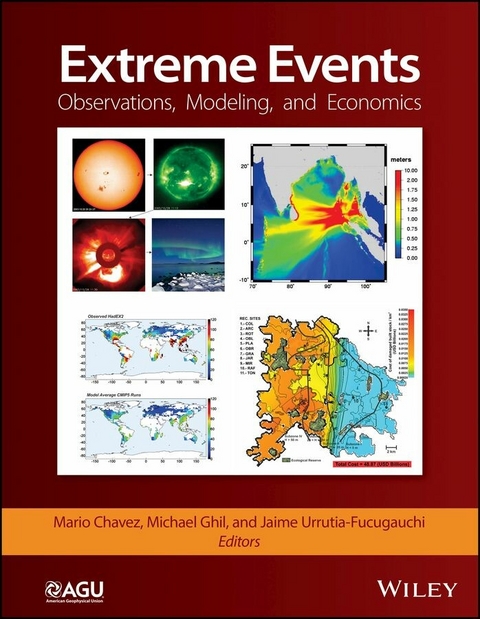
The monograph covers the fundamentals and the consequences of extreme geophysical phenomena like asteroid impacts, climatic change, earthquakes, tsunamis, hurricanes, landslides, volcanic eruptions, flooding, and space weather. This monograph also addresses their associated, local and worldwide socio-economic impacts. The understanding and modeling of these phenomena is critical to the development of timely worldwide strategies for the prediction of natural and anthropogenic extreme events, in order to mitigate their adverse consequences.
This monograph is unique in as much as it is dedicated to recent theoretical, numerical and empirical developments that aim to improve:
(i) the understanding, modeling and prediction of extreme events in the geosciences, and, (ii) the quantitative evaluation of their economic consequences. The emphasis is on coupled, integrative assessment of the physical phenomena and their socio-economic impacts.
With its overarching theme, Extreme Events: Observations, Modeling and Economics will be relevant to and become an important tool for researchers and practitioners in the fields of hazard and risk analysis in general, as well as to those with a special interest in climate change, atmospheric and oceanic sciences, seismo-tectonics, hydrology, and space weather.
The monograph covers the fundamentals and the consequences of extreme geophysical phenomena like asteroid impacts, climatic change, earthquakes, tsunamis, hurricanes, landslides, volcanic eruptions, flooding, and space weather. This monograph also addresses their associated, local and worldwide socio-economic impacts. The understanding and modeling of these phenomena is critical to the development of timely worldwide strategies for the prediction of natural and anthropogenic extreme events, in order to mitigate their adverse consequences. This monograph is unique in as much as it is dedicated to recent theoretical, numerical and empirical developments that aim to improve: (i) the understanding, modeling and prediction of extreme events in the geosciences, and, (ii) the quantitative evaluation of their economic consequences. The emphasis is on coupled, integrative assessment of the physical phenomena and their socio-economic impacts. With its overarching theme, Extreme Events: Observations, Modeling and Economics will be relevant to and become an important tool for researchers and practitioners in the fields of hazard and risk analysis in general, as well as to those with a special interest in climate change, atmospheric and oceanic sciences, seismo-tectonics, hydrology, and space weather.
Mario Chavez is a scientist at the Institute of Engineering in Mexico. He has served as a Secretary (1981-1983) and Vice President (1991-1993) of the Mexican Society for Earthquake Engineering AC, Network Director accelerograph and Seismological Research Institute for Engineering, Guadalajara, Mexico (1993-1998 ), and also as an External Adviser of the Secretary of Environment and Natural Resources of the Government of Mexico (2001-2003). He has published 30 articles in journals and 65 conferences, national and international, as well as 76 technical studies. He has directed 12 theses of Bachelor, Masters and 7 Doctoral. His research interests include seismic risk in urban and industrial environment, numerical modeling with supercomputer seismic waves propagation, and extreme events and their economic impact. Michael Ghil is a distinguished research Professor of Atmospheric and Oceanic Sciences at the University of California, Los Angeles (UCLA) and the Director of the Institute of Geophysics and Planetary Physics at UCLA. He joined the Dynamic Meteorology Laboratory (Ecole Normale Supérieure (ENS)) in the year 2002 as a distinguished Professor of Geosciences. He is a highly cited author in the field of geosciences with his research focus on the physics of climate change on all time scales. He is the author of a dozen books and over 275 refereed articles (including the Proc. Natl. Acad. Sci. USA) and book chapters in the area of geophysics and climate dynamics. His research interests include atmospheric and oceanic sciences, climate dynamics, dynamical and complex systems theory, estimation theory, extreme events and prediction, geophysical fluid dynamics, macroeconomics, numerical and statistical methods, remote sensing and applications. He was awarded the 2011 Alfred Wegener Medal from the European Geosciences Union and has been recognized as an honorary member of the Union in 2012. Jaime Urrutia Fucugauchi is the Director of the Institute of Geophysics at National Autonomous University of Mexico (UNAM) since 1997 and is a Professor at the Institute of Geophysics at UNAM since 1984. He is also the Chairman, Department of Geomagnetism and Geophysical Exploration at the Institute of Geophysics, UNAM (since 1984). He is a former President of the Mexican Geophysical Union (1985-1987). He has also served as an Associate Editor of the Journal of Geophysical Research (1993-1995) (American Geophysical Union). He has over 200 research articles in the field. His research interests include Geo- and Paleo-magnetism, Magnetostratigraphy, Paleogeography and Tectonics, Paleoclimatic and Environmental Evolution and Exploration Geophysics.
Contributors vii
Preface xi
Acknowledgments xiii
1 Introduction
Mario Chavez, Michael Ghil, and Jaime Urrutia?]Fucugauchi 1
Part I: Fundamentals and Theory 7
2 Applications of Extreme Value Theory to Environmental Data Analysis
Gwladys Toulemonde, Pierre Ribereau, and Philippe Naveau 9
3 Dynamical Systems Approach to Extreme Events
Catherine Nicolis and Gregoire Nicolis 23
4 Skill of Data?]based Predictions versus Dynamical Models: A Case Study on Extreme Temperature Anomalies
Stefan Siegert, Jochen Bröcker, and Holger Kantz 35
5 Detecting and Anticipating Climate Tipping Points
Timothy M Lenton and Valerie N Livina 51
6 Understanding ENSO Variability and Its Extrema: A Delay Differential Equation Approach
Michael Ghil and Ilya Zaliapin 63
Part II: Extreme Events in Earth's Space Environment 79
7 Drivers of Extreme Space Weather Events: Fast Coronal Mass Ejections
Alexander Ruzmaikin, Joan Feynman, and Stilian Stoev 81
8 Chicxulub Asteroid Impact: An Extreme Event at the Cretaceous/Paleogene Boundary
Jaime Urrutia?]Fucugauchi and Ligia Pérez?]Cruz 93
Part III: Climate and Weather Extremes 113
9 Weather and Climatic Drivers of Extreme Flooding Events over the Midwest of the United States
Andrew W Robertson, Yochanan Kushnir, Upmanu Lall, and Jennifer Nakamura 115
10 Analysis of the Hazards and Vulnerability of the Cancun Beach System: The Case of Hurricane Wilma
Edgar Mendoza, Rodolfo Silva, Cecilia Enriquez?]Ortiz, Ismael Mariño?]Tapia, and Angélica Felix 125
11 Observations and Modeling of Environmental and Human Damage Caused by the 2004 Indian Ocean Tsunami
Kazuhisa Goto, Fumihiko Imamura, Shunichi Koshimura, and Hideaki Yanagisawa 137
12 Extreme Capillary Wave Events Under Parametric Excitation
Michael G Shats, Hua Xia, and Horst Punzmann 153
Part IV: Extreme Events in the Solid Earth 163
13 A Review of Great Magnitude Earthquakes and Associated Tsunamis along the Guerrero, Mexico Pacific Coast: A Multiproxy Approach
María?]Teresa Ramírez?]Herrera, Néstor Corona, and Gerardo Suárez 165
14 Landslide Risk to the Population of Italy and Its Geographical and Temporal Variations
Paola Salvati, Mauro Rossi, Cinzia Bianchi, and Fausto Guzzetti 177
15 An Extreme Event Approach to Volcanic Hazard Assessment
Servando De la Cruz?]Reyna and Ana Teresa Mendoza?]Rosas 195
Part V: Socioeconomic Impacts of Extreme Events 205
16 Economic Impact of Extreme Events: An Approach Based on Extreme Value Theory
Richard W Katz 207
17 Extreme Magnitude Earthquakes and Their Direct Economic Impacts: A Hybrid Approach
Mario Chavez, Eduardo Cabrera, Silvia Garcia, Erik Chavez, Mike Ashworth, Narciso Perea, and Alejandro Salazar 219
18 Tropical Cyclones: From the Influence of Climate to Their Socioeconomic Impacts
Suzana J Camargo and Solomon M Hsiang 303
19 Impacts of Natural Disasters on a Dynamic Economy
Andreas Groth, Patrice Dumas, Michael Ghil, and Stéphane Hallegatte 343
Part VI: Prediction and Preparedness 361
20 Extreme Tsunami Events in the Mediterranean and Its Impact on the Algerian Coasts
Lubna A Amir, Walter Dudley, and Brian G McAdoo 363
21 High?]Tech Risks: The 2011 Tôhoku Extreme Events
Heriberta Castaños and Cinna Lomnitz 381
22 On Predictive Understanding of Extreme Events: Pattern Recognition Approach; Prediction Algorithms; Applications to Disaster Preparedness
Vladimir Keilis?]Borok, Alexandre Soloviev, and Andrei Gabrielov 391
Index 407
CONTRIBUTORS
Lubna A. Amir
Department of Geophysics
Faculty of Earth Sciences
University of Earth Sciences and Technology
Bab Ezzouar, Algiers, Algeria
Mike Ashworth
Scientific Computing Department
STFC Daresbury Laboratory
Sci-Tech Daresbury
Warrington, UK
Cinzia Bianchi
Istituto di Ricerca per la Protezione Idrogeologica
Consiglio Nazionale delle Ricerche
Perugia, Italy
Jochen Bröcker
Max Planck Institute for the Physics of Complex Systems
Dresden, Germany
Department of Mathematics and Statistics
University of Reading
Reading, UK
Eduardo Cabrera
Institute of Advanced Research Computing
School of Engineering and Computing Sciences
Durham University
Durham, UK
Suzana J. Camargo
Lamont-Doherty Earth Observatory
Columbia University
Palisades, NY, USA
Heriberta Castaños
Instituto de Investigaciones Económicas
Universidad Nacional Autónoma de México
México, DF, México
Erik Chavez
Centre for Environmental Policy
Imperial College London
London, UK
Mario Chavez
Instituto de Ingeniería
Universidad Nacional Autónoma de México (UNAM)
México, DF, México
Néstor Corona
Centro de Estudios en Geografía Humana
El Colegio de Michoacán
Michoacán, México
Servando De la Cruz-Reyna
Instituto de Geofísica
Universidad Nacional Autónoma de México
México, DF, México
Walter Dudley
Marine Science Department
University of Hawaii at Hilo
Hilo, HI, USA
Patrice Dumas
Environmental Research & Teaching Institute
Ecole Normale Supérieure
Paris, France
Centre de coopération Internationale en Recherche Agronomique pour le Développement
Nogent-sur-Marne, France
Centre International de Recherche sur l’Environnement et le Développement
Nogent-sur-Marne, France
Cecilia Enriquez-Ortiz
Instituto de Ingeniería
Universidad Nacional Autónoma de México
México, DF, México
Angélica Felix
Instituto de Ingeniería
Universidad Nacional Autónoma de México
México, DF, México
Joan Feynman
Jet Propulsion Laboratory
California Institute of Technology
Pasadena, CA, USA
Andrei Gabrielov
Departments of Mathematics & Earth and Atmospheric Sciences
Purdue University
West Lafayette, IN, USA
Silvia Garcia
Instituto de Ingeniería
Universidad Nacional Autónoma de México (UNAM)
México, DF, México
Michael Ghil
Geosciences Department, Environmental Research & Teaching Institute (CERES-ERTI), and Laboratoire de Meteorologie Dynamique (CNRS and IPSL)
Ecole Normale Supérieure
Paris, France
Department of Atmospheric & Oceanic Sciences and Institute of Geophysics & Planetary Physics
University of California
Los Angeles, CA, USA
Kazuhisa Goto
Disaster Control Research Center
Graduate School of Engineering
Tohoku University
Sendai, Japan
Present address: International Research Institute of Disaster Science
Tohoku University
Sendai, Japan
Andreas Groth
Department of Atmospheric & Oceanic Sciences
University of California
Los Angeles, CA, USA
Environmental Research & Teaching Institute
Ecole Normale Supérieure
Paris, France
Fausto Guzzetti
Istituto di Ricerca per la Protezione Idrogeologica
Consiglio Nazionale delle Ricerche
Perugia, Italy
Stéphane Hallegatte
Centre International de Recherche sur l’Environnement et le Développement
Nogent-sur-Marne, France
The World Bank
Climate Change Group
Washington, DC, USA
Solomon M. Hsiang
Goldman School of Public Policy
University of California Berkeley
Berkeley, CA, USA
Fumihiko Imamura
Disaster Control Research Center
Graduate School of Engineering
Tohoku University
Sendai, Japan
Present address: International Research Institute of Disaster Science
Tohoku University
Sendai, Japan
Holger Kantz
Max Planck Institute for the Physics of Complex Systems
Dresden, Germany
Richard W. Katz
National Center for Atmospheric Research
Boulder, CO, USA
Vladimir Keilis-Borok†
Institute of Geophysics & Planetary Physics and Department of Earth & Space Sciences
University of California
Los Angeles, CA, USA
Institute of Earthquake Prediction Theory & Mathematical Geophysics
Russian Academy of Sciences
Moscow, Russia
†Deceased (2013).
Shunichi Koshimura
Disaster Control Research Center
Graduate School of Engineering
Tohoku University
Sendai, Japan
Present address: International Research Institute of Disaster Science
Tohoku University
Sendai, Japan
Yochanan Kushnir
Lamont-Doherty Earth Observatory
Columbia University
New York, USA
Upmanu Lall
Department of Earth and Environmental Engineering
Columbia University
New York, USA
Timothy M. Lenton
Earth System Science
College of Life and Environmental Sciences
University of Exeter
Exeter, UK
Valerie N. Livina
National Physical Laboratory
Teddington,
Middlesex, UK
Cinna Lomnitz
Instituto de Geofísica
Universidad Nacional Autónoma de México
México, DF, México
Ismael Mariño-Tapia
Departamento de Recursos del Mar
CINVESTAV-Mérida
Yucatán, México
Brian G. McAdoo
Department of Geography
Vassar College
Poughkeepsie, NY, USA
Edgar Mendoza
Instituto de Ingeniería
Universidad Nacional Autónoma de México
México, DF, México
Ana Teresa Mendoza-Rosas
Instituto de Geofísica
Universidad Nacional Autónoma de México
México, DF, México
Jennifer Nakamura
Lamont-Doherty Earth Observatory
Columbia University
New York, USA
Philippe Naveau
Laboratoire des Sciences du Climat et de l’Environnement LSCE-IPSL-CNRS
Gif-sur-Yvette, France
Catherine Nicolis
Institut Royal Météorologique de Belgique
Brussels, Belgium
Gregoire Nicolis
Interdisciplinary Center for Nonlinear Phenomena and Complex Systems
Université Libre de Bruxelles
Brussels, Belgium
Narciso Perea
Instituto de Ingeniería
Universidad Nacional Autónoma de México (UNAM)
México, DF, México
Ligia Pérez-Cruz
Programa Universitario de Perforaciones en Océanos y Continentes
Departamento de Geomagnetismo y Exploración Geofísica
Instituto de Geofísica
Universidad Nacional Autónoma de México
México, DF, México
Horst Punzmann
Research School of Physics and Engineering
The Australian National University
Canberra, Australian Capital Territory, Australia
María-Teresa Ramírez-Herrera
Laboratorio Universitario de Geofísica Ambiental (LUGA) and Instituto de Geografía
Universidad Nacional Autónoma de México
México, DF, México
Pierre Ribereau
Institut de Mathématiques et de Modélisation de Montpellier – UMR 5149
Montpellier, France
Andrew W. Robertson
International Research Institute for Climate and Society (IRI)
Columbia University
New York, USA
Mauro Rossi
Istituto di Ricerca per la Protezione Idrogeologica
Consiglio Nazionale delle Ricerche
Perugia, Italy
Dipartimento di Scienze della Terra
Università degli Studi di Perugia
Perugia, Italy
Alexander Ruzmaikin
Jet Propulsion Laboratory
California Institute of Technology
Pasadena, CA, USA
Alejandro Salazar
Instituto de Geofísica
Universidad Nacional Autónoma de México (UNAM)
México, DF, México
Paola Salvati
Istituto di Ricerca per la Protezione Idrogeologica
Consiglio Nazionale delle Ricerche
Perugia, Italy
Michael G. Shats
Research School of Physics and Engineering
The Australian National University
Canberra, Australian Capital Territory, Australia
Stefan Siegert
Max Planck Institute for the Physics of Complex Systems
Dresden, Germany
College of Engineering
Mathematics and Physical Sciences
University of Exeter
Exeter, UK
Rodolfo Silva
Instituto de Ingeniería
Universidad Nacional Autónoma de México
México, DF, México
Alexandre Soloviev
Institute of Earthquake Prediction Theory & Mathematical Geophysics
Russian Academy of Sciences
Moscow, Russia
Stilian Stoev
Department of Statistics
University of Michigan
Ann Arbor, MI, USA
Gerardo Suárez
Instituto de Geofísica
Universidad Nacional Autónoma de México
México, DF, México
Gwladys...
| Erscheint lt. Verlag | 24.11.2015 |
|---|---|
| Reihe/Serie | Geophysical Monograph Series |
| Geophysical Monograph Series | Geophysical Monograph Series |
| Sprache | englisch |
| Themenwelt | Naturwissenschaften ► Biologie ► Ökologie / Naturschutz |
| Naturwissenschaften ► Geowissenschaften ► Geologie | |
| Sozialwissenschaften ► Politik / Verwaltung ► Staat / Verwaltung | |
| Sozialwissenschaften ► Soziologie | |
| Technik ► Bauwesen | |
| Wirtschaft ► Volkswirtschaftslehre | |
| Schlagworte | Bauingenieur- u. Bauwesen • Civil Engineering & Construction • earth sciences • Environmental Engineering • Geologie u. Geophysik • Geology & Geophysics • geology, geophysics, geoscience, earth science, environmental science, environmental management, environmental policy, asteroid impacts, climate change, climatology, earthquakes, tsunamis, hurricanes, landslides, volcanoes, volcanic eruoptions • Geophysics • Geophysik • Geowissenschaften • Umwelttechnik |
| ISBN-10 | 1-119-15703-X / 111915703X |
| ISBN-13 | 978-1-119-15703-8 / 9781119157038 |
| Informationen gemäß Produktsicherheitsverordnung (GPSR) | |
| Haben Sie eine Frage zum Produkt? |
 EPUB (Adobe DRM)
Kopierschutz: Adobe-DRM
Adobe-DRM ist ein Kopierschutz, der das eBook vor Mißbrauch schützen soll. Dabei wird das eBook bereits beim Download auf Ihre persönliche Adobe-ID autorisiert. Lesen können Sie das eBook dann nur auf den Geräten, welche ebenfalls auf Ihre Adobe-ID registriert sind.
Details zum Adobe-DRM
Dateiformat: EPUB (Electronic Publication)
EPUB ist ein offener Standard für eBooks und eignet sich besonders zur Darstellung von Belletristik und Sachbüchern. Der Fließtext wird dynamisch an die Display- und Schriftgröße angepasst. Auch für mobile Lesegeräte ist EPUB daher gut geeignet.
Systemvoraussetzungen:
PC/Mac: Mit einem PC oder Mac können Sie dieses eBook lesen. Sie benötigen eine
eReader: Dieses eBook kann mit (fast) allen eBook-Readern gelesen werden. Mit dem amazon-Kindle ist es aber nicht kompatibel.
Smartphone/Tablet: Egal ob Apple oder Android, dieses eBook können Sie lesen. Sie benötigen eine
Geräteliste und zusätzliche Hinweise
Buying eBooks from abroad
For tax law reasons we can sell eBooks just within Germany and Switzerland. Regrettably we cannot fulfill eBook-orders from other countries.
aus dem Bereich