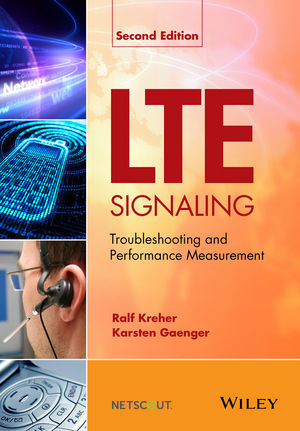
LTE Signaling (eBook)
John Wiley & Sons (Verlag)
978-1-118-72508-5 (ISBN)
This extensively updated second edition of LTE Signaling, Troubleshooting and Performance Measurement describes the LTE signaling protocols and procedures for the third generation of mobile communications and beyond. It is one of the few books available that explain the LTE signaling messages, procedures and measurements down to the bit & byte level, and all trace examples are taken for a real lab and field trial traces. This book covers the crucial key performance indicators (KPI) to be measured during field trials and deployment phase of new LTE networks. It describes how statistic values can be aggregated and evaluated, and how the network can be optimized during the first stages of deployment, using dedicated examples to enhance understanding.
Written by experts in the field of mobile communications, this book systematically describes the most recent LTE signaling procedures, explaining how to identify and troubleshoot abnormal network behavior and common failure causes, as well as describing the normal signaling procedures. This is a unique feature of the book, allowing readers to understand the root cause analysis of problems related to signaling procedures.
This book will be especially useful for network operators and equipment manufacturers; engineers; technicians; network planners; developers; researchers; designers; testing personnel and project managers; consulting and training companies; standardization bodies.
This extensively updated second edition of LTE Signaling, Troubleshooting and Performance Measurement describes the LTE signaling protocols and procedures for the third generation of mobile communications and beyond. It is one of the few books available that explain the LTE signaling messages, procedures and measurements down to the bit & byte level, and all trace examples are taken for a real lab and field trial traces. This book covers the crucial key performance indicators (KPI) to be measured during field trials and deployment phase of new LTE networks. It describes how statistic values can be aggregated and evaluated, and how the network can be optimized during the first stages of deployment, using dedicated examples to enhance understanding. Written by experts in the field of mobile communications, this book systematically describes the most recent LTE signaling procedures, explaining how to identify and troubleshoot abnormal network behavior and common failure causes, as well as describing the normal signaling procedures. This is a unique feature of the book, allowing readers to understand the root cause analysis of problems related to signaling procedures. This book will be especially useful for network operators and equipment manufacturers; engineers; technicians; network planners; developers; researchers; designers; testing personnel and project managers; consulting and training companies; standardization bodies.
Ralf Kreher, Tektronix Communications - Mobile Access, Berlin, Germany Ralf Kreher works as Senior Software Architect for Tektronix Communications (Test and Optimization) business with focus on UMTS and LTE Performance Measurement and Key Performance Indicator (KPI) implementation. Before joining the engineering department he lead the Tektronix Mobile Protocol Test Customer Training Department for almost four years being responsible for a world-class seminar portfolio for mobile technologies and measurement products. Kreher holds a Communication Engineering Degree of the University of Applied Science, Deutsche Telekom Leipzig. He is internationally recognized author of the books UMTS Signaling and UMTS Performance Measurement. Karsten Gaenger, Tektronix Communications - Mobile Access, Berlin, Germany Karsten Gaenger received a Dipl.-Ing. degree in electrical engineering from the Berlin University of Technology. He was with the Fraunhofer HHI research institute from 2004 to 2006. During this time he published several IEEE papers on his development of a reliable real-time streaming system and protocol for Mobile Ad-Hoc networks. His research interests are mobile communications, IPTV, and robust real-time video streaming. Currently he is with Tektronix, Inc. and takes part in the mobile test and optimization division for 3G and LTE networks. He is a Solution Architect with RAN focus for testing and monitoring real-time multi-media streaming in next generation mobile networks. His current projects include the development of a passive LTE air interface probe.
Chapter 1
Standards, Protocols, and Functions
Long-Term Evolution (LTE) of Universal Mobile Telecommunications Service (UMTS) is one of the latest steps in an advancing series of mobile telecommunication systems. The standards body behind the paperwork is the 3rd Generation Partnership Project (3GPP).
Along with the term LTE, the acronyms EPS (Evolved Packet System), EPC (Evolved Packet Core), and SAE (System Architecture Evolution) are often heard. Figure 1.1 shows how these terms are related to each other: EPS is the umbrella that covers both the LTE of the Evolved Universal Terrestrial Radio Access Network (E-UTRAN) and the SAE of the EPC network.
Figure 1.1 EPC and LTE under the umbrella of EPS
LTE was and is standardized in parallel to other radio access network technologies like EDGE (Enhanced Data Rates for GSM Evolution) and HSPA (High-Speed Packet Access). This means that LTE is not a simple replacement of existing technologies. Rather it is expected that different kinds of radio access will coexist in operator networks.
From this background, it emerges that understanding LTE also requires understanding alternative and coexisting technologies. Indeed, one of the major challenges of LTE signaling analysis will concern the analysis of handover procedures. Especially, the options for possible inter-RAT (Radio Access Technology) handovers have multiplied compared to what was possible in UMTS Release 99. However, also intra-system handover and dynamic allocation of radio resources to particular subscribers will play an important role.
The main drivers for LTE development are:
- reduced delay for connection establishment;
- reduced transmission latency for user plane data;
- increased bandwidth and bit rate per cell, also at the cell edge;
- reduced costs per bit for radio transmission;
- greater flexibility of spectrum usage;
- simplified network architecture;
- seamless mobility, including between different radio access technologies;
- reasonable power consumption for the mobile terminal.
It must be said that LTE as a RAT is flanked by a couple of significant improvements in the core network known as the EPS. Simplifying things a little, it is not wrong to state that EPS is an all-IP (Internet Protocol) transport network for mobile operators. IP will also become the physical transport layer on the wired interfaces of the E-UTRAN. This all-IP architecture is also one of the facts behind the bullet point on simplified network architecture. However, to assume that to be familiar with the TCP/IP world is enough to understand and measure LTE would be a fatal error. While the network architecture and even the basic signaling procedures (except the handovers) become simpler, the understanding and tracking of radio parameters require more knowledge and deeper investigation than they did before. Conditions on the radio interface will change rapidly and with a time granularity of 1 ms, the radio resources assigned to a particular connection can be adjusted accordingly.
For instance, the radio quality that is impacted by the distance between the User Equipment (UE) and base station can determine the modulation scheme and, hence, the maximum bandwidth of a particular connection. Simultaneously, the cell load and neighbor cell interference – mostly depending on the number of active subscribers in that cell – will trigger fast handover procedures due to changing the best serving cell in city center areas, while in rural areas, macro cells will ensure the best possible coverage.
The typical footprint of an LTE cell is expected by 3GPP experts to be in the range from approximately 700 m up to 100 km. Surely, due to the wave propagation laws, such macro cells cannot cover all services over their entire footprint. Rather, the service coverage within a single cell will vary, for example, from the inner to the outer areas and the maximum possible bit rates will decline. Thus, service optimization will be another challenge too.
1.1 LTE Standards and Standard Roadmap
To understand LTE, it is necessary to look back at its predecessors and follow its path of evolution for packet switched services in mobile networks.
The first stage of the General Packet Radio Service (GPRS), which is often referred to as the 2.5G network, was deployed in live networks starting after the year 2000. It was basically a system that offered a model of how radio resources (in this case, GSM time slots) that had not been used by Circuit Switched (CS) voice calls could be used for data transmission and, hence, profitability of the network could be enhanced. At the beginning, there was no pre-emption for PS (Packet Switched) services, which meant that the packet data needed to wait to be transmitted until CS calls had been finished.
In contrast to the GSM CS calls that had a Dedicated Traffic Channel (DTCH) assigned on the radio interface, the PS data had no access to dedicated radio resources and PS signaling, and the payload was transmitted in unidirectional Temporary Block Flows (TBFs) as shown in Figure 1.2.
Figure 1.2 Packet data transfer in 2.5G GPRS across Radio and Abis interfaces
These TBFs were short and the size of data blocks was small due to the fact that the blocks must fit the transported data into the frame structure of a 52-multiframe, which is the GSM radio transmission format on the physical layer. Larger Logical Link Control (LLC) frames that contain already segmented IP packets needed to be segmented into smaller Radio Link Control (RLC) blocks.
The following tasks are handled by the RLC protocol in 2.5G:
- Segmentation and reassembly of LLC packets → segmentation results in RLC blocks.
- Provision of reliable links on the air interface → control information is added to each RLC block to allow Backward Error Correction (BEC).
- Performing sub-multiplexing to support more than one MS (Mobile Station) by one physical channel.
The Medium Access Control (MAC) protocol is responsible for:
- point-to-point transfer of signaling and user data within a cell;
- channel combining to provide up to eight physical channels to one MS;
- mapping RLC blocks onto physical channels (time slots).
As several subscribers can be multiplexed on one physical channel, each connection has to be (temporarily) uniquely identified. Each TBF is identified by a Temporary Flow Identifier (TFI). The TBF is unidirectional (uplink (UL) and downlink (DL)) and is maintained only for the duration of the data transfer.
Toward the core network in 2.5G GPRS, the Gb interface is used to transport the IP payload as well as GPRS Mobility Management/Session Management (GMM/SM) signaling messages and short messages (Short Message Service, SMS) between SGSN and the PCU (Packet Control Unit) – see Figure 1.3. The LLC protocol is used for peer-to-peer communication between SGSN and the MS and provides acknowledged and unacknowledged transport services. Due to different transmission conditions on physical layers (E1/T1 on the Gb and Abis interfaces, 52-multiframe on the Air interface), the size of IP packets needs to be adapted. The maximum size of the LLC payload field is 1540 octets (bytes) while IP packets can have up to 65 535 octets (bytes). So the IP frame is segmented on SGSN before transmission via LLC and reassembled on the receiver side. All in all, the multiple segmentation/reassembly of IP payload frames generates a fair overhead of transport header information that limits the chargeable data throughput. In addition, the availability of radio resources for PS data transport has not been guaranteed. So this system was only designed for non-real-time services like web browsing or e-mail.
Figure 1.3 Packet data transfer in 2.5G GPRS
To overcome these limitations, the standards organizations proposed a set of enhancements that led to the parallel development of UMTS and EGPRS (Enhanced GPRS) standards. The most successful EGPRS standard that is found today in operators' networks is the EDGE standard. From the American Code Division Multiple Access (CDMA) technology family, another branch of evolution led to the CDMA2000 standards (defined by the 3GGP2 standards organization), but since the authors have not seen any interworking between CDMA2000 and Universal Terrestrial Radio Access Network (UTRAN) or GSM/EDGE Radio Access Network (GERAN) so far, this technology will not be discussed further in this book.
The most significant enhancements of EGPRS compared to GSM/GPRS are shown in Figures 1.4 and 1.5. On the one hand, a new modulation technique, 8-Phase Shift Keying (8PSK), was introduced to allow transmission of 8 bits per symbol across the air interface and, thus, an increase in the maximum possible bit rate from 20 to 60 kbps. On the other hand, to use the advantages of the new 8PSK modulation technique, it was necessary to adapt the data format on the RLC/MAC layer, especially regarding the size of the transport blocks and the time transmission interval of the transport blocks. Different transport block formats require a different CS. Thus, the so-called Modulation and Coding Scheme (MCS) and CS for GPRS and EGPRS as shown in Figure 1.4 have been defined. These MCSs stand for defined radio transmission capabilities on the UE and BTS (Base Transceiver Station) side. It is important to mention this, because in a similar way capability definition with UE physical layer categories...
| Erscheint lt. Verlag | 29.10.2015 |
|---|---|
| Sprache | englisch |
| Themenwelt | Technik ► Elektrotechnik / Energietechnik |
| Technik ► Nachrichtentechnik | |
| Schlagworte | 3GPP • Communications technology • Communication technology • Communication Technology - Networks • Drahtlose Kommunikation • Electrical & Electronics Engineering • Elektrotechnik u. Elektronik • Kommunikationsnetz • Kommunikationsnetze • Kommunikationstechnik • LTE • Mobile & Wireless Communications • Performance Management • Signaling • Signal Processing |
| ISBN-10 | 1-118-72508-5 / 1118725085 |
| ISBN-13 | 978-1-118-72508-5 / 9781118725085 |
| Informationen gemäß Produktsicherheitsverordnung (GPSR) | |
| Haben Sie eine Frage zum Produkt? |
 EPUB (Adobe DRM)
Kopierschutz: Adobe-DRM
Adobe-DRM ist ein Kopierschutz, der das eBook vor Mißbrauch schützen soll. Dabei wird das eBook bereits beim Download auf Ihre persönliche Adobe-ID autorisiert. Lesen können Sie das eBook dann nur auf den Geräten, welche ebenfalls auf Ihre Adobe-ID registriert sind.
Details zum Adobe-DRM
Dateiformat: EPUB (Electronic Publication)
EPUB ist ein offener Standard für eBooks und eignet sich besonders zur Darstellung von Belletristik und Sachbüchern. Der Fließtext wird dynamisch an die Display- und Schriftgröße angepasst. Auch für mobile Lesegeräte ist EPUB daher gut geeignet.
Systemvoraussetzungen:
PC/Mac: Mit einem PC oder Mac können Sie dieses eBook lesen. Sie benötigen eine
eReader: Dieses eBook kann mit (fast) allen eBook-Readern gelesen werden. Mit dem amazon-Kindle ist es aber nicht kompatibel.
Smartphone/Tablet: Egal ob Apple oder Android, dieses eBook können Sie lesen. Sie benötigen eine
Geräteliste und zusätzliche Hinweise
Buying eBooks from abroad
For tax law reasons we can sell eBooks just within Germany and Switzerland. Regrettably we cannot fulfill eBook-orders from other countries.
aus dem Bereich