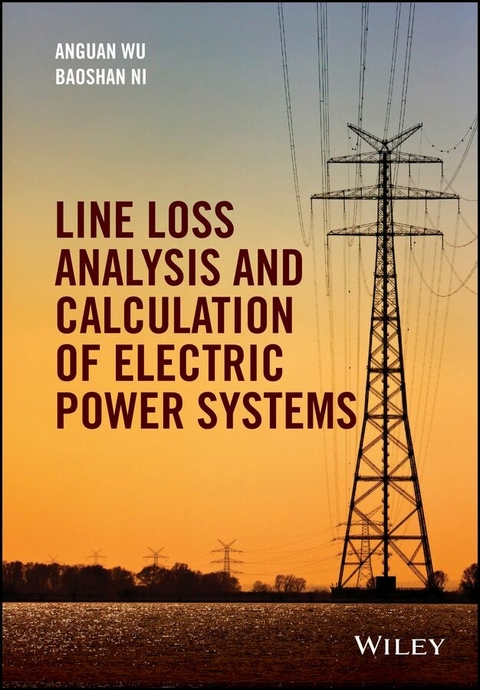
Line Loss Analysis and Calculation of Electric Power Systems (eBook)
384 Seiten
Wiley (Verlag)
978-1-118-86723-5 (ISBN)
• Written by a very experienced expert in this field
• Introduces various technical measures for loss reduction, and appended with a large number of examples
• Offers a progressive and systematic approach to various aspects of the problems
• A timely and original book to meet the challenges of power and grid industry development
Presents the fundamentals and calculation of transmission line losses, their reduction, and economic implications Written by a very experienced expert in this field Introduces various technical measures for loss reduction, and appended with a large number of examples Offers a progressive and systematic approach to various aspects of the problems A timely and original book to meet the challenges of power and grid industry development
Anguan Wu, North China Electric Power University, China Baoshan Ni, Zhejiang University, China
Foreword
Energy saving and consumption reduction in the electric power system are important tasks to which generations of people have always paid attention and been committed. In recent years, I heard that several aspiring experts have been summarizing and writing (revising) works or papers based on their working practices in line loss. A few days ago, Wu Anguan told me that he had finished the revision of the second edition of Analysis and Calculation of Line Loss in Electric Power Systems (hereinafter referred to as Line Loss) and asked me to write a foreword for this second edition. I felt happy that new results were created against new challenges, and also afraid that my words could not express my thoughts. However, as I wanted to live up to an old friend’s sincerity, I pleasantly promised to have a try, taking this opportunity to focus on loss reduction in power grids and to express my respect for line loss workers. I was filled with emotion when looking back on my participation in the line loss business, recalling the benefits I gained from the revision and review of the line loss management guidelines (provisions) and the loss reduction plans of the State Grid Corporation of China, and reading Wu’s second edition of Line Loss and his papers published in recent years.
Over the past 30 years since the reform and opening-up policy, China has implemented both energy development and savings, promoting the rapid development and increasing the benefits of the electric power system. As of 2011, the installed power-generating capacity has ranked second in the world for consecutive years, and the size of power grids and the total electricity consumption nationwide have ranked first in the world. The economic efficiency of the electric power industry was significantly improved: the average electric supply coal consumption rate of coal-fired units reached 330 g/(kW∙h), and some large units even realized a coal consumption rate of 300 g/(kW∙h); the electric supply line loss rate in power grids was 6.39% nationwide, and even maintained 5.5% or below in some provinces and cities; and overall, the line loss rate was at an internationally advanced level.
Looking back to the progress of power grid loss reduction in China after the reform and opening-up, the first 20 years saw a remarkable reduction of line loss rate from 9.64% in 1978 to 7.81% in 2000, but the curve of the annual line loss rate revealed several saddle-shaped fluctuations, showing that loss reduction was still difficult. During the first 12 years of the new century, with progress in science, technology, and equipment, especially strengthened line loss management, the line loss rate kept a steady decline without any big fluctuation, and was reduced by 1.42% in 2011 over 2000. Based on the size of the electric supply in 2010, if the line loss rate was reduced by 1%, equal to an annual electric loss reduction of about 42 × 1012 kW∙h, then over 13.8 × 10⁶ t of coal was saved each year and over 27.6 × 10⁶ t of carbon emissions were reduced, marking a great achievement in energy conservation and emission reduction. Due to my personal experiences, I pay close attention to and feel delighted with each year’s new achievements in the loss reduction in power grids. I deeply respect the technicians and managers engaged in the loss reduction for their steadfast and diligent professional ethics.
These remarkable achievements in the reduction of loss in power grids are mainly attributable to improvements in the theoretical analysis and calculation of line loss, the implementation of loss reduction technologies and measures, and effective policy management, as well as the assiduous efforts of relevant personnel. Since the 1980s, many professors, scientific and technical personnel, and business personnel working in the frontline of power grid enterprises, who were engaged in theoretical research into power grid line loss and in practical analysis and calculation, have worked hard and closely with each other. They have made outstanding contributions to the promotion of the theoretical research, analysis, and calculation of line loss in China, the implementation of loss reduction measures and technical management, and the realization of a continuous and steady decline in the line loss rate. In the 1980s, Zhejiang University and Nanjing Administration of Power Supply cooperated in preparing Theoretical Calculation of Line Loss and Technical Measures of Loss Reduction (written by Professor Ni Baoshan); Professor Yang Xiutai of Chongqing University compiled Theoretical Calculation and Analysis of Line Loss in Power Grids; Wu Anguan (Senior Engineer of Taiyuan Administration of Power Supply) and Professor Ni Baoshan coauthored Line Loss in Electric Power System (1996); Yu Zhongian (Senior Engineer of Jiangsu Electric Power Company) and Professor Chen Xingying of Hohai University wrote Electric Energy Loss in Power Grids (2000). They studied, learnt, and introduced the theoretical results of Europe, America, and the former Soviet Union in the calculation of line loss in the electric power system. Based on the actual situations of power grids in China, they discussed and proposed many methods for the theoretical calculation of line loss, and promoted the application of microcomputers in the calculation of line loss. In addition, they participated in many seminars, exchange meetings, and information sessions, making good technical preparations and doing real work for the formulation of line loss calculation guidelines, line loss management provisions, and other industrial standards or corporate regulations, both for training in line loss management and reviewing loss reduction plans. Their efforts have had an enduring influence on the theoretical calculation of line loss by power grid enterprises, the preparation of loss reduction plans, and improvements in the technical management of line loss in power grid enterprises. Meanwhile, the national competent authority and the State Grid Corporation of China, by following the scientific development perspective and adhering to the energy development and conservation policy, worked together to promote an industry–university–research cooperation, to formulate, propagate, and implement regulations and guidelines, to take effective input and technical measures, and to play an organizational leadership and regulatory role. This is an important reason why great achievements have been made in loss reduction for so many years, and an experience that should be learnt.
Since the twenty-first century, power grids have developed fast in China, with a continuously expanded size, more complicated network, and personnel increase or turnover. In addition, China has boosted the development and utilization of renewable energy sources, and the electricity market is increasingly growing. All of these developments and changes have posed new challenges to the objective of line loss management and loss reduction. Therefore, even after his retirement, the author of this book, with diligent study and tireless exploration, was still dedicated to the work of line loss and spent over eight years in making this new achievement.
In the second revision of Line Loss, the author retained or improved the basic knowledge and methods of theoretical calculation of line loss from the first edition, such as the line loss calculation considering power factor, the concept of load loss coefficient, the change rule of line loss, the methods of calculating line loss in loss calculation units and multi-branch lines, the methods of prediction of electricity line loss and line loss rate, and the principles of optimal distribution of an electric supply. New additions in this revision include the calculation of loss in complicated power grids, the link electricity price, the balance between electricity flow and capital flow within power grid enterprises, the analysis of coal-electricity price linkage, and the utilization of mass information in line loss. In addition, new results are theoretically explored and presented in terms of the three section division of the load curve, the loss calculation and loss allocation in complicated power grids, and the composition and application of a multi-section electricity price. Real analysis and calculation cases or parameters are also selected and provided. These studies and results are instructive when focusing on energy conservation and loss reduction against the back drop of a market-oriented economy, and when seeking ways to improve benefits by power grid enterprises.
Wu Anguan and I are schoolmates, and we exchanged and cooperated much with each other on the line loss in power grids after the 1990s. Wu studies hard, assiduously and ambitiously, and has always been keen on the professional theories of line loss and the practical application of research. Despite being over 60, Wu tirelessly writes papers and makes friends with others for sharing and improvement, which I respect very much.
I sincerely recommend the second edition of Line Loss, and believe that it will be conducive to professionals and college students involved in line loss management practices. I hope that more young scholars can constantly dig into the ancient but young subject of “line loss”, to help resolve many complicated technical and economic problems arising from electricity marketization and the accessability of renewable energy sources to the network. Witnessing the development of line loss management in China, I would like to take this opportunity to share my thoughts and experiences with all young...
| Erscheint lt. Verlag | 30.10.2015 |
|---|---|
| Sprache | englisch |
| Themenwelt | Technik ► Elektrotechnik / Energietechnik |
| Schlagworte | Circuit Theory & Design / VLSI / ULSI • Electrical & Electronics Engineering • Elektrotechnik u. Elektronik • Leistungselektronik • Power Electronics • Qualität u. Zuverlässigkeit • Qualität u. Zuverlässigkeit • Quality & Reliability • Schaltkreise - Theorie u. Entwurf / VLSI / ULSI |
| ISBN-10 | 1-118-86723-8 / 1118867238 |
| ISBN-13 | 978-1-118-86723-5 / 9781118867235 |
| Informationen gemäß Produktsicherheitsverordnung (GPSR) | |
| Haben Sie eine Frage zum Produkt? |
Kopierschutz: Adobe-DRM
Adobe-DRM ist ein Kopierschutz, der das eBook vor Mißbrauch schützen soll. Dabei wird das eBook bereits beim Download auf Ihre persönliche Adobe-ID autorisiert. Lesen können Sie das eBook dann nur auf den Geräten, welche ebenfalls auf Ihre Adobe-ID registriert sind.
Details zum Adobe-DRM
Dateiformat: EPUB (Electronic Publication)
EPUB ist ein offener Standard für eBooks und eignet sich besonders zur Darstellung von Belletristik und Sachbüchern. Der Fließtext wird dynamisch an die Display- und Schriftgröße angepasst. Auch für mobile Lesegeräte ist EPUB daher gut geeignet.
Systemvoraussetzungen:
PC/Mac: Mit einem PC oder Mac können Sie dieses eBook lesen. Sie benötigen eine
eReader: Dieses eBook kann mit (fast) allen eBook-Readern gelesen werden. Mit dem amazon-Kindle ist es aber nicht kompatibel.
Smartphone/Tablet: Egal ob Apple oder Android, dieses eBook können Sie lesen. Sie benötigen eine
Geräteliste und zusätzliche Hinweise
Buying eBooks from abroad
For tax law reasons we can sell eBooks just within Germany and Switzerland. Regrettably we cannot fulfill eBook-orders from other countries.
aus dem Bereich