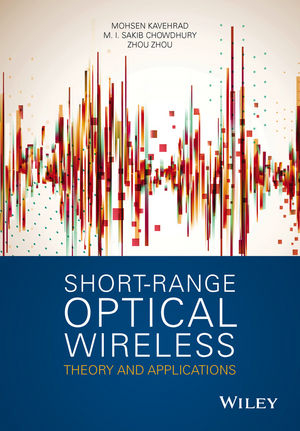
Short-Range Optical Wireless (eBook)
John Wiley & Sons (Verlag)
978-1-118-88768-4 (ISBN)
This book discusses the fundamental aspects of multiple-source Optical Wireless Applications, including Visible Light Communications (VLC). Moreover, the authors explore VLC performance in several conventional household layouts and investigate the impact of these layouts on VLC. Multiple sources increase multipath distortion. Multi-input- Multi-Output (MIMO) techniques will be included as they provide either reliability improvement or bandwidth efficiency increase. Based on these topics, the book further explores VLC performance in real applications, such as aircraft cabin wireless communications.
In addition, the authors describe the Lambertian emitting pattern of LEDs and the diffused features in indoor environments. Based on the theory, they trace light pulses to establish a MIMO indoor wireless channel model on specific sources layout. Next, they generate test data to simulate BER distribution in a room and calculate the outage. Furthermore, addresses the performance improvement when MIMO techniques are applied. Lastly, the authors investigate VLC performance in specific applications, including for aircraft on-board wireless communications. Finally, the pitfalls of MIMO systems are discussed.
This book discusses the fundamental aspects of multiple-source Optical Wireless Applications, including Visible Light Communications (VLC). Moreover, the authors explore VLC performance in several conventional household layouts and investigate the impact of these layouts on VLC. Multiple sources increase multipath distortion. Multi-input- Multi-Output (MIMO) techniques will be included as they provide either reliability improvement or bandwidth efficiency increase. Based on these topics, the book further explores VLC performance in real applications, such as aircraft cabin wireless communications. In addition, the authors describe the Lambertian emitting pattern of LEDs and the diffused features in indoor environments. Based on the theory, they trace light pulses to establish a MIMO indoor wireless channel model on specific sources layout. Next, they generate test data to simulate BER distribution in a room and calculate the outage. Furthermore, addresses the performance improvement when MIMO techniques are applied. Lastly, the authors investigate VLC performance in specific applications, including for aircraft on-board wireless communications. Finally, the pitfalls of MIMO systems are discussed.
Dr Mohsen Kavehrad, The Pennsylvania State University, USA Mohsen Kavehrad is the W. L. Weiss Chair Professor of Electrical Engineering at The Pennsylvania State University. He received his Ph.D. degree in Electrical Engineering from Polytechnic Institute of New York University (formerly; Brooklyn Polytechnic Institute) in 1977. Dr Zhou Zhou, The Pennsylvania State University, USA Zhou Zhou is a research fellow in the Center for Information and Communications Technology Research (CICTR) at the Pennsylvania State University. He was at Huazhong University of Science and Technology, Wuhan, China, where he received his B.Sc. in Electrical Engineering in 2006 and M.Sc. in Optoelectronics and Information Engineering in 2009, respectively. He joined the Department of Electrical Engineering at the Pennsylvania State University in 2009 as a research assistant pursing Ph.D. in Electrical Engineering, supervised by the W. L. Weiss Chair Professor, Dr. Mohsen Kavehrad.
1
Introduction
1.1 Motivation
Optical wireless communications (OWC) has become an increasingly important research area. The potential of solving complicated communications problems, such as the shortage of radio frequency (RF) spectrum, interference, and the necessity of transmission at very high data rates by optical wireless systems has seen vast improvement. Optical wireless links can establish communications channels even millions of miles apart, as evidenced by the use of optical links in space exploratory missions by NASA [1]. For shorter terrestrial distances, optical wireless links in outdoor free space are a good choice for establishing pointed links a couple of miles apart. On a much smaller scale, the existence of millions of remote controls that operate using infrared light-emitting-diodes (LEDs) is a proof of the usefulness of optical wireless systems.
Apart from the various applications of OWC that are currently in use, probably the main motivating factor to focus on this area is the possibility of mitigating the increasing spectrum shortage issue. As consumption of high data rate multimedia materials is increasing day by day and the use of handheld devices is becoming more and more widespread, the precious RF spectrum range of about 1.9 GHz that is used for mobility is getting scarcer [2]. Users are encouraged to shift to the Wi-Fi bands instead of the bands used for cellular services in order to alleviate this increasing load of high data rate applications. However, there are places where even Wi-Fi bands do not operate as expected or are found to be so congested that their use becomes next to impossible, for example, heavily crowded conference halls. Also, supported data rates of Wi-Fi as well as cellular data services should be considered in this discussion. Though IEEE 802.11ac and IEEE 802.11ad standards are supposed to support high bit rates, they are not yet widespread, and so the cost issue is involved. LTE and LTE-Advanced standards are also supposed to support high bit rates, but they use the same precious cellular spectrum band and thus due to congestion cannot provide satisfactory performance. Hence, the pursuit of and research on alternatives to these radio frequency-based solutions such as optical wireless-based systems and technologies are greatly desirable [3, 4].
OWC can be both indoors and outdoors and are usually broadly divided into two categories based on the type of optical source employed. Two types of optical sources—LEDs and lasers—are currently in use as transmitters of optical links. The difference between these two sources lies in their supported bandwidth: where LEDs have a much lower electrical bandwidth than lasers, and hence if very high data rate transmission in the range of Gbps is required, lasers are the popular choice. Also, lasers emit monochromatic light signals, that is, light signals that have only one wavelength in it, whereas LEDs have a very broad spectral linewidth. LED-based communications mainly involve visible light communications (VLC) using white LEDs (WLEDs), and lasers are used only as very high-speed infrared sources. Hence, these two types of optical sources have different application scenarios. In this book, we will cover different types of applications where both LEDs and lasers are used.
The energy-saving aspect of WLEDs is probably one of the most important benefits that can be obtained using VLC. Lighting is a major source of electric energy consumption. It is estimated that one-third of the global consumption of electricity is spent for lighting purposes; therefore, development of more efficient lighting sources is important. This acknowledgment of concerns about significant consumption has generated significant activity toward the development of solid-state sources, to replace incandescent and fluorescent lights. Fluorescent lamps contain environmental pollutants, thus their elimination will remove a significant source of environmental pollution and more specifically, their replacement with highly efficient LEDs generating “white light” will reduce energy consumption. It is fortunate that WLEDs are already commercially available. WLEDs require roughly 20 times less power compared to conventional light sources, even 5 times less power compared to fluorescent bulbs that consume less energy. An entire rural village can be lit with less energy than that used by a single conventional 100 W light bulb. Switching to solid-state lighting would reduce global electricity use by 50% and reduce power consumption by 760 GW in the United States alone over a 20-year period. To get a clear picture of the positive impact the use of WLEDs will have, some concrete estimates can be provided. If all existing bulbs were replaced by WLED sources, within 10 years we will have the following benefits: energy savings of 1.9 × 10²⁰ J, US$1.83 trillion financial savings, 10.68 GT reduction of carbon dioxide emissions, and 962 million barrels less consumption of crude oil [4].
The field of photonics starts with the efficient generation of light. The generation of efficient yet highly controllable light can indeed be accomplished using LEDs. Using a WLED instead of conventional lighting means the size, cost, and energy consumption will decrease considerably, as optical devices are smaller and simpler than electrical devices. WLEDs are semiconductor devices. About 13 000 LEDs can be formed on a substrate, which can be about 0.25 × 0.25 units in size. WLEDs use 5% of the energy of a regular incandescent bulb. An entire rural village can be lit with less energy than that used by a single conventional 100 W light bulb. By replacing the conventional lights with WLEDs and by using them for both data transmission and lighting, large amounts of energy can be saved. Undoubtedly, white light emitting solid-state devices will be the lighting sources of the twenty-first century. About 10–15 years ago, researchers came to the realization that WLED devices, in addition to being very fit for lighting the surrounding space, could also be used for wireless communications purposes. The advantages of such technology applications are many. It belongs to the “green technologies” category when used for lighting purposes, becoming even more environmentally friendly when it supports communication functionality compared to RF alternatives. Also, LEDs and photodetectors tend to be considerably cheaper compared to RF counterparts. OWC allows easy bandwidth reuse and improves security, as light is confined within the room it illuminates. It does not generate RF contamination, nor is it impacted by RF interference. Thus, replacing RF devices with devices using white light for communications (at least for indoor environments) will reduce interference in the RF bands. It should be pointed out that while the consumer market and the product developers will benefit from this, the technology can also make a major breakthrough in cases where RF radiation is of great concern, as in the case of hospitals, schools, airplanes, and mines. RF interference has caused accidental triggering of explosions when using remote detonator devices. Federal regulation places 1 W as the maximum acceptable RF power within mines using remotely triggered detonators. Also, baby monitoring RF signals have interfered with landing instructions of planes approaching airport runways.
1.1.1 Spectrum Scarcity Issues and Optical Wireless Communications as a Solution
Let us delve a bit deeper into the RF spectrum scarcity problem that we mentioned earlier and how OWC using either LEDs or lasers can help in this regard.
With the increasing popularity of multimedia services supplied over the RF networks and services such as web browsing, audio and video on demand, it is for sure only a matter of time before users will face extreme congestion while trying to connect to avail themselves of these aforementioned services. Advancements in displays, battery technology, and processing power have made it possible for users to afford and carry around smart phones and tablets. As we are entering a new era of always on connectivity, the expectation from users for not only ubiquitous but also seamless voice and video services presents a significant challenge for today’s telecommunications systems. The prospects for the delivery of such multimedia services to these users are crucially dependent on the development of low-cost physical layer delivery mechanisms.
According to market research published by Cisco Systems, Inc. [5], the largest manufacturer of networking equipment, mobile data consumption is going to explode in the next 5 years, largely due to the proliferation of mobile video and mobile web applications. Cisco market research includes the Visual Networking Index (VNI). The VNI research predicts mobile data use to expand from 2.5 to 24.3 EB monthly. This is an increase of a factor of 10 in 5 years, or about 57% cumulative annual growth rate (CAGR). This is an enormous growth in mobile data, a very large portion of which is growth due to the proliferation of mobile video (66%). Much of this mobile data growth (about 70%) will be consumed by laptops and other mobile ready portables such as pico-projectors, wireless reading devices, digital photo frames, and smart phones. These mobile devices can generally be thought of as in-building networked devices that are used to share information (video) within a classroom, conference, or meeting room. The report predicts that a greater amount of traffic will migrate from fixed to...
| Erscheint lt. Verlag | 30.10.2015 |
|---|---|
| Sprache | englisch |
| Themenwelt | Technik ► Elektrotechnik / Energietechnik |
| Technik ► Nachrichtentechnik | |
| Schlagworte | blocks • channel • Characteristics • communications • detection • Drahtlose Kommunikation • Electrical & Electronics Engineering • Elektrotechnik u. Elektronik • Introduction • Ix • Methods • Mobile & Wireless Communications • Optical • Optical Communications • Optics & Photonics • Optik u. Photonik • Optische Nachrichtentechnik • organization references fundamentals • owc system • Physics • Physik • propagation • References • Scarcity • Solution • Wireless |
| ISBN-10 | 1-118-88768-9 / 1118887689 |
| ISBN-13 | 978-1-118-88768-4 / 9781118887684 |
| Informationen gemäß Produktsicherheitsverordnung (GPSR) | |
| Haben Sie eine Frage zum Produkt? |
 EPUB (Adobe DRM)
Kopierschutz: Adobe-DRM
Adobe-DRM ist ein Kopierschutz, der das eBook vor Mißbrauch schützen soll. Dabei wird das eBook bereits beim Download auf Ihre persönliche Adobe-ID autorisiert. Lesen können Sie das eBook dann nur auf den Geräten, welche ebenfalls auf Ihre Adobe-ID registriert sind.
Details zum Adobe-DRM
Dateiformat: EPUB (Electronic Publication)
EPUB ist ein offener Standard für eBooks und eignet sich besonders zur Darstellung von Belletristik und Sachbüchern. Der Fließtext wird dynamisch an die Display- und Schriftgröße angepasst. Auch für mobile Lesegeräte ist EPUB daher gut geeignet.
Systemvoraussetzungen:
PC/Mac: Mit einem PC oder Mac können Sie dieses eBook lesen. Sie benötigen eine
eReader: Dieses eBook kann mit (fast) allen eBook-Readern gelesen werden. Mit dem amazon-Kindle ist es aber nicht kompatibel.
Smartphone/Tablet: Egal ob Apple oder Android, dieses eBook können Sie lesen. Sie benötigen eine
Geräteliste und zusätzliche Hinweise
Buying eBooks from abroad
For tax law reasons we can sell eBooks just within Germany and Switzerland. Regrettably we cannot fulfill eBook-orders from other countries.
aus dem Bereich