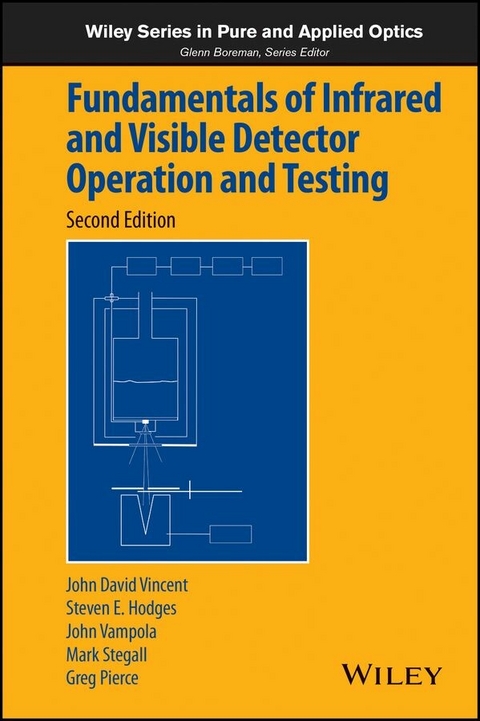
Fundamentals of Infrared and Visible Detector Operation and Testing (eBook)
John Wiley & Sons (Verlag)
978-1-119-01188-0 (ISBN)
Presents a comprehensive introduction to the selection, operation, and testing of infrared devices, including a description of modern detector assemblies and their operation
This book discusses how to use and test infrared and visible detectors. The book provides a convenient reference for those entering the field of IR detector design, test or use, those who work in the peripheral areas, and those who teach and train others in the field.
Chapter 1 contains introductory material. Radiometry is covered in Chapter 2. The author examines Thermal detectors in Chapter 3; the 'Classical' photon detectors - simple photoconductors and photovoltaics in Chapter 4; and 'Modern Photon Detectors' in Chapter 5. Chapters 6 through 8 consider respectively individual elements and small arrays of elements the 'readouts' (ROICs) used with large imaging arrays; and Electronics for FPA Operation and Testing. The Test Set and The Testing Process are analyzed in Chapters 9 and 10, with emphasis on uncertainty and trouble shooting. Chapters 11 through 15 discuss related skills, such as Uncertainty, Cryogenics, Vacuum, Optics, and the use of Fourier Transforms in the detector business. Some highlights of this new edition are that it
- Discusses radiometric nomenclature and calculations, detector mechanisms, the associated electronics, how these devices are tested, and real-life effects and problems
- Examines new tools in Infrared detector operations, specifically: selection and use of ROICs, electronics for FPA operation, operation of single element and very small FPAs, microbolometers, and multi-color FPAs
- Contains five chapters with frequently sought-after information on related subjects, such as uncertainty, optics, cryogenics, vacuum, and the use of Fourier mathematics for detector analyses
Fundamentals of Infrared and Visible Detector Operation and Testing, Second Edition, provides the background and vocabulary necessary to help readers understand the selection, operation, and testing of modern infrared devices.
John David Vincent: Consultant after 50 years as an IR test engineer and system engineer (SBRC, Amber Engineering, Raytheon Infrared Operations, FLIR-Indigo). His interests include uncertainty analysis, radiometrics, data analysis and presentation.
Steve Hodges (Principal Senior Scientist, Alion Science and Technology) has developed fire detection and suppression systems for 30 years.
John Vampola (Principal Engineering Fellow, Raytheon Vision Systems) has specialized in ROIC and FPA design and applications for 35 years.
Mark Stegall and Greg Pierce. (Founder and CEO respectively SE-IR Corporation, Goleta, CA) have designed and produced test electronics for FPA evaluation and imaging demonstrations for over 25 years.
Presents a comprehensive introduction to the selection, operation, and testing of infrared devices, including a description of modern detector assemblies and their operation This book discusses how to use and test infrared and visible detectors. The book provides a convenient reference for those entering the field of IR detector design, test or use, those who work in the peripheral areas, and those who teach and train others in the field. Chapter 1 contains introductory material. Radiometry is covered in Chapter 2. The author examines Thermal detectors in Chapter 3; the Classical photon detectors simple photoconductors and photovoltaics in Chapter 4; and Modern Photon Detectors in Chapter 5. Chapters 6 through 8 consider respectively individual elements and small arrays of elements the readouts (ROICs) used with large imaging arrays; and Electronics for FPA Operation and Testing. The Test Set and The Testing Process are analyzed in Chapters 9 and 10, with emphasis on uncertainty and trouble shooting. Chapters 11 through 15 discuss related skills, such as Uncertainty, Cryogenics, Vacuum, Optics, and the use of Fourier Transforms in the detector business. Some highlights of this new edition are that it Discusses radiometric nomenclature and calculations, detector mechanisms, the associated electronics, how these devices are tested, and real-life effects and problems Examines new tools in Infrared detector operations, specifically: selection and use of ROICs, electronics for FPA operation, operation of single element and very small FPAs, microbolometers, and multi-color FPAs Contains five chapters with frequently sought-after information on related subjects, such as uncertainty, optics, cryogenics, vacuum, and the use of Fourier mathematics for detector analyses Fundamentals of Infrared and Visible Detector Operation and Testing, Second Edition, provides the background and vocabulary necessary to help readers understand the selection, operation, and testing of modern infrared devices.
John David Vincent: Consultant after 50 years as an IR test engineer and system engineer (SBRC, Amber Engineering, Raytheon Infrared Operations, FLIR-Indigo). His interests include uncertainty analysis, radiometrics, data analysis and presentation. Steve Hodges (Principal Senior Scientist, Alion Science and Technology) has developed fire detection and suppression systems for 30 years. John Vampola (Principal Engineering Fellow, Raytheon Vision Systems) has specialized in ROIC and FPA design and applications for 35 years. Mark Stegall and Greg Pierce. (Founder and CEO respectively SE-IR Corporation, Goleta, CA) have designed and produced test electronics for FPA evaluation and imaging demonstrations for over 25 years.
Foreword ix
Preface xiii
About the Companion Website xv
Unit I Detector Basics 1
1 Introduction and Overview 3
2 Radiometry 25
3 Thermal Detectors: Mechanisms, Operation, and Performance 85
4 Classical Photon Detectors: Simple Photoconductor and Photovoltaics 105
5 Modern Photon Detectors 149
Unit II Detector Assemblies 171
6 Single Detector Assemblies and Small Arrays 173
7 Readout Integrated Circuits 191
8 Electronics for FPA Operation 237
Unit III Testing 257
9 Test Equipment 259
10 Detector Testing 315
Unit IV Related Skills 379
11 Measurements and Uncertainty 381
12 Cryogenics 407
13 Vacuum 441
14 Optics and Optical Materials 469
15 Fourier Analysis of Detector Problems 507
Appendix A - Symbols, Abbreviations, and Acronyms 549
Index 553
"This is a useful guidebook for anyone involved with system design and testing of visible and infrared detectors." (Optics & Photonics News, 31 December 2015)
| Erscheint lt. Verlag | 26.10.2015 |
|---|---|
| Reihe/Serie | Wiley Series in Pure and Applied Optics |
| Wiley Series in Pure and Applied Optics | Wiley Series in Pure and Applied Optics |
| Sprache | englisch |
| Themenwelt | Technik ► Elektrotechnik / Energietechnik |
| Technik ► Nachrichtentechnik | |
| Schlagworte | Classical Photon Detectors • Cryogenics • detector mechanisms • Electrical & Electronics Engineering • Electronics • Electronics for ROIC Operation • Elektrotechnik u. Elektronik • fire sensors • Focal Plane Arrays (FPAs) • Focal Plane Assemblies • Fourier Methods for Detectors • Fourier Transforms • intrusion alarms • Modern Photon Detectors • Motion Detectors • Optical Communications • Optics • Optics & Photonics • Optik • Optik u. Photonik • Optische Nachrichtentechnik • Physics • Physik • radiometric calculations • radiometry • Readout Integrated Circuits (ROICs) • Sensor • Sensoren, Instrumente u. Messung • Sensors, Instrumentation & Measurement • Single Detector Assemblies • Single Element Detector Assemblies and Small Arrays • Small Arrays • Test Equipment • Test set • Thermal Detectors • The Testing Process • Vacuum |
| ISBN-10 | 1-119-01188-4 / 1119011884 |
| ISBN-13 | 978-1-119-01188-0 / 9781119011880 |
| Informationen gemäß Produktsicherheitsverordnung (GPSR) | |
| Haben Sie eine Frage zum Produkt? |
 PDF (Adobe DRM)
Kopierschutz: Adobe-DRM
Adobe-DRM ist ein Kopierschutz, der das eBook vor Mißbrauch schützen soll. Dabei wird das eBook bereits beim Download auf Ihre persönliche Adobe-ID autorisiert. Lesen können Sie das eBook dann nur auf den Geräten, welche ebenfalls auf Ihre Adobe-ID registriert sind.
Details zum Adobe-DRM
Dateiformat: PDF (Portable Document Format)
Mit einem festen Seitenlayout eignet sich die PDF besonders für Fachbücher mit Spalten, Tabellen und Abbildungen. Eine PDF kann auf fast allen Geräten angezeigt werden, ist aber für kleine Displays (Smartphone, eReader) nur eingeschränkt geeignet.
Systemvoraussetzungen:
PC/Mac: Mit einem PC oder Mac können Sie dieses eBook lesen. Sie benötigen eine
eReader: Dieses eBook kann mit (fast) allen eBook-Readern gelesen werden. Mit dem amazon-Kindle ist es aber nicht kompatibel.
Smartphone/Tablet: Egal ob Apple oder Android, dieses eBook können Sie lesen. Sie benötigen eine
Geräteliste und zusätzliche Hinweise
Buying eBooks from abroad
For tax law reasons we can sell eBooks just within Germany and Switzerland. Regrettably we cannot fulfill eBook-orders from other countries.
aus dem Bereich