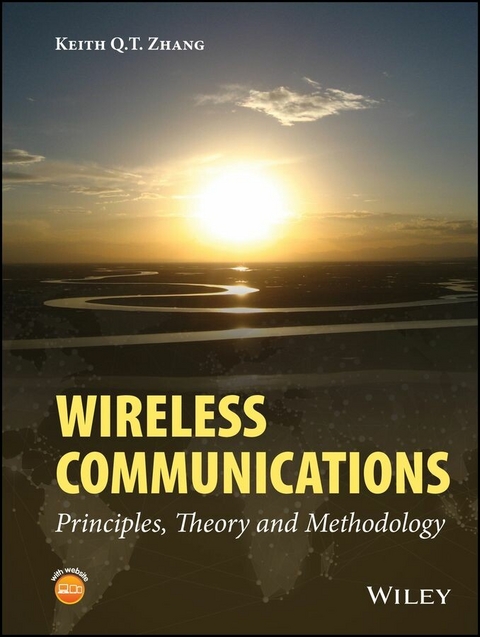
Wireless Communications (eBook)
John Wiley & Sons (Verlag)
978-1-119-11328-7 (ISBN)
Keith Q.T. Zhang, electronics engineer, educator. Achievements include research in wireless communications. Member of Institute of Electrical and Electronics Engineers (associate editor letters 2000-2008). B. England, Tsinghua University, Beijing, 1970. Doctor of Philosophy, McMaster University, Hamilton, Ontario, Canada, 1985. Senior member technical staff Spar Aerospace Ltd, Satellite Communications Division, Montreal, 1991--1993. Professor Ryerson, Toronto, Canada, 1993--2002, City University, Hong Kong, since 2000.
Preface xvii
Acknowledgments xix
1 Introduction 1
1.1 Resources for wireless communications 3
1.2 Shannon's theory 3
1.3 Three challenges 4
1.4 Digital modulation versus coding 5
1.5 Philosophy to combat interference 6
1.6 Evolution of processing strategy 7
1.7 Philosophy to exploit two-dimensional random fields 7
1.8 Cellular: Concept, Evolution, and 5G 8
1.9 The structure of this book 10
1.10 Repeatedly used abbreviations and math symbols 10
Problems 12
References 12
2 Mathematical Background 14
2.1 Introduction 14
2.2 Congruence mapping and signal spaces 14
2.3 Estimation methods 19
2.3.1 Maximum likelihood estimation (MLE) 20
2.3.2 Maximum a posteriori estimation 21
2.4 Commonly used distributions in wireless 21
2.4.1 Chi-square distributions 21
2.4.2 Gamma distribution 25
2.4.3 Nakagami distribution 26
2.4.4 Wishart distribution 26
2.5 The calculus of variations 28
2.6 Two inequalities for optimization 29
2.6.1 Inequality for Rayleigh quotient 29
2.6.2 Hadamard inequality 29
2.7 Q-function 30
2.8 The CHF method and its skilful applications 32
2.8.1 Gil-Pelaez's lemma 32
2.8.2 Random variables in denominators 32
2.8.3 Parseval's theorem 33
2.9 Matrix operations and differentiation 33
2.9.1 Decomposition of a special determinant 33
2.9.2 Higher order derivations 33
2.9.3 Kronecker product 34
2.10 Additional reading 34
Problems 34
References 35
3 Channel Characterization 37
3.1 Introduction 37
3.2 Large-scale propagation loss 38
3.2.1 Free-space propagation 39
3.2.2 Average large-scale path loss in mobile 40
3.2.3 Okumura's model 40
3.2.4 Hata's model 42
3.2.5 JTC air model 42
3.3 Lognormal shadowing 43
3.4 Multipath characterization for local behavior 44
3.4.1 An equivalent bandwidth 44
3.4.2 Temporal evolution of path coefficients 49
3.4.3 Statistical description of local fluctuation 50
3.4.4 Complex Gaussian distribution 50
3.4.5 Nakagami fading 51
3.4.6 Clarke-Jakes model 52
3.5 Composite model to incorporate multipath and shadowing 53
3.6 Example to illustrate the use of various models 54
3.6.1 Static design 54
3.6.2 Dynamic design 55
3.6.3 Large-scale design 56
3.7 Generation of correlated fading channels 56
3.7.1 Rayleigh fading with given covariance structure 56
3.7.2 Correlated Nakagami fading 57
3.7.3 Complex correlated Nakagami channels 62
3.7.4 Correlated lognormal shadowing 62
3.7.5 Fitting a lognormal sum 64
3.8 Summary 65
3.9 Additional reading 66
Problems 66
References 68
4 Digital Modulation 70
4.1 Introduction 70
4.2 Signals and signal space 71
4.3 Optimal MAP and ML receivers 72
4.4 Detection of two arbitrary waveforms 74
4.5 MPSK 77
4.5.1 BPSK 77
4.5.2 QPSK 79
4.5.3 MPSK 81
4.6 M-ary QAM 85
4.7 Noncoherent scheme-differential MPSK 88
4.7.1 Differential BPSK 88
4.7.2 Differential MPSK 89
4.7.3 Connection to MPSK 89
4.8 MFSK 90
4.8.1 BFSK with coherent detection 90
4.9 Noncoherent MFSK 92
4.10 Bit error probability versus symbol error probability 93
4.10.1 Orthogonal MFSK 93
4.10.2 Square M-QAM 93
4.10.3 Gray-mapped MPSK 94
4.11 Spectral efficiency 96
4.12 Summary of symbol error probability for various schemes 97
4.13 Additional reading 98
Problems 98
References 102
5 Minimum Shift Keying 103
5.1 Introduction 103
5.2 MSK 104
5.3 de Buda's approach 105
5.3.1 The basic idea and key equations 105
5.4 Properties of MSK signals 106
5.5 Understanding MSK 108
5.5.1 MSK as FSK 108
5.5.2 MSK as offset PSK 109
5.6 Signal space 109
5.7 MSK power spectrum 110
5.8 Alternative scheme-differential encoder 113
5.9 Transceivers for MSK signals 115
5.10 Gaussian-shaped MSK 116
5.11 Massey's approach to MSK 117
5.11.1 Modulation 117
5.11.2 Receiver structures and error performance 117
5.12 Summary 119
Problems 119
References 120
6 Channel Coding 121
6.1 Introduction and philosophical discussion 121
6.2 Preliminary of Galois fields 123
6.2.1 Fields 123
6.2.2 Galois fields 124
6.2.3 The primitive element of GF(q) 124
6.2.4 Construction of GF(q) 124
6.3 Linear block codes 126
6.3.1 Syndrome test 129
6.3.2 Error-correcting capability 132
6.4 Cyclic codes 134
6.4.1 The order of elements: a concept in GF(q) 134
6.4.2 Cyclic codes 136
6.4.3 Generator, parity check, and syndrome polynomial 137
6.4.4 Systematic form 138
6.4.5 Syndrome and decoding 140
6.5 Golay code 141
6.6 BCH codes 141
6.6.1 Generating BCH codes 142
6.6.2 Decoding BCH codes 143
6.7 Convolutional codes 146
6.7.1 Exampl
1
Introduction
Abstract
The main goal of modern wireless communications is reliable transmission over an imperfect channel with the data rate to approach the channel capacity as much as possible. A physical channel often introduces additive white Gaussian noise, interference of various natures, and probably also multipath fading. The latter two impairments are often the sources that eventually limit the performance of a wireless system. Efforts of combating interference and multipath fading constitute an important part of the history of communications. The mathematical nature of interference is the collision between multiple symbols or multiple users in a low-dimensional space. Today, the paradigm of orthogonality has become a basic thought for combating different types of interference, while multi-antenna technology is a powerful means to exploit the inherent capacity of multipath fading channels.
James Clerk Maxwell's electromagnetic theory, established in 1864, uncovered the field nature of electromagnetic waves, marking a transition in our understanding of electromagnetism from phenomenology to physical theory. It is a prelude to the two far-reaching and revolutionary events in contemporary sciences: quantum physics and Einstein's theory of relativity. In engineering aspect, Maxwell's electromagnetic theory essentially becomes a physical foundation for telecommunications, stimulating the invention of the radio by Guglielmo Marconi in 1901, the invention of television broadcasting by Philo Farnsworth in 1928, and the invention of frequency modulation by Edwin Armstrong in 1933. These inventions and their practical applications, in turn, spurred the revolutionary advances in electronic devices, as exemplified by the invention of the vacuum tube in 1904 by John Fleming, transistors in 1948 by Walter Brattain, John Bardeen, and William Stockley at Bell Labs, and digital computers in 1946 by a team led by von Neumann. Further development of telecommunications required various key technologies for transmission, among which we can list the most representatives as follows:
- Nyquist's sampling theorem in 1928 by Harry Nyquist;
- Pulse-code modulation (PCM) in 1937 by Alec Reeves;
- Matched filters in 1943 by D.O. North.
Indeed, the electromagnetic theory and the emergence of various electronic devices had prepared the physical stage for communications. However, communication is of a different nature and is aimed at transporting information over an impaired channel; it is a process always associated with uncertainty and randomness. Clearly, we need a rigorous theory to fully reveal the nature of communications before the possibility to implement it reliably. Such a theory occurred in 1948 when Claude Shannon published his celebrated paper entitled “A mathematical theory of communication.” Shannon proved, for the first time, that the maximum data rate achievable by a communication system was upper-bounded by the channel capacity and that error-free communication was possible as long as the transmission rate did not exceed the Shannon limit. It is fair to say that, while Maxwell's electromagnetic theory laid the physical foundation for communications, Shannon's theory provided it with a rigorous information-theoretic framework. Although various communication experiments had been conducted well before Shannon published his seminal papers, it was Shannon who made communication a rigorous science, casting dawn light on the horizon of modern communications.
With the advances in theories and technology, cellular mobile communications gradually developed as an industry. The idea of mobile communications dated back to 1946, when the Federal Communications Commission (FCC) granted a license for the first frequency-modulation (FM)-based land-mobile telephone operating at 150 MHz. But, a successful improved mobile-telephone service (IMTS) did not become a reality until the early 1960s when semiconductors became a matured technology. The flourishing of mobile phones, however, relied on frequency reuse over different geographical areas. That was the concept of cellular systems initiated by the Bell Laboratories in late 1940s as it requested the frequency band 470–890 MHz from the FCC for cellular telephony. Unfortunately, the request was declined twice due to other spectrum arrangements. The conflict between the industry and the FCC continued for many years. Ultimately, in 1981, the FCC finalized a bandwidth of 50 MHz from 800 to 900 MHz for cellular mobile communications, giving birth to the first-generation (1G) cellular mobile systems.
Since its first deployment in the early 1980s, cellular mobile communication technology evolved, shortly in two decades, from its first generation to the second employing digital voice transmission in 1985–1988, as represented by the GSM and IS-95, to meet the ever-increasing global market. It then evolved into its third generation (3G), which employed the wide-band CDMA technology and offered multimedia services. All the 3G standards were developed and released by an international organization called the Third Generation Partnership Project (3GPP). On the way to the fourth-generation (4G) cellular technology, the 3GPP took the strategy of long-term evolution (LTE) and released its LTE-8 standard in 2008. The standard LTE-8 and the subsequently released LTE-9 represent the transition from 3G to 4G. The true 4G is defined by the standard LTE-Advanced, which was released on December 6, 2010. 4G cellular technology can support data rate up to 1 Gb/s, and allows for variable bandwidth assignments to meet the requirements of different users.
Today, cellular phones, the Internet, and information exchange are ubiquitous, bringing us into the era of a knowledge explosion. In the short span of the past five decades, wireless communication has evolved from its inception to 4G, and is now moving to 5G, leaving a variety of dazzling achievements behind. We may give a long list of various events and activities that have had far-reaching impacts upon the human society and technological evolution, but it is impossible and unnecessary. What we really need is the fundamentals as well as the thoughts and philosophy behind them. Knowledge can be easily found by a google search. Only thoughts and philosophy that dictate the development of modern wireless communication can inspire us to further create novel knowledge and technology for the future. Indeed, as stated by Will Durant, “Every science begins as philosophy and ends as arts.” Searching for the trajectory of thoughts, methodology, and philosophy from the history of wireless communications is interesting and challenging, and it is the direction of this book to endeavor.
We need to comb through the aforementioned dazzling events to uncover the underlying philosophy behind them. We identify four key issues, namely Shannon's theory and channel coding, the principle of orthogonality, diversity, and the turbo principle.
1.1 Resources for wireless communications
A typical communication system consists of transmitters, receivers and physical channels. By a physical channel we mean a medium connecting the transmitter to the receiver, which can be an optical fiber, a cable, twisted lines, or open air as encountered in wireless communications. Transmitters and receivers can be configured as a point-to-point communication link, a point-to-multipoint broadcast system, or a communication network. Communication networks are not in the scope of this book. A physical channel is usually imperfect, introducing noise, distortion, and interference. The objective of communication is the reliable transmission of information-bearing messages from the transmitter to the destination.
The three basic resources available for wireless communication are frequency resource, energy resource, and spatial resource. The first is usually called frequency bandwidth, the second is called the transmit power, and the third takes the form of random fields created when a wireless signal propagates through a spatial channel with a multitude of scatterers in random motion relative to the transceiver. The central issue to modern wireless communications is to fully exploit these resources to implement reliable communication between transmitters and receivers to satisfy a certain optimal criterion in terms of, for instance, spectral efficiency, energy efficiency, or error performance.
1.2 Shannon's theory
A fundamental challenge to communications is to look for a rigorous theoretical answer to the question of what is the maximum data rate that can be reliably supported by a given physical channel. Shannon answered this question by establishing three theorems, from the information-theoretic point of view. In his celebrated paper published in 1948 [1], Shannon showed that when a Gaussian random signal of power watts is transmitted over an additive white Gaussian noise (AWGN) channel of one-sided power spectral density W/Hz and frequency bandwidth Hz, the reliable communication data rate is upper-bounded by the channel capacity
where is the signal-to-noise ratio (SNR) and is the noise power. Channel capacity is an inherent feature of a physical channel. We use a white Gaussian signal to test it, in much the same way as a delta function is used to test the impulse response of a linear system. This theorem clarifies that the resources of system bandwidth and signal power are convertible to reliable transmission data rate which, however, has a ceiling.
Shannon further...
| Erscheint lt. Verlag | 13.10.2015 |
|---|---|
| Sprache | englisch |
| Themenwelt | Technik ► Elektrotechnik / Energietechnik |
| Technik ► Nachrichtentechnik | |
| Schlagworte | Communication Technology - Networks • Drahtlose Kommunikation • Electrical & Electronics Engineering • Electronic Engineering • Elektrotechnik u. Elektronik • IT communication • Kommunikationsnetze • Mobile & Wireless Communications • understanding wireless technology • Wi-Fi theory • wireless communication engineering • wireless communications explained • wireless communications math • wireless communications textbook • wireless mechanics • Wireless technology • wireless technology physics |
| ISBN-10 | 1-119-11328-8 / 1119113288 |
| ISBN-13 | 978-1-119-11328-7 / 9781119113287 |
| Informationen gemäß Produktsicherheitsverordnung (GPSR) | |
| Haben Sie eine Frage zum Produkt? |
 EPUB (Adobe DRM)
Kopierschutz: Adobe-DRM
Adobe-DRM ist ein Kopierschutz, der das eBook vor Mißbrauch schützen soll. Dabei wird das eBook bereits beim Download auf Ihre persönliche Adobe-ID autorisiert. Lesen können Sie das eBook dann nur auf den Geräten, welche ebenfalls auf Ihre Adobe-ID registriert sind.
Details zum Adobe-DRM
Dateiformat: EPUB (Electronic Publication)
EPUB ist ein offener Standard für eBooks und eignet sich besonders zur Darstellung von Belletristik und Sachbüchern. Der Fließtext wird dynamisch an die Display- und Schriftgröße angepasst. Auch für mobile Lesegeräte ist EPUB daher gut geeignet.
Systemvoraussetzungen:
PC/Mac: Mit einem PC oder Mac können Sie dieses eBook lesen. Sie benötigen eine
eReader: Dieses eBook kann mit (fast) allen eBook-Readern gelesen werden. Mit dem amazon-Kindle ist es aber nicht kompatibel.
Smartphone/Tablet: Egal ob Apple oder Android, dieses eBook können Sie lesen. Sie benötigen eine
Geräteliste und zusätzliche Hinweise
Buying eBooks from abroad
For tax law reasons we can sell eBooks just within Germany and Switzerland. Regrettably we cannot fulfill eBook-orders from other countries.
aus dem Bereich