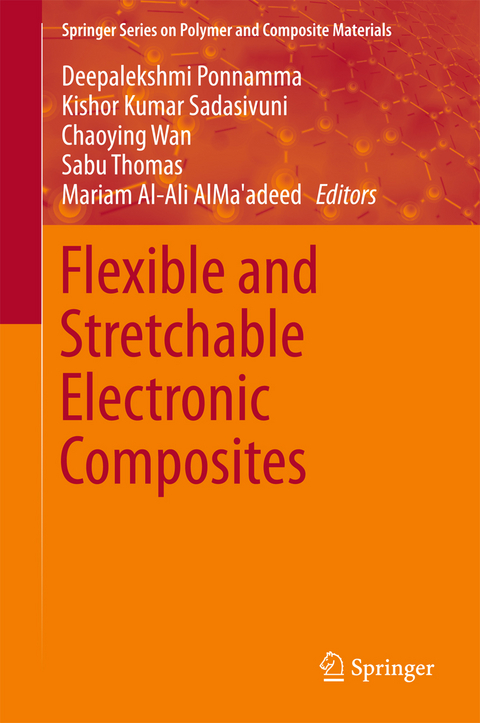
Flexible and Stretchable Electronic Composites (eBook)
390 Seiten
Springer International Publishing (Verlag)
978-3-319-23663-6 (ISBN)
The book is structured and organized by the rubber/elastomer type: each chapter describes a different elastomer matrix and its composites. While introducing to important fundamentals, it is application-oriented, discussing the current issues and challenges in the field of elastomer composites. This book will thus appeal to researchers and scientists, to engineers and technologists, but also to graduate students, working on elastomer composites, or on electronics engineering with the composites, providing the readers with a sound introduction to the field and solutions to both fundamental and applied problems.
Dr. Deepalekshmi Ponnamma works at the University of Qatar. Her research in the field of polymer elastomers (among other topics) has been published in international journals and book contributions, and has been awarded at several international conferences with best poster and oral presentation awards. Deepalekshmi Ponnamma already is experienced book editor.
Dr. Kishor Kumar Sadasivuni is an experienced researcher in the fields of polymers, elastomers and composites. He has been involved in the publication of several papers in international journals and of book chapters and has already coedited several books in his area of expertise.
Dr. Chaoying Wan joined WMG, University of Warwick, Coventry, UK as Assistant Professor in Nanocomposites in 2012. She had gained her PhD degree in Materials Science in 2004, and has conducted postdoctoral research at Loughborough University UK from 2006 to 2008. She was a Marie Curie Fellow at Trinity College Dublin during 2009 and 2011.
Prof. Sabu Thomas is listed in position of no. 5 in the list of most productive researchers in India. He has published over 600 peer reviewed publications, reviews and book chapters (h-index 65, with over 15000 citations) in the fields of polymers, elastomers, composites, blends, and connected fields. Sabu Thomas has co-edited 30 books and is the inventor of 3 patents.
Professor Mariam AlMaadeed is the director of the Center for Advanced Materials at Qatar University. She received her PhD in Materials Science from Alexandria University in Alexandria, Egypt in 2001 and joined the Physics Department at Qatar University in the same year. Mariam has had a long experience and a large body of internationally recognized work in the field of polymers characterization and structure, as well as in nanocomposites and nanotechnology techniques. Her work is featured in more than 80 journals and conference publication
s. Dr. Mariam has many research grants as PI and Co-PI on different projects with total funds amounting to approximately $6,700,000 during the last five years.Dr. AlMaadeed has given many consultations and workshops to a diverse group of organizations such as industries and ministries, as well as the community. She is currently a member of Research Council Committee, Quality and Management Committee and New Reform Committee. Dr. Mariam designed and contributed to many workshops, symposiums and conferences in the field of materials science and in teaching and learning strategies. Among the accolades she has received is the Physics State Award on 2010/ 2011 and the Gulf Petrochemical Association (GPCA) Plastic Excllence Award 2014.
Dr. Deepalekshmi Ponnamma works at the University of Qatar. Her research in the field of polymer elastomers (among other topics) has been published in international journals and book contributions, and has been awarded at several international conferences with best poster and oral presentation awards. Deepalekshmi Ponnamma already is experienced book editor. Dr. Kishor Kumar Sadasivuni is an experienced researcher in the fields of polymers, elastomers and composites. He has been involved in the publication of several papers in international journals and of book chapters and has already coedited several books in his area of expertise. Dr. Chaoying Wan joined WMG, University of Warwick, Coventry, UK as Assistant Professor in Nanocomposites in 2012. She had gained her PhD degree in Materials Science in 2004, and has conducted postdoctoral research at Loughborough University UK from 2006 to 2008. She was a Marie Curie Fellow at Trinity College Dublin during 2009 and 2011. Prof. Sabu Thomas is listed in position of no. 5 in the list of most productive researchers in India. He has published over 600 peer reviewed publications, reviews and book chapters (h-index 65, with over 15000 citations) in the fields of polymers, elastomers, composites, blends, and connected fields. Sabu Thomas has co-edited 30 books and is the inventor of 3 patents. Professor Mariam AlMaadeed is the director of the Center for Advanced Materials at Qatar University. She received her PhD in Materials Science from Alexandria University in Alexandria, Egypt in 2001 and joined the Physics Department at Qatar University in the same year. Mariam has had a long experience and a large body of internationally recognized work in the field of polymers characterization and structure, as well as in nanocomposites and nanotechnology techniques. Her work is featured in more than 80 journals and conference publications. Dr. Mariam has many research grants as PI and Co-PI on different projects with total funds amounting to approximately $6,700,000 during the last five years. Dr. AlMaadeed has given many consultations and workshops to a diverse group of organizations such as industries and ministries, as well as the community. She is currently a member of Research Council Committee, Quality and Management Committee and New Reform Committee. Dr. Mariam designed and contributed to many workshops, symposiums and conferences in the field of materials science and in teaching and learning strategies. Among the accolades she has received is the Physics State Award on 2010/ 2011 and the Gulf Petrochemical Association (GPCA) Plastic Excllence Award 2014.
Contents 6
Natural Polyisoprene Composites and Their Electronic Applications 8
Abstract 8
1 Introduction 9
2 NR-Based Composites 12
2.1 Synthesis Methods 12
2.1.1 Solution Processing 12
2.1.2 Melt Processing 12
2.1.3 Latex-Stage Compounding 14
2.2 NR Composite Applications 14
2.2.1 Electromagnetic Interference Shielding 14
2.2.2 Microwave Absorption 16
2.2.3 Sensing Properties 19
2.2.4 Dielectric Property 22
2.2.5 Thermal Conductivity 27
2.2.6 Shape Memory Materials 29
2.2.7 Actuators 33
3 Conclusions 35
References 35
Electronic Applications of Polymer Electrolytes of Epoxidized Natural Rubber and Its Composites 43
Abstract 43
1 Introduction to Epoxidized Natural Rubber 43
1.1 Structure and Composition 43
1.2 Synthesis Pathways 44
1.3 Characteristics 46
1.3.1 1H-Nuclear Magnetic Resonance (1H-NMR) 46
1.3.2 Fourier Transform Infrared Spectroscopy (FTIR) 47
1.3.3 Thermal Properties 47
1.3.4 X-ray Diffraction 48
1.3.5 Mechanical Properties 49
1.3.6 Air Permeability 49
1.3.7 Aging Behavior 50
1.4 Techniques to Determine Epoxide Content 51
1.5 Applications of ENR 52
2 Electronic Applications of ENR 52
2.1 Solid Polymer Electrolytes (SPEs) 52
2.1.1 ENR 53
2.1.2 ENR Composites 55
2.1.3 ENR-Based Blends 56
2.1.4 ENR-Blend Composites 58
2.2 Gel Polymer Electrolytes (GPEs) 58
2.2.1 ENR 58
2.2.2 ENR Blend 59
3 Conclusion 60
References 60
Electronic Applications of Ethylene Vinyl Acetate and Its Composites 66
Abstract 66
1 Introduction of EVA 66
1.1 Synthesis and Structure of EVA Copolymers 67
1.2 Relationship of Structure and Properties 68
2 Electronic Application of EVA Copolymers 70
2.1 Supercapacitors 72
2.2 Actuators 75
2.3 EMI Shielding 78
2.4 Sensors 82
2.5 Photovoltaic Modules 83
2.6 Flame-Retardant Properties 85
3 The Challenges and Perspectives of EVA and EVA-Based Composites 86
References 87
Electronic Applications of Polyurethane and Its Composites 91
Abstract 91
1 Introduction 91
2 Shape Memory Applications 92
2.1 Thermoresponsive Shape Memory Effect 94
2.2 Electrically Triggered Shape Memory Effect 97
2.3 Light-Responsive Shape Memory Effect 99
2.4 Magnetically Triggered Shape Memory Effect 99
2.5 Moisture-Solvent-Driven Shape Memory Effect 100
2.6 Multistimuli-Responsive Shape Memory Effect 101
3 Sensors 102
3.1 Gas Sensors 102
3.2 Biosensors 104
3.3 Strain Sensors 106
3.4 Ion Sensors 107
4 Polyurethane-Based Actuators 107
4.1 Electrical Actuators 107
4.2 Thermoresponsive and pH-Sensitive Actuators 110
4.3 Optical Actuators 111
4.4 Pneumatic Actuators 112
5 EMI Shielding 114
5.1 Carbon NanotubePolyurethane Composites 114
5.2 GrapheneOther Fillers—Polyurethane Composites 115
5.3 Polyurethane Blends 116
6 Polymer Electrolytes 116
6.1 Polyurethane-Based Electrolytes 117
6.2 PUPVDF Blends-Based Electrolytes 119
6.3 Polyurethane Composites-Based Electrolytes 120
7 Flexible and Printed Electronics 120
8 Energy Harvesting 125
9 Conclusions 128
References 128
Electronic Applications of Polyamide Elastomers and Its Composites 139
Abstract 139
Abbreviations 139
1 Introduction 140
2 Structure and Synthesis of TPE-A 141
3 Properties 145
4 TPE-A Market 148
5 Applications 150
5.1 Cable Insulators 150
5.2 Antistatic Blends and Composites 155
5.3 Conductive Composites and Nanocomposites 157
5.4 Sensors 158
5.5 Textiles Composites 159
6 Conclusions 161
References 161
Electronic Applications of Polyacrylic Rubber and Its Composites 165
Abstract 165
1 Introduction 166
2 History 167
3 Electrical Application of Pristine ACM Rubbers 168
3.1 ACM Rubbers as the Sealing Rubber for Electric Motors 168
3.2 ACM Rubbers as the Dielectric Electroactive Polymers 168
3.2.1 Artificial Muscles for Robots 176
3.2.2 Optical Switches, Micro-lenses, and Tunable Transmission Gratings 180
3.2.3 Diaphragm Actuators 181
3.2.4 Motors 184
3.2.5 Generators 186
3.2.6 Sensor 187
3.2.7 Variable-Stiffness Devices 189
4 Electrical Application of ACM Rubbers Composites 190
4.1 Conductive ACM Rubbers as Electromagnetic Interference (EMI) Shielding Materials 190
4.2 Electrorheological (ER) Material Based on ACMs 195
4.2.1 ER Material Based on ACMPiezoelectric Particles 196
4.2.2 ER Material Based on ACMConductive Polymer Particles 198
5 Summary 200
References 200
Electronic Applications of Polydimethylsiloxane and Its Composites 203
Abstract 203
1 Introduction 203
2 Structure and Properties 205
3 Preparation and Characterizations 206
4 Electronic Applications of PDMS Composites 207
4.1 Sensors 207
4.2 Actuators 210
4.3 Piezoelectric Properties 213
4.4 Dielectric Properties and Super Capacitors 217
4.5 Thermal Conductivity 223
4.6 Other Electronic Applications 224
5 Conclusion 228
References 228
Chlorosulphonated Polyethylene and Its Composites for Electronic Applications 233
Abstract 233
Abbreviations 234
1 Introduction 235
2 Why Chlorosulphonated Polyethylene? 237
2.1 Synthesis Methods of Chlorosulphonated Polyethylene 238
3 Filler-Impregnated Chlorosulphonated Polyethylene Composites 240
4 Electronic Applications 244
4.1 Conducting Coating Application 244
4.2 Wire and Cable Application 245
4.2.1 Special-Purpose Flame-Resistant Cable Application 248
4.2.2 Shielded Electronic Cable Application 248
4.3 CSM Applications in Sensor and Actuator Field 249
4.3.1 Why Elastomers Deform in the Presence of Electric Stimuli? 252
4.4 CSM-Based Radiation Shielding Applications 254
4.4.1 Mechanisms of Electromagnetic Interference (EMI) Shielding 254
Primary Mechanism of Shielding: Reflection 254
Secondary Mechanism of Shielding: Absorption 254
Theory of Multiple Reflections 255
4.4.2 Chlorosulphonated Polyethylene Used in Radiation Shielding Applications 256
5 Conclusion 258
References 259
Electronic Applications of Styrene–Butadiene Rubber and Its Composites 264
Abstract 264
1 Introduction 264
2 Relevance of Stretchable Materials in Electronics 265
3 Conductive Styrene–Butadiene Rubber (SBR) Composites 265
3.1 SBRMetal, Metal Oxides and Ceramics 266
3.2 SBRCarbonaceous Materials 269
3.2.1 SBRCarbon Black 269
3.2.2 SBRCarbon Nanotubes (CNTs) 270
3.2.3 SBRGraphene (GN) 272
4 Electronic Applications of SBR Composites 274
4.1 Electromagnetic Interference (EMI) Shielding 274
4.2 Piezoelectric Materials 275
4.3 Other Applications 276
5 Concluding Remarks 276
References 276
Electronic Applications of Chloroprene Rubber and Its Composites 281
Abstract 281
Abbreviations 281
1 Introduction 282
1.1 Chloroprene Rubber: Dipole Structure and Electrical Properties 283
2 Dielectric Properties of Chloroprene Rubber Composites 285
3 Electrical Conductivity of Chloroprene Rubber Composites 288
3.1 Carbon Black (CB)-Based Electrically Conductive Chloroprene Rubber Composites 288
3.2 Carbon Fiber-Based Electrically Conductive Chloroprene Rubber Composites 289
3.3 Effect of Ionic Liquid on the Electrical Conductivity of MWCNT-Filled Chloroprene Rubber Composites 291
4 Effect of Aging on Electrical Properties of Chloroprene Rubber Composites 292
5 Other Potential Applications of Chloroprene Rubber Composites 294
5.1 Electromagnetic Interference (EMI) Shielding 294
5.2 Microwave Absorbance 296
5.3 Electroresponsive Materials 300
5.4 Electrically Conductive Chloroprene Rubber-Based Adhesive 300
6 Summary and Conclusion 302
References 302
Electronic Applications of Ethylene Propylene Diene Monomer Rubber and Its Composites 307
Abstract 307
1 General Aspects of EPDM 307
1.1 Chemistry and Structure 307
1.2 Synthesis, Compounding, and Vulcanization of EPDM 308
1.3 Properties of EPDM 310
2 General Applications of EPDM 311
3 Applications of EPDM as Insulator in Electronic Devices 312
4 Applications of EPDM as Conductor in Electronic Devices 318
4.1 Conductive Composites 318
4.1.1 Composites with Carbon 319
4.1.2 Composites with Expanded Graphite 323
4.1.3 Composites with Conductive Polymers 324
4.1.4 Composites with Ceramics 324
4.1.5 Composites with Inorganic Conductive Fillers 325
4.1.6 Composites with Steel Fibers 326
4.2 Conductive Blends 327
4.3 Conductive Coatings 328
4.4 Conductive Foams 328
4.5 Conductive Nanocomposites 329
5 Conclusions 331
References 331
Poly(Isobutylene-co-Isoprene) Composites for Flexible Electronic Applications 336
Abstract 336
1 Introduction 337
1.1 Butyl Rubber 337
2 Preparation of Butyl Rubber (BR)–Ceramic Composites 340
3 Dielectric Properties 341
3.1 Theoretical Modeling of Relative Permittivity 347
3.2 Temperature Coefficient of Relative Permittivity (??r) 350
3.3 Bending 352
4 Thermal Conductivity 354
4.1 Theoretical Modeling of Thermal Conductivity 357
5 Mechanical Properties 358
6 Moisture Absorption of Composites 359
7 Coefficient of Thermal Expansion 360
8 Conclusions 361
References 362
Nanomaterials-Embedded Liquid Crystal Elastomers in Electronics Devices Application 366
Abstract 366
1 Introduction 367
2 Hybridization of 0D and 1D Nanomaterials with LCEs 368
2.1 Nanoparticles 368
2.2 Nanotubes 371
3 Characteristics and Devices Application 373
3.1 Refreshable Braille Displays 376
3.2 Soft Robotics 379
3.3 Artificial Muscles 382
3.4 Artificial Heliotropism 384
3.5 Magnetic Actuation 385
3.6 Shape Memory 387
4 Conclusions 388
References 389
| Erscheint lt. Verlag | 16.10.2015 |
|---|---|
| Reihe/Serie | Springer Series on Polymer and Composite Materials | Springer Series on Polymer and Composite Materials |
| Zusatzinfo | VI, 390 p. |
| Verlagsort | Cham |
| Sprache | englisch |
| Themenwelt | Naturwissenschaften ► Chemie ► Organische Chemie |
| Technik ► Maschinenbau | |
| Schlagworte | Composites Electronic Engineering • Conductive Elastomer Composites • dielectrics • Electromagnetic Shielding • Flexible electronics • Micro- and Nanofabrication • natural rubber • Piezoelectric Composites • Rubber Composites • Sensors and actuators • Stretchable Electronics Composites • Synthetic Rubber • Wearable electronics |
| ISBN-10 | 3-319-23663-6 / 3319236636 |
| ISBN-13 | 978-3-319-23663-6 / 9783319236636 |
| Informationen gemäß Produktsicherheitsverordnung (GPSR) | |
| Haben Sie eine Frage zum Produkt? |
 PDF (Wasserzeichen)
DRM: Digitales Wasserzeichen
Dieses eBook enthält ein digitales Wasserzeichen und ist damit für Sie personalisiert. Bei einer missbräuchlichen Weitergabe des eBooks an Dritte ist eine Rückverfolgung an die Quelle möglich.
Dateiformat: PDF (Portable Document Format)
Mit einem festen Seitenlayout eignet sich die PDF besonders für Fachbücher mit Spalten, Tabellen und Abbildungen. Eine PDF kann auf fast allen Geräten angezeigt werden, ist aber für kleine Displays (Smartphone, eReader) nur eingeschränkt geeignet.
Systemvoraussetzungen:
PC/Mac: Mit einem PC oder Mac können Sie dieses eBook lesen. Sie benötigen dafür einen PDF-Viewer - z.B. den Adobe Reader oder Adobe Digital Editions.
eReader: Dieses eBook kann mit (fast) allen eBook-Readern gelesen werden. Mit dem amazon-Kindle ist es aber nicht kompatibel.
Smartphone/Tablet: Egal ob Apple oder Android, dieses eBook können Sie lesen. Sie benötigen dafür einen PDF-Viewer - z.B. die kostenlose Adobe Digital Editions-App.
Buying eBooks from abroad
For tax law reasons we can sell eBooks just within Germany and Switzerland. Regrettably we cannot fulfill eBook-orders from other countries.
aus dem Bereich