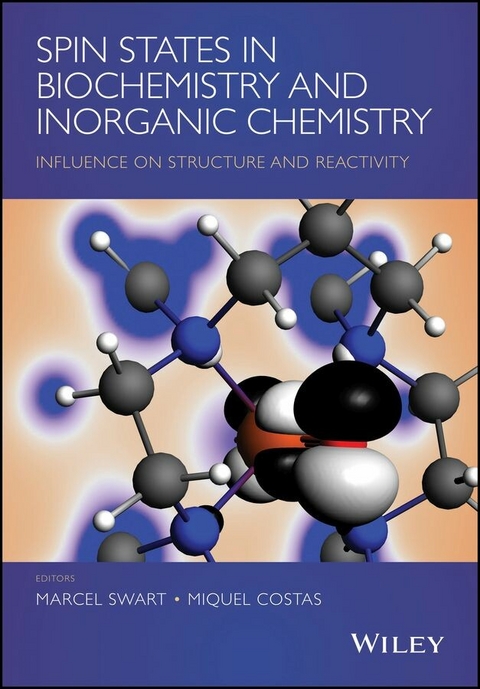
Spin States in Biochemistry and Inorganic Chemistry (eBook)
472 Seiten
Wiley (Verlag)
978-1-118-89828-4 (ISBN)
It has long been recognized that metal spin states play a central role in the reactivity of important biomolecules, in industrial catalysis and in spin crossover compounds. As the fields of inorganic chemistry and catalysis move towards the use of cheap, non-toxic first row transition metals, it is essential to understand the important role of spin states in influencing molecular structure, bonding and reactivity.
Spin States in Biochemistry and Inorganic Chemistry provides a complete picture on the importance of spin states for reactivity in biochemistry and inorganic chemistry, presenting both theoretical and experimental perspectives. The successes and pitfalls of theoretical methods such as DFT, ligand-field theory and coupled cluster theory are discussed, and these methods are applied in studies throughout the book. Important spectroscopic techniques to determine spin states in transition metal complexes and proteins are explained, and the use of NMR for the analysis of spin densities is described.
Topics covered include:
- DFT and ab initio wavefunction approaches to spin states
- Experimental techniques for determining spin states
- Molecular discovery in spin crossover
- Multiple spin state scenarios in organometallic reactivity and gas phase reactions
- Transition-metal complexes involving redox non-innocent ligands
- Polynuclear iron sulfur clusters
- Molecular magnetism
- NMR analysis of spin densities
This book is a valuable reference for researchers working in bioinorganic and inorganic chemistry, computational chemistry, organometallic chemistry, catalysis, spin-crossover materials, materials science, biophysics and pharmaceutical chemistry.
Prof. Dr. Marcel Swart, Universitat de Girona, Spain Marcel Swart is ICREA Research Professor in the Institute of Computational Chemistry Catalysis at the Universitat de Girona, Spain. He is a computational/theoretical chemist working in the field of (bio)chemistry and biomedicine. He has published >100 papers in peer-reviewed scientific journals and has an h-index of 26. He was awarded the Young Scientist 2005 award by ICCMSE (International Conference of Computational Methods in Sciences and Engineering), and was selected as one of the promising young inorganic chemists of "The next generation" that were invited to contribute to a special issue of Inorganica Chimica Acta in 2007, and to a special issue of Polyhedron in 2010. In 2012, he was awarded the MGMS Silver Jubilee Prize "for his development of new computational chemistry programs, design of new research tools and application to (bio)chemical systems that are highly relevant for society and science." In September 2012 he organized a CECAM/ESF Workshop on "Spin states in biochemistry and inorganic chemistry", highlighted in Nature Chem. 2013, 5, 7-9. Prof. Dr. Miquel Costas, Universitat de Girona, Spain Miquel Costas became Professor Titular at the University of Girona in 2003. He has published over 70 papers in international journals that have received over 3470 citations. His research interests involve the study of transition metal complexes involved in challenging oxidative transformations, including functionalization of C-H bonds and water oxidation. These systems commonly operate in multistate reactivity scenarios, implicating multiple spin states.
"Spin States in Biochemistry and Inorganic Chemistry: Influence on Structure and Reactivity, edited by Marcel Swart and Miquel Costas is impressive testimony to the advances in theory, computations, and experiment, especially regarding transition metals in recent years, and a revealing look at how much remains to be developed....The authors provide detailed comparison of various computational methods with each other and with experimental data in many cases. Each chapter is an extensively referenced focused review article. Chapters 1-3 emphasize computational methods....No single monograph can encompass a topic as broad as the title of this book, which is almost the entire chemistry of the periodic table. However, for the selected topics, the volume provides a very valuable concise snapshot of the field.Computational chemistry for compounds of CHNO have advanced to the point that many experimentalists can routinely apply standard methods in Gaussian and other such programs with confidence, guided only by the state of the art described in other publications. This book shows that in spite of enormous effort related to transition metal energy states and spin states, even the expert computational chemists need to proceed with caution and compare many functionals"- (Gareth Eaton- December 2016)
1
General Introduction to Spin States
Marcel Swart1,2 and Miquel Costas1
1Institut de Química Computacional i Catàlisi and Departament de Química, Universitat de Girona, Spain
2Institució Catalana de Recerca i Estudis Avançats (ICREA), Barcelona, Spain
1.1 Introduction
Spin is a fundamental property of all elements and molecules, which originates from their unpaired electrons. Spin states have a major role in defining the structure, reactivity, magnetic and spectroscopic properties of a molecule. Furthermore it is possible that more than one spin state is energetically accessible for a given molecule. In such cases, the molecule can accumulate multiple spectroscopic, magnetic and reactivity patterns arising from the different accessible spin states. The ground spin state of most organic molecules is a singlet, that is, they have a closed-shell electronic structure, and other states are energetically not accessible under standard conditions. Important exceptions are carbenes, which can exist as singlet and triplet spin states, and the molecule of dioxygen, whose triplet nature poses kinetic barriers to its thermodynamically favorable reaction with organic matter. The situation is completely reversed when transition metals are present, which makes that different spin states are accessible for the majority of transition metal complexes. This primarily results from the particular nature of d-orbitals of the metals (see Figure 1.1) that are close in energy and which can be occupied in different ways depending on the metal oxidation state, its ligands and its coordination geometry (see Figure 1.1). This picture can be further complicated when ligands are not redox innocent and can have a spin that can also engage in ferro or anti-ferromagnetic interactions with the spin of the metal center.
Figure 1.1 Transition metal d-orbitals shape (left) and orbital-level diagram (right).
Spin states play an important role [1, 2] in metalloenzymatic reactions (e.g. cytochrome P450cam), in metal-oxo complexes, in spin-crossover compounds and even in catalysis processes mediated by organometallic compounds where different reactions take place via different spin states [3, 4]. However, computational studies have shown that a correct description of the spin state is not trivial [1, 5, 6], and a combination of different density functionals (DFT) and/or ab initio methods may be needed. Experimental studies on biomimetic model complexes, enzymes or spin-crossover compounds have added to the complexity, making the spin state a challenging property that is poorly understood [1]. This was the origin for a CECAM/ESF Workshop organized in Zaragoza in September 2012 [7], leading subsequently to a COST Action (CM1305, ECOSTBio).
1.2 Experimental Chemistry: Reactivity, Synthesis and Spectroscopy
Spin states constitute a fundamental aspect of the electronic structure of molecules, and as such spin determines their electronic properties, magnetism and reactivity. Therefore, rationalization of the latter properties in paramagnetic molecules most often requires determination of their spin state. The most important spectroscopic techniques employed to determine spin states in transition metal complexes and proteins have been discussed in Chapter 4, and the use of nuclear magnetic resonance spectroscopy as a tool to shed information on the electronic structure of paramagnetic metal centers, especially those of metalloenzymes, is described in Chapter 16.
Compounds that can exist in multiple spin states open exciting possibilities in a number of fields. An interesting, widely explored case is transition metal centers in octahedral coordination environments with d-electron configurations d4 to d7, which can exist as high spin (HS) and low spin (LS) (see Chapters 5 and 12). Low-spin complexes favor pairing of electrons in t2g orbitals rather than population of eg orbitals, and the opposite happens for high-spin complexes. The energy difference between both states can be small, and with certain stimulus (light, heat or pressure) one can switch the predominant population of the two states in a reversible manner. In the solid state, cooperative intermolecular interactions may install kinetic barriers to spin interconversion, leading to hysteresis effects. In these cases, the system exhibits a bistability, a property that can potentially find use as memory units in electronic devices. Ongoing and exciting efforts in this field target the manipulation of the electronic spin by taking advantage of the quantum mechanical properties at molecular scale (quantum coherence and entanglement) as the key element for realizing quantum computing.
An important consequence of different spin states for a transition metal complex is that because of the change in occupation from non-bonding (dxy, dxz, dyz) to anti-bonding orbitals (dz2, dx2-y2), dramatic changes in spectroscopic properties and the metal–ligand bond distances are observed. For instance, typical FeII–N distances in low (S=0) or intermediate (S=1) are of the order of 1.98–2.09 Å, while for the high-spin state (S=2) distances of 2.15–2.25 Å are observed [8]. When comparing the geometries of low- and high-spin states for one and the same metal–ligand system, one finds usually mainly a lengthening of the metal–ligand distances. However, a recent study showed [9] that if the ligand is flexible enough with a large number of possible ligating atoms, severe changes in the coordination around the metal can be observed for different spin states. This feature is often observed for different oxidation states of a metal (e.g. CuI vs CuII), but is not so common for different spin states of the same metal in the same oxidation state. Translation of spin crossover phenomena in changes in the first coordination sphere of transition metal complexes may allow taking advantage of this property in solution state [10, 11].
The influence of spin states on reactivity can manifest itself in many ways. For example, it is at the basis of the reactions that sustain aerobic life. Spin-forbidden reactions, of, e.g. triplet dioxygen with singlet organic molecules to give singlet-only products, tend to be sluggish, despite being thermodynamically favorable processes. This is altered dramatically by the intermediacy of first-row transition metal ions in low oxidation states (FeII, CuI), which reduce the dioxygen molecule and form peroxide species that can oxidize organic functionalities (non-heme iron oxygenases, and models for the oxidizing species that form in their reactions are discussed in Chapters 10 and 15). Intermediacy of transition metals with multiple spin states in close energetic proximity is also used by nature extensively in order to open reaction paths to catalyze many otherwise unfeasible elementary processes. The interplay of multiple spin states in the oxidation reactivity of P450 is recognized as the origin of its chameleonic reactivity nature [12].
Multiple spin states are usually the result of the different possibilities of accommodating valence electrons in d-orbitals, but sometimes ligands are redox non-innocent (see, for example, Chapter 11) and can either offer ligand-based orbitals to accommodate electrons from the metal center or also transfer electrons to d-orbitals. P450 constitutes again a paradigmatic example for this situation. CpI of P450 is best defined as an oxoiron(IV) center with a porphyrin radical ligand. Occupation of the d-orbitals of the iron center and the porphyrin-based radical with the five electrons produces S=1/2 and S=3/2 systems, close in energy, which exhibit important differences in their reactivity [12].
The idea that the spin state can dramatically influence the reactivity of transition metal centers, including those present in enzymes, is now commonly accepted but was initially recognized in reactions of transition metal ions in the gas phase. The excellent connection between computational and experimental observations for reactions taking place in this phase converts this field in a powerful tool for exploring and understanding the role of spin state in reactivity (see, e.g. Chapter 8). Joint computational and experimental studies have also produced understanding on the role of spin-state-dependent reactivity in organometallic chemistry (Chapter 6). Novel reactivity principles such as the exchange-enhanced reactivity are also emerging to explain the prevalence of high spin states as the most favorable path in reactions that can occur in multiple spin energy surfaces (Chapter 7). Reactivity patterns of transition metal complexes are often difficult to predict, interpret and/or understand, and this complexity is further accentuated in metalloenzymes. Only through a combination of a variety of techniques can one be assured that the interpretation of experimental and/or computational results is plausible. A number of good examples of this are present in the literature on oxidation states and/or spin states. For instance, until a few years ago the iron–molybdenum cofactor of nitrogenase was thought to consist of only Fe/Mo and sulfurs. However, through a series of breakthroughs [13] of X-ray crystallography, X-ray emission spectroscopy and computational chemistry, it was finally determined that...
| Erscheint lt. Verlag | 22.9.2015 |
|---|---|
| Sprache | englisch |
| Themenwelt | Naturwissenschaften ► Biologie ► Biochemie |
| Naturwissenschaften ► Chemie ► Anorganische Chemie | |
| Technik | |
| Schlagworte | Bioanorganische Chemie • Biochemie u. Chemische Biologie • Biochemistry (Chemical Biology) • bioinorganic chemistry • Chemie • Chemistry • Computational Chemistry & Molecular Modeling • Computational Chemistry u. Molecular Modeling • spin-states, biochemistry, inorganic chemistry, reactivity, density functional theory, molecular magnetism, ligand-field DFT, molecular discovery |
| ISBN-10 | 1-118-89828-1 / 1118898281 |
| ISBN-13 | 978-1-118-89828-4 / 9781118898284 |
| Informationen gemäß Produktsicherheitsverordnung (GPSR) | |
| Haben Sie eine Frage zum Produkt? |
 EPUB (Adobe DRM)
Kopierschutz: Adobe-DRM
Adobe-DRM ist ein Kopierschutz, der das eBook vor Mißbrauch schützen soll. Dabei wird das eBook bereits beim Download auf Ihre persönliche Adobe-ID autorisiert. Lesen können Sie das eBook dann nur auf den Geräten, welche ebenfalls auf Ihre Adobe-ID registriert sind.
Details zum Adobe-DRM
Dateiformat: EPUB (Electronic Publication)
EPUB ist ein offener Standard für eBooks und eignet sich besonders zur Darstellung von Belletristik und Sachbüchern. Der Fließtext wird dynamisch an die Display- und Schriftgröße angepasst. Auch für mobile Lesegeräte ist EPUB daher gut geeignet.
Systemvoraussetzungen:
PC/Mac: Mit einem PC oder Mac können Sie dieses eBook lesen. Sie benötigen eine
eReader: Dieses eBook kann mit (fast) allen eBook-Readern gelesen werden. Mit dem amazon-Kindle ist es aber nicht kompatibel.
Smartphone/Tablet: Egal ob Apple oder Android, dieses eBook können Sie lesen. Sie benötigen eine
Geräteliste und zusätzliche Hinweise
Buying eBooks from abroad
For tax law reasons we can sell eBooks just within Germany and Switzerland. Regrettably we cannot fulfill eBook-orders from other countries.
aus dem Bereich