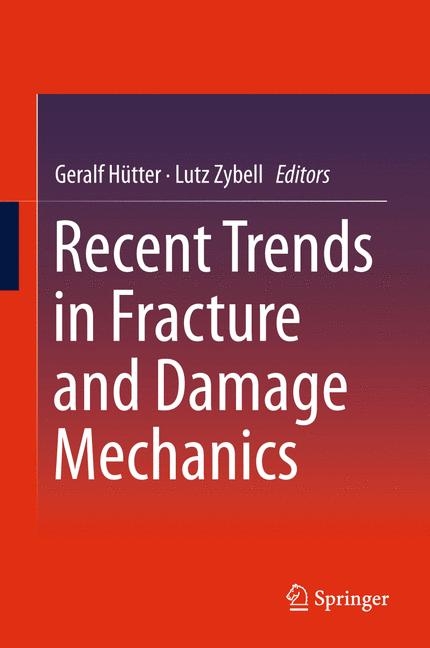
Recent Trends in Fracture and Damage Mechanics (eBook)
IX, 442 Seiten
Springer International Publishing (Verlag)
978-3-319-21467-2 (ISBN)
This book covers a wide range of topics in fracture and damage mechanics. It presents historical perspectives as well as recent innovative developments, presented by peer reviewed contributions from internationally acknowledged authors.
The volume deals with the modeling of fracture and damage in smart materials, current industrial applications of fracture mechanics, and it explores advances in fracture testing methods. In addition, readers will discover trends in the field of local approach to fracture and approaches using analytical mechanics.
Scholars in the fields of materials science, engineering and computational science will value this volume which is dedicated to Meinhard Kuna on the occasion of his 65th birthday in 2015. This book incorporates the proceedings of an international symposium that was organized to honor Meinhard Kuna's contributions to the field of theoretical and applied fracture and damage mechanics.
Preface 5
Contents 7
Part IHistorical Perspective 10
1 Meinhard Kuna: Physics and Engineering at the Crack Tip---A Retrospective 11
1 A Brief Scientific Biography 11
2 The Making of an Engineering Physicist in Fracture and Damage Mechanics 15
2.1 Studies at TU Magdeburg and Working at IFE Halle Until 1990 15
2.2 The Time After the Reunification of Germany 21
2.3 Professorship at TU Bergakademie Freiberg 23
References 27
2 Experimental and Numerical Fracture Mechanics---An Individually Dyed History 31
Abstract 31
1 Introduction 31
2 Linear Elastic Fracture Mechanics (LEFM) 32
2.1 Fundamentals 32
2.1.1 Historic Development 32
2.1.2 Non-singular Terms 34
2.2 Crack Extension by Fatigue 35
3 Elastic-Plastic Fracture Mechanics (EPFM) 38
3.1 Crack Extension: JR-Curves 39
3.2 Energy Dissipation Rate 40
3.3 The CTOD Concept 41
4 Test Procedures 44
4.1 Some Test Techniques 44
4.2 Harmonisation of Test Procedures 46
5 Assessment Procedures 47
6 Models of the Process Zone 52
6.1 Damage Models 53
6.2 Cohesive Models 56
7 Conclusions 59
References 60
Part IIApplications 66
3 Fracture Mechanics Assessment of Welded Components at Static Loading 67
Abstract 67
1 Introduction 67
2 Inhomogeneity of the Microstructure and Strength Mismatch 68
3 Welding Residual Stresses 72
4 Strength Mismatch and Residual Stresses in Determining the Fracture Toughness 76
5 Fracture Mechanics Assessment of Components 80
5.1 General 80
5.2 Consideration of Strength Mismatch 82
5.3 Considering Welding Residual Stresses 84
5.4 Validation of the SINTAP Strength Mismatch Option 86
6 Application to a Component with Strength Mismatch 87
7 Summary 90
References 91
4 Application of Fracture Mechanics for the Life Prediction of Critical Rotating Parts for Aero Engines 93
Abstract 93
1 Introduction 93
2 Material A718Plus 95
3 Material Testing 96
4 Validation 98
5 Modelling 101
6 Summary and Outlook 106
Acknowledgments 106
References 107
5 Consideration of Fatigue Crack Growth Aspects in the Design and Assessment of Railway Axles 108
Abstract 108
1 Introduction 108
2 Review of Fatigue Crack Growth Data for Railway Axle Materials 109
2.1 Material Characterisation 109
2.2 Effect of Specimen Geometry 111
3 Stress Analysis for Railway Axles 113
3.1 Example of Stress Calculations 113
3.2 Effect of Press Fit Conditions 115
4 Stress Intensity Factors for Surface Cracks in Axles 117
5 Fatigue Crack Growth Calculations 119
6 Notes on Crack Growth Behaviour in Press Fits 123
7 Conclusions 126
Acknowledgments 127
References 127
Part IIIFracture Testing 130
6 Assessment of Material Properties by Means of the Small Punch Test 131
Abstract 131
1 Introduction 131
2 Literature Review 133
3 Material Modelling 140
4 Parameter Identification 144
5 Applications 148
5.1 Damage Mechanical Assessment of a Gas Pipe Weld Line 148
5.2 Characterization of Carbon Bonded Alumina 153
6 Conclusions and Discussion 156
Acknowledgments 156
References 156
7 Determination of Fracture Mechanics Parameters for Cast Iron Materials Under Static, Dynamic and Cyclic Loading 162
Abstract 162
1 Introduction 162
2 Static Loading 163
3 Dynamic Loading 173
4 Cyclic Loading Conditions 180
4.1 Constant Amplitude Loading 181
4.2 Variable Amplitude Loading 192
5 Summary 196
References 197
8 On the Development of Experimental Methods for the Determination of Fracture Mechanical Parameters of Ceramics 200
Abstract 200
1 Introduction 200
2 Theoretical Background 201
2.1 Strength of Ceramics 202
2.2 Toughness of Ceramics 203
2.3 Principle of Fracture Toughness Measurements 204
3 Development of Fracture Mechanics Measurements 205
3.1 Testing of Metals: ASTM E399 205
3.2 Early Techniques Used for Ceramics 206
4 Fracture Toughness Testing of Ceramics 206
4.1 Tests on Bend Bars 207
4.1.1 Pre-cracked Bend Bars 207
4.1.2 Notched Bars 208
4.1.3 Indentation Cracks in Bending 209
4.2 Indentation Cracks---Direct Measurements 210
4.3 Comparison of Methods 211
5 Recent Developments 211
6 Summary 212
References 213
9 Transition from Flat to Slant Fracture in Ductile Materials 218
Abstract 218
1 Introduction 218
2 Experimental Procedure 221
3 Experimental Results 223
4 Microscopic Observations 229
4.1 Fracture Surface Observations: Cross-Sectional Planes 230
4.2 Quantitative Microscopy and Grain Based Strain Measurements 232
5 Conclusions 234
Acknowledgements 235
Appendix: Determination of the Stress from Strain Measurements 235
References 237
Part IVSmart Materials 239
10 Interaction of Cracks and Domain Structures in Thin Ferroelectric Films 240
Abstract 240
1 Introduction 241
2 Phase Field Model 242
3 Crack Face Conditions 246
4 Numerical Simulations 247
4.1 Problem Setup 248
4.2 Crack Tip Driving Forces 249
5 Discussion 253
Acknowledgments 254
References 254
11 Modeling Approaches to Predict Damage Evolution and Life Time of Brittle Ferroelectrics 257
Abstract 257
1 Introduction 257
2 Ferroelectric Constitutive Behavior: A Microphysical Approach 259
2.1 Thermodynamical Fundamentals 259
2.2 Evolution of Internal Variables of Domain Wall Motion 260
3 A Condensed Approach for Polycrystalline Ferroelectrics 262
3.1 Theoretical Background 262
3.2 Results for the Condensed Model: Constitutive Behavior 265
4 Modeling of Damage Evolution in Ferroelectrics 266
4.1 Homogenisation and Effective Material Properties in Piezoelectrics 267
4.2 Modeling of the Defect Phase 268
4.3 Damage Evolution and Accumulation Model for High Cycle Fatigue and Life Time Prediction 272
5 Results of Damage and Lifetime Predictions in Electromechanically Loaded Ferroelectrics 275
5.1 Life Time Prediction at High Cycle Fatigue 275
5.2 Damage of a Stack Actuator Due to Poling 279
6 Conclusions 280
References 281
12 Numerical Analysis of Interface Cracks in Layered Piezoelectric Solids 283
Abstract 283
1 Introduction 283
2 Problem Formulation 284
3 Time-Domain Boundary Integral Equations and Fundamental Solutions 286
4 Numerical Solution Algorithm 288
5 Intensity Factors for an Interfacial Crack 290
6 Numerical Examples 291
6.1 A Central Interface Crack in a Layered Rectangular Plate 291
6.2 A Rectangular Plate with Two Interface Cracks 295
7 Conclusions 299
Acknowledgments 299
References 299
Part VAnalytical Mechanics 300
13 Crack-Tip Fields of a Crack Impinging upon the Yielding/Debonding Slippage in Anisotropic Body 301
Abstract 301
1 Introduction 301
2 Problem Statements 302
3 Fundamental Solutions 304
3.1 Stress Fields of a Crack in an Anisotropic Homogeneous Body 304
3.2 Fundamental Solution of a Sliding Dislocation in an Anisotropic Body 305
3.3 Appendix Fields for Removing the Stress on the Crack Surface Induced by the Dislocations 307
3.4 Singular Integral Equation to Determine the Dislocation Distribution and Its Numerical Implementation 311
4 Numerical Results and Discussions 312
5 Conclusions 314
Acknowledge 315
References 315
14 On Conservation Laws and Reciprocity in Configurational Mechanics 317
Abstract 317
1 Introduction 317
2 Conservation Laws of Linear Elasticity 319
3 Application in Fracture Mechanics 325
4 Material Reciprocity Relations 327
5 Conclusion 330
References 331
Part VILocal Approach to Fracture 332
15 A Model for Predicting Fracture Toughness and Scatter in Thermally Embrittled Steels 333
Abstract 333
1 Introduction 334
2 Material and Experimental Procedures 336
3 Results 337
3.1 Mechanical Tests 337
3.2 Fractography 339
3.3 Auger Spectroscopy 339
4 Modelling 341
4.1 Intergranular Segregation 341
4.2 Effect of Grain Boundary Segregation on Fracture Toughness 343
5 Conclusions 346
Acknowledgments 346
References 347
16 Micromechanical-Based Models for Describing Damage of Ferritic Steels 349
Abstract 349
1 Introduction 349
2 Failure by Void Initiation, Growth and Coalescence [244] 350
2.1 Formation of Voids 352
2.1.1 Which Deformations Lead to Voids? 355
2.1.2 At Which Particles Void Initiation Takes Place? 356
2.2 Void Growth 357
2.2.1 Dependence of Void Growth on Stress Multiaxiality 357
2.2.2 Dependence of Void Growth on Particle Form and Size 358
2.2.3 Void Locking 358
2.2.4 Dependence of Void Growth on the Yield Strength and the Hardening of the Matrix Material 359
2.3 Coalescence of Voids 359
2.3.1 Influence of the Stress Multiaxiality on Void Coalescence 362
2.3.2 Effect of Void Formation on the Void Coalescence 363
2.3.3 Influence of the Materials on the Coalescence 364
3 Continuum Mechanical Models for Failure by Void Initiation, Growth and Coalescence [244] 364
3.1 Models Describing Void Initiation 366
3.1.1 Void Initiation Model of Tanaka et al. 367
3.1.2 Void Initiation Model of Argon, Im and Safoglu 368
3.1.3 Void Initiation Model of Gurson 368
3.1.4 Void Initiation Model of Goods and Brown 368
3.1.5 Void Initiation Model Acc. to Chu and Needleman 369
3.1.6 Void Initiation Model of Beremin 370
3.1.7 Void Initiation Model of Huber et al. 370
Void Initiation Model of Morgeneyer et al. 371
3.1.8 Void Initiation Caused by Particle Fracture 371
3.2 Models Describing Void Growth 372
3.2.1 Uncoupled Models 373
McClintock Model 373
Rice and Tracey Model 373
3.2.2 Coupled Models 374
Lemaitre Type Models 374
Gurson Model 376
Rousselier Model 379
3.2.3 Discussion of the Void Growth Models 380
3.3 Models to Describe Void Coalescence 381
3.3.1 Coalescence When Reaching a Critical Void Volume, a Critical Void Growth or a Critical Damage Condition 382
3.3.2 Coalescence Triggered by Formation of Shear Bands Between Voids 383
3.3.3 Plastic Limit Load-Model by Thomason for the Calculation of Void Coalescence 383
3.3.4 Yield Criterion to Describe Material Behaviour in the Case of Plastic Collapse 386
3.3.5 Simulation of Void Coalescence Using Void Growth Models 386
3.3.6 Discussion of the Models Describing Void Coalescence 387
3.4 Common Combinations of Damage Models and a Comparison 387
3.4.1 Gurson, Tvergaard and Needleman (GTN) Model Combinations 387
3.4.2 Rousselier Seidenfuss (RS) Model Combination 388
3.4.3 Gologanu, Leblond and Devaux (GLD) Model with Thomason-Criterion 388
3.5 Mesh Dependency of Results and Definition of a Characteristic Length 389
3.6 Determination of the Material Dependent Parameters 390
3.6.1 Determination of the Parameters Out of the Microstructure of the Material 390
3.6.2 Direct or Iterative Determination Out of Macroscopically Measured Values from Simple Specimens 390
3.6.3 Adaption to Results of Cell Model Computations 391
3.7 Concluding Remarks Considering Damage-Mechanical Models 391
4 Nonlocal Damage Models 392
4.1 Localization 393
4.2 Regularization Methods, Non-local Formulations 393
4.2.1 Nonlocal Integral Types 394
4.2.2 Explicit Gradient Formulations 395
4.2.3 Implicit Gradient Formulations 395
4.2.4 Non-local Formulations of Ductile Damage Models 396
5 Combination of Damage Models in the Brittle-Ductile Transition Region 396
5.1 Beremin Model---Uncoupled Probabilistic Model for Cleavage Fracture 397
5.2 Coupled Models for Cleavage Softening 398
6 Conclusions 399
References 400
17 Recent Trends in the Development of Gurson's Model 413
Abstract 413
1 Introduction 413
2 Development of Gurson's Model 414
3 Development of Models for Nucleation, Growth and Coalescence of Voids 427
4 Modification of Gurson's Model for Failure Prediction Under Shear Deformation 431
5 Conclusions 432
References 435
| Erscheint lt. Verlag | 1.9.2015 |
|---|---|
| Zusatzinfo | IX, 442 p. 246 illus., 123 illus. in color. |
| Verlagsort | Cham |
| Sprache | englisch |
| Themenwelt | Mathematik / Informatik ► Informatik |
| Mathematik / Informatik ► Mathematik ► Wahrscheinlichkeit / Kombinatorik | |
| Technik ► Maschinenbau | |
| Schlagworte | damage mechanics • fracture mechanics • Material Testing • Meinhard Kuna • Smart Materials |
| ISBN-10 | 3-319-21467-5 / 3319214675 |
| ISBN-13 | 978-3-319-21467-2 / 9783319214672 |
| Informationen gemäß Produktsicherheitsverordnung (GPSR) | |
| Haben Sie eine Frage zum Produkt? |
 PDF (Wasserzeichen)
DRM: Digitales Wasserzeichen
Dieses eBook enthält ein digitales Wasserzeichen und ist damit für Sie personalisiert. Bei einer missbräuchlichen Weitergabe des eBooks an Dritte ist eine Rückverfolgung an die Quelle möglich.
Dateiformat: PDF (Portable Document Format)
Mit einem festen Seitenlayout eignet sich die PDF besonders für Fachbücher mit Spalten, Tabellen und Abbildungen. Eine PDF kann auf fast allen Geräten angezeigt werden, ist aber für kleine Displays (Smartphone, eReader) nur eingeschränkt geeignet.
Systemvoraussetzungen:
PC/Mac: Mit einem PC oder Mac können Sie dieses eBook lesen. Sie benötigen dafür einen PDF-Viewer - z.B. den Adobe Reader oder Adobe Digital Editions.
eReader: Dieses eBook kann mit (fast) allen eBook-Readern gelesen werden. Mit dem amazon-Kindle ist es aber nicht kompatibel.
Smartphone/Tablet: Egal ob Apple oder Android, dieses eBook können Sie lesen. Sie benötigen dafür einen PDF-Viewer - z.B. die kostenlose Adobe Digital Editions-App.
Buying eBooks from abroad
For tax law reasons we can sell eBooks just within Germany and Switzerland. Regrettably we cannot fulfill eBook-orders from other countries.
aus dem Bereich