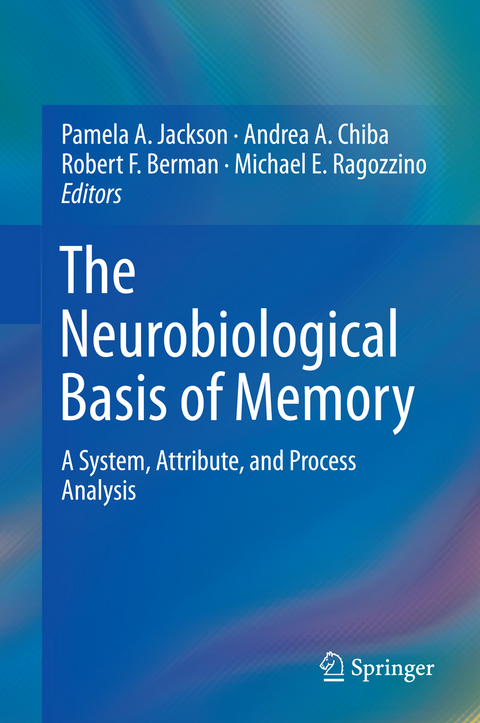
The Neurobiological Basis of Memory (eBook)
XXV, 428 Seiten
Springer International Publishing (Verlag)
978-3-319-15759-7 (ISBN)
This exciting volume offers an up-to-date tour of current trends in the neurobiology of memory while saluting Raymond Kesner's pioneering contributions to the field as a theorist and researcher, teacher and mentor. Starting with his signature chapter introducing the Attribute Model of Memory, the first half of the book focuses on the central role of the hippocampus in processing dimensions of space and time, and branches out to memory system interactions across brain structures. Later chapters apply the attribute model to multiple functions of memory in learning, and to specific neurological contexts, including Huntington's disease, traumatic brain injury, and Fragile X. As a bonus, the book concludes with an essay on Kesner's life and work, and reminiscences by colleagues.
Among the topics covered:
- How the hippocampus supports the spatial and temporal attributes of memory.
- Self-regulation of memory processing centers of the brain.
- Multiple memory systems: the role of Kesner's Attribute Model in understanding the neurobiology of memory.
- Pattern separation: a key processing deficit associated with aging?
· Prefrontal cortex and basal ganglia attributes underlying behavioral flexibility.
- Memory disruption following traumatic brain injury.
Cognitive neuroscientists, neuropsychologists, gerontologists, psychiatrists, and neurobiologists will find The Neurobiological Basis of Memory both enlightening and inspiring--much like Kesner himself.
Robert F. Berman, Ph.D. is Professor and Vice Chair for Research in the Department of Neurological Surgery and a member of the Center for Neuroscience at the University of California Davis. He is also Director of Research for the Neurotrauma Research Laboratories on the faculty of the UC Davis M.I.N.D. Institute. Andrea Chiba is an Associate Professor in the Department of Cognitive Science and in the Program for Neuroscience and Computational Neuroscience at the University of California, San Diego. She is Science Director for the Temporal Dynamics of Learning Center, an NSF Science of Learning Center.
Pamela Jackson is a Professor in the Department of Psychology at Radford University. Her postdoctoral training, with Dr. Raymond Kesner, was in Physiological Psychology at the University of Utah. Her research interests have ranged from spatial learning in hippocampal-lesioned rats and pigeons to the role of the parietal and frontal cortices in implicit and explicit memory.
Michael Ragozzino obtained his Ph.D from the University of Virginia conducting research on the neurochemical mechanisms that underlie learning and memory. He has been a faculty member at the University of Illinois at Chicago since 1999. He currently serves on the editorial board of Behavioral Neuroscience and as director of the Laboratory of Integrative Neuroscience at the University of Illinois at Chicago.
Robert F. Berman, Ph.D. is Professor and Vice Chair for Research in the Department of Neurological Surgery and a member of the Center for Neuroscience at the University of California Davis. He is also Director of Research for the Neurotrauma Research Laboratories on the faculty of the UC Davis M.I.N.D. Institute. Andrea Chiba is an Associate Professor in the Department of Cognitive Science and in the Program for Neuroscience and Computational Neuroscience at the University of California, San Diego. She is Science Director for the Temporal Dynamics of Learning Center, an NSF Science of Learning Center. Pamela Jackson is a Professor in the Department of Psychology at Radford University. Her postdoctoral training, with Dr. Raymond Kesner, was in Physiological Psychology at the University of Utah. Her research interests have ranged from spatial learning in hippocampal-lesioned rats and pigeons to the role of the parietal and frontal cortices in implicit and explicit memory. Michael Ragozzino obtained his Ph.D from the University of Virginia conducting research on the neurochemical mechanisms that underlie learning and memory. He has been a faculty member at the University of Illinois at Chicago since 1999. He currently serves on the editorial board of Behavioral Neuroscience and as director of the Laboratory of Integrative Neuroscience at the University of Illinois at Chicago.
Attribute Memory Model and Behavioral Neurophysiology of Memory.- Prefrontal Cortex and Basal Ganglia Attributes Underlying Behavioral Flexibility.- Balancing the Contributions of Multiple Neural Systems During Learning and Memory.- ATTRIBUTE THEORY OF MEMORY APPLIED TO MODELS OF NEUROLOGICAL DISORDERS:.- Memory Disruption Following Traumatic Brain Injury.- Altered Neural Synchronies Underlying Cognitive Deficits in a Transgenic Mouse Model of Huntington's Disease.- Applying the Attribute Model to Develop Behavioral Tasks that Phenocopy Human Clinical Phenotypes using Mouse Disease Models: An Endophenotyping Approach.- PERSONAL:The Life and Science of Raymond P. Kesner.- Recollections of, and Letters to, Ray Kesner.
| Erscheint lt. Verlag | 19.9.2015 |
|---|---|
| Zusatzinfo | XXV, 428 p. 73 illus., 30 illus. in color. |
| Verlagsort | Cham |
| Sprache | englisch |
| Themenwelt | Geisteswissenschaften ► Psychologie |
| Medizin / Pharmazie ► Studium | |
| Technik | |
| Schlagworte | goal-directed memory retrieval • hippocampus and memory • neurobiology of learning • neurobiology of memory • Raymond P. Kesner • Spatial Memory |
| ISBN-10 | 3-319-15759-0 / 3319157590 |
| ISBN-13 | 978-3-319-15759-7 / 9783319157597 |
| Informationen gemäß Produktsicherheitsverordnung (GPSR) | |
| Haben Sie eine Frage zum Produkt? |
 PDF (Wasserzeichen)
DRM: Digitales Wasserzeichen
Dieses eBook enthält ein digitales Wasserzeichen und ist damit für Sie personalisiert. Bei einer missbräuchlichen Weitergabe des eBooks an Dritte ist eine Rückverfolgung an die Quelle möglich.
Dateiformat: PDF (Portable Document Format)
Mit einem festen Seitenlayout eignet sich die PDF besonders für Fachbücher mit Spalten, Tabellen und Abbildungen. Eine PDF kann auf fast allen Geräten angezeigt werden, ist aber für kleine Displays (Smartphone, eReader) nur eingeschränkt geeignet.
Systemvoraussetzungen:
PC/Mac: Mit einem PC oder Mac können Sie dieses eBook lesen. Sie benötigen dafür einen PDF-Viewer - z.B. den Adobe Reader oder Adobe Digital Editions.
eReader: Dieses eBook kann mit (fast) allen eBook-Readern gelesen werden. Mit dem amazon-Kindle ist es aber nicht kompatibel.
Smartphone/Tablet: Egal ob Apple oder Android, dieses eBook können Sie lesen. Sie benötigen dafür einen PDF-Viewer - z.B. die kostenlose Adobe Digital Editions-App.
Buying eBooks from abroad
For tax law reasons we can sell eBooks just within Germany and Switzerland. Regrettably we cannot fulfill eBook-orders from other countries.
aus dem Bereich