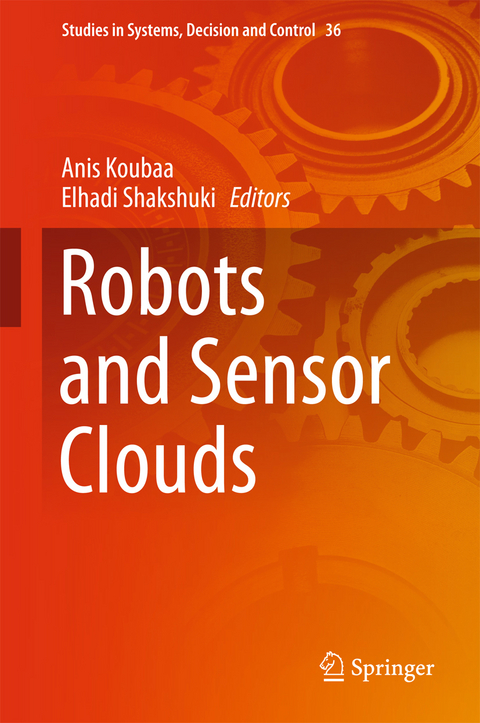
Robots and Sensor Clouds (eBook)
VII, 94 Seiten
Springer International Publishing (Verlag)
978-3-319-22168-7 (ISBN)
This book comprises four chapters that address some of the latest research in clouds robotics and sensor clouds.
The first part of the book includes two chapters on cloud robotics. The first chapter introduces a novel resource allocation framework for cloud robotics and proposes a Stackelberg game model and the corresponding task oriented pricing mechanism for resource allocation. In the second chapter, the authors apply Cloud Computing for building a Cloud-Based 3D Point Cloud extractor for stereo images. Their objective is to have a dynamically scalable and applicable to near real-time scenarios.
Preface 6
Contents 7
Part ICloud Robotics 8
A Pricing Mechanism for Task Oriented Resource Allocation in Cloud Robotics 9
1 Introduction 9
2 Related Work 11
2.1 Service-Oriented Architecture in Cloud Computing 11
2.2 Current Cloud Robotic Systems 12
2.3 Robotic Task Allocation Mechanisms 12
2.4 Resource Allocation Mechanisms 14
3 System Architecture of Cloud Robotics 15
3.1 Structure Design 15
3.2 Resource Management Framework 16
3.3 Data Flow Management 18
3.4 Quality of Service Criteria (QoS) 19
4 A Pricing Resource Allocation Mechanism for MSDR 20
4.1 System Model 20
4.2 Problems and Solutions 21
4.3 Scheduling Scheme 23
5 Simulation 24
5.1 Parameter Investigation 24
5.2 Time Cost of the Scheduling Scheme 26
6 Experiment 27
6.1 Robot Setup 27
6.2 Experiment Design 27
6.3 Qualitative Results on Localization Behavior 30
6.4 Quantitative Results on Resource Allocation 30
6.5 Discussions 31
7 Conclusion 33
References 34
Study of Communication Issues in Dynamically Scalable Cloud-Based Vision Systems for Mobile Robots 38
1 Introduction 38
2 Background 40
3 Related Work 40
4 Cloud Offloading for Robotics Applications 42
5 3D Point Cloud (3DPC) Extraction Platform 45
5.1 Software Implementation 45
5.2 Time Analysis 48
6 Experimental Results 49
6.1 Scalability of the Platform 49
6.2 Communication Technology Performance Measures 50
6.3 Time Delay Measures 51
6.4 Interference Analysis with WiFi AC 52
6.5 Application Case: Navigation Assistant 53
7 Conclusions and Lessons Learned 55
References 56
Part IICloud for the IoT 58
Architecting the Internet of Things: State of the Art 59
1 Introduction 60
2 IoT Building Blocks 61
2.1 Sensing 62
2.2 Middleware 64
2.3 Actuating 65
3 The Proposed IoT Architectures and Classification 66
3.1 High Level Architecture 66
3.2 Tailored Architectures 67
3.3 Clean Slate Architectures 71
4 Critics and Analysis 74
5 Conclusions 77
References 78
Cloud of Things: Integration of IoT with Cloud Computing 80
1 Introduction 81
2 Contributions of the Book Chapter 82
3 Related Work 82
4 Internet of Things 84
5 Cloud Computing 87
6 Cloud of Things 88
7 Challanges Associated with Cloud of Things 89
7.1 Protocol Support 90
7.2 Energy Efficiency 90
7.3 Resource Allocation 91
7.4 Identity Management 91
7.5 IPv6 Deployment 92
7.6 Service Discovery 92
7.7 Quality of Service Provisioning 92
7.8 Location of Data Storage 92
7.9 Security and Privacy 93
7.10 Communication of Unnecessary Data 93
8 Conclusion 94
References 95
| Erscheint lt. Verlag | 17.8.2015 |
|---|---|
| Reihe/Serie | Studies in Systems, Decision and Control | Studies in Systems, Decision and Control |
| Zusatzinfo | VII, 94 p. 27 illus., 26 illus. in color. |
| Verlagsort | Cham |
| Sprache | englisch |
| Themenwelt | Informatik ► Theorie / Studium ► Künstliche Intelligenz / Robotik |
| Technik ► Maschinenbau | |
| Schlagworte | cloud robotics • Computational Intelligence • Intelligent Systems • Sensor Clouds • service robotics |
| ISBN-10 | 3-319-22168-X / 331922168X |
| ISBN-13 | 978-3-319-22168-7 / 9783319221687 |
| Informationen gemäß Produktsicherheitsverordnung (GPSR) | |
| Haben Sie eine Frage zum Produkt? |
 PDF (Wasserzeichen)
DRM: Digitales Wasserzeichen
Dieses eBook enthält ein digitales Wasserzeichen und ist damit für Sie personalisiert. Bei einer missbräuchlichen Weitergabe des eBooks an Dritte ist eine Rückverfolgung an die Quelle möglich.
Dateiformat: PDF (Portable Document Format)
Mit einem festen Seitenlayout eignet sich die PDF besonders für Fachbücher mit Spalten, Tabellen und Abbildungen. Eine PDF kann auf fast allen Geräten angezeigt werden, ist aber für kleine Displays (Smartphone, eReader) nur eingeschränkt geeignet.
Systemvoraussetzungen:
PC/Mac: Mit einem PC oder Mac können Sie dieses eBook lesen. Sie benötigen dafür einen PDF-Viewer - z.B. den Adobe Reader oder Adobe Digital Editions.
eReader: Dieses eBook kann mit (fast) allen eBook-Readern gelesen werden. Mit dem amazon-Kindle ist es aber nicht kompatibel.
Smartphone/Tablet: Egal ob Apple oder Android, dieses eBook können Sie lesen. Sie benötigen dafür einen PDF-Viewer - z.B. die kostenlose Adobe Digital Editions-App.
Buying eBooks from abroad
For tax law reasons we can sell eBooks just within Germany and Switzerland. Regrettably we cannot fulfill eBook-orders from other countries.
aus dem Bereich