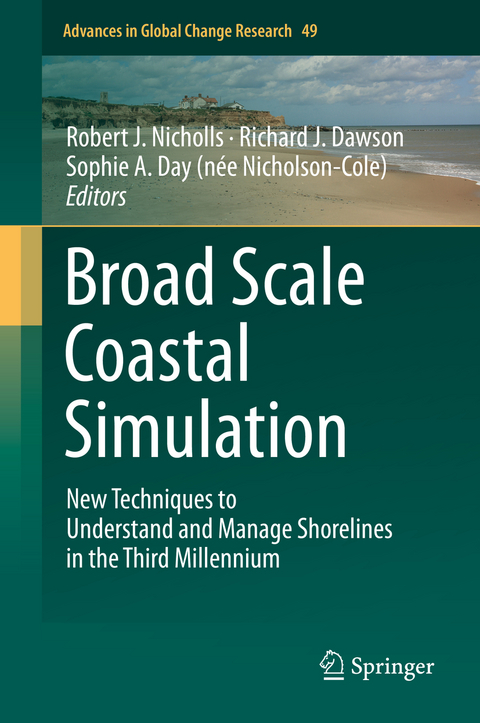
Broad Scale Coastal Simulation (eBook)
XXI, 398 Seiten
Springer Netherland (Verlag)
9789400752580 (ISBN)
Robert Nicholls has studied coastal processes and coastal hazards for the last 25 years. In particular, he has an international reputation concerning climate change in coastal areas, especially the potential impacts and the possible responses. His research has involved studies across a range of scales from local (e.g., small towns) to the global. A distinctive dimension has been consideration of the coastal zone as a series of interacting systems which facilitates policy analysis. He has advised national governments (e.g., UK, Netherlands, Singapore, the Maldives) and intergovernmental organisations (e.g., OECD) on climate change and coastal issues, including as a lead author to five reports of the Intergovernmental Panel for Climate Change assessment process. Currently, he is contributing to a series of research projects, including being Principal Investigator as follows:
- iCOASST - a NERC-funded consortium project on predicting
He was awarded the Roger Revelle Medal by the Intergovernmental Oceanographic Commission in 2008. This recognises 'outstanding contributions to the ocean sciences by inspired researchers who communicate their knowledge and global vision of the challenges facing our Planet in order to shape a better future for humankind'.
See Web page: http://www.southampton.ac.uk/engineering/about/staff/rjn.pageCoastal zones exemplify the environmental pressures we face: their beauty attracts settlement, they offer potential for diverse economic activities, and they are sensitive natural habitats for important species, as well as providing a range of ecosystem services. They are also extremely vulnerable to the vicissitudes of climate change, which include rising sea levels and changes in extreme events such as storms. With large populations living in coastal and estuarine cities facing the ongoing threat of inundation, coordinated management is essential, especially as coastal zones form a linked system in which piecemeal, uncoordinated management could be counterproductive.
Robert Nicholls has studied coastal processes and coastal hazards for the last 25 years. In particular, he has an international reputation concerning climate change in coastal areas, especially the potential impacts and the possible responses. His research has involved studies across a range of scales from local (e.g., small towns) to the global. A distinctive dimension has been consideration of the coastal zone as a series of interacting systems which facilitates policy analysis. He has advised national governments (e.g., UK, Netherlands, Singapore, the Maldives) and intergovernmental organisations (e.g., OECD) on climate change and coastal issues, including as a lead author to five reports of the Intergovernmental Panel for Climate Change assessment process. Currently, he is contributing to a series of research projects, including being Principal Investigator as follows:iCOASST – a NERC-funded consortium project on predicting decadal coastal morphological evolutionESPA Deltas – an ESPA (DFID/NERC/ESRC-funded) project which is examining the future of ecosystem services and human well-being in coastal Bangladesh;DECCMA – a CARRIA (IDRC/DFID-funded) project which is examining adaptation to climate change in the three contrasting deltas of the Volta, Mahanadi and Ganges-Brahmaputra Deltas, with a main focus on migration. He was awarded the Roger Revelle Medal by the Intergovernmental Oceanographic Commission in 2008. This recognises ‘outstanding contributions to the ocean sciences by inspired researchers who communicate their knowledge and global vision of the challenges facing our Planet in order to shape a better future for humankind’.See Web page: http://www.southampton.ac.uk/engineering/about/staff/rjn.page
Chapter 1 - The Challenge for Coastal Management During the Third MillenniumSummary1.1 Introduction1.2 Coastal Management in the Third Millennium: The Need for an Integrated Response1.3 Conceptualizing and Designing a Coastal Simulator1.4 Scenarios for Coastal Assessment1.5 The Study Sites1.6 Conclusions and Next StepsAcknowledgementsReferences Chapter 2 - Climate Downscaling: Local Mean Sea-Level, Surge and Wave ModellingSummary2.1 Introduction2.2. Regional Scale Variability in Climate and Sea Level2.3. Storms in the Present and Future Climate2.4. Model Forcing from Hadley Centre Climate Model2.5. Surge and Wave Models and the Downscaling Methodology2.6. Model Results for Future Climate Scenarios2.7. Conclusions and Next StepsAcknowledgementsReferences Chapter 3 - Broad-Scale Hydrodynamic Simulation, Wave Transformation and Sediment PathwaysSummary 3.1 Introduction3.2 Methodology for Transferring Waves and Surge Towards the Coastline and Assessing Residual Sediment Transport3.3 Changes in Inshore Waves Due to Climate Change and Sea Level Rise 3.4 Influence of Sea Level Rise on Sediment Pathways3.5. Conclusions and Next StepsReferences Chapter 4 – Land Use Dynamics and Coastal Management Summary4.1. Introduction4.2. Modelling Land Use Change in Coastal Areas4.2.1 Challenges4.2.2 Spatial Dynamic Modelling: Some Principles4.2.3 Socio-Economic Storylines4.3. Translating Socio-Economic Storylines with an Algorithm-Based Approach4.4. Translating Socio-Economic Storylines with A Choice-Based Approach4.5. Conclusions and Next StepsReferences Chapter 5 - Evaluating Broad-Scale Morphological Change in the Coastal Zone Using a Logic Based Behavioural Systems ApproachSummary1.1 Introduction1.2 Capturing Current Knowledge and Understanding1.3 Illustrative Application to the East Anglian Coast, UK1.4 Benefits of a Qualitative Deductive Assessment1.5 Conclusions and Next StepsReferences Chapter 6 – Coastal Wetland Habitats: Future Challenges and Potential Solutions Summary 6.1 Introduction 6.2 The Tyndall Simulator Approach6.3 Conclusions and Next Steps References Chapter 7 – Simulating the Shore and Cliffs of North NorfolkSummary7.1 Introduction 7.2 Description of the Coast 7.3 Model Construction 7.4 Future Climate Change and Coastal Management 7.5 Results 7.6 Conclusions and Next Steps References Chapter 8 – Broad Scale Coastal Inundation ModellingSummary 8.1 Introduction 8.2 Approaches to Coastal Inundation Modelling 8.3 Application to North Norfolk 8.4 Conclusions and Next Steps AcknowledgementsReferences Chapter 9 – Broad Scale Flood and Erosion Risk Analysis Chapter 10 – Visualising Potential Coastal Change: Communicating Results Using Visualisation Techniques Summary 10.1 Introduction – Challenges Associated with Communicating and Visualising Coastal Change 10.2 The Coastal Simulator – Visualisation Approach(Es) 10.3 Exploring Coastal Futures – Testing the Visualisations in Coastal Decision-Making and Stakeholder Engagement 10.4 Conclusions and Next Steps References Chapter 11 – The Coastal Simulator Interface: Integration and Application Chapter 12 – Many Stakeholders, Multiple Perspectives: Long-Term Planning for a Future CoastSummary 12.1 Introduction 12.2 The Challenges of a Changeable Coast: North Norfolk, UK 12.3 Stakeholder Engagement in the Development of the Tyndall Coastal Simulator 12.4 Shifting Sands: Lessons Learned for Managing a Changing Coast 12.5 Conclusions and Next Steps References Chapter 13 – Living with Uncertainty: Difficult Choices for Coastal Management in the UK During the Third Millennium Summary 13.1 Introduction 13.2 Re-Visiting the Response to the 1953 Event 13.3 How the Simulator Approach Helps Improve Coastal Management 13.4 The Process of Developing a Coastal Simulator: What Have We Learnt? 13.5 Key Lessons for UK Coastal Management: Transferring the Simulator for Wider Application 13.6 Key Lessons for Researchers and Research Funders to Develop UK Coastal Simulator Capacity References Chapter 14 – Generic Lessons for Coastal Management in the Third Millennium Summary 14.1 Introduction 14.2 Key Threats, Opportunities and Priorities for Adaptation and Development in Coastal Areas in the Next 5 Decades 14.3 Transference of Methods and the Wider Lessons for the International Community14.4 Coastal Management for the Third Millennium – A Manifesto for Research, Development and Collaboration References
| Erscheint lt. Verlag | 26.8.2015 |
|---|---|
| Reihe/Serie | Advances in Global Change Research | Advances in Global Change Research |
| Zusatzinfo | XXI, 398 p. 153 illus., 94 illus. in color. |
| Verlagsort | Dordrecht |
| Sprache | englisch |
| Themenwelt | Mathematik / Informatik ► Informatik ► Web / Internet |
| Naturwissenschaften ► Biologie ► Ökologie / Naturschutz | |
| Naturwissenschaften ► Geowissenschaften ► Geografie / Kartografie | |
| Naturwissenschaften ► Geowissenschaften ► Geologie | |
| Sozialwissenschaften ► Politik / Verwaltung | |
| Technik ► Bauwesen | |
| Schlagworte | climate change • Coastal • Coastal Sciences • Erosion • Flooding • Integrated Assessment Modelling • Landscape/Regional and Urban Planning |
| ISBN-13 | 9789400752580 / 9789400752580 |
| Informationen gemäß Produktsicherheitsverordnung (GPSR) | |
| Haben Sie eine Frage zum Produkt? |
 PDF (Wasserzeichen)
DRM: Digitales Wasserzeichen
Dieses eBook enthält ein digitales Wasserzeichen und ist damit für Sie personalisiert. Bei einer missbräuchlichen Weitergabe des eBooks an Dritte ist eine Rückverfolgung an die Quelle möglich.
Dateiformat: PDF (Portable Document Format)
Mit einem festen Seitenlayout eignet sich die PDF besonders für Fachbücher mit Spalten, Tabellen und Abbildungen. Eine PDF kann auf fast allen Geräten angezeigt werden, ist aber für kleine Displays (Smartphone, eReader) nur eingeschränkt geeignet.
Systemvoraussetzungen:
PC/Mac: Mit einem PC oder Mac können Sie dieses eBook lesen. Sie benötigen dafür einen PDF-Viewer - z.B. den Adobe Reader oder Adobe Digital Editions.
eReader: Dieses eBook kann mit (fast) allen eBook-Readern gelesen werden. Mit dem amazon-Kindle ist es aber nicht kompatibel.
Smartphone/Tablet: Egal ob Apple oder Android, dieses eBook können Sie lesen. Sie benötigen dafür einen PDF-Viewer - z.B. die kostenlose Adobe Digital Editions-App.
Buying eBooks from abroad
For tax law reasons we can sell eBooks just within Germany and Switzerland. Regrettably we cannot fulfill eBook-orders from other countries.
aus dem Bereich