Risk Analysis (eBook)
John Wiley & Sons (Verlag)
978-1-119-05782-6 (ISBN)
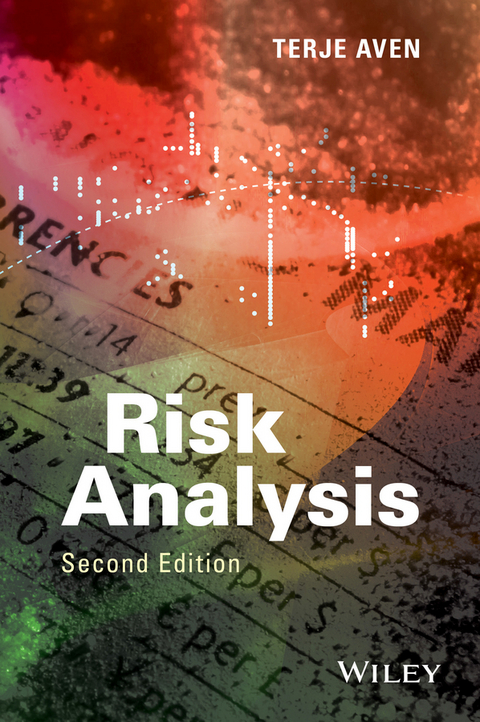
Risk Analysis, Second Edition
Terje Aven, University of Stavanger, Norway
A practical guide to the varied challenges presented in the ever-growing field of risk analysis.
Risk Analysis presents an accessible and concise guide to performing risk analysis, in a wide variety of field, with minimal prior knowledge required. Forming an ideal companion volume to Aven's previous Wiley text Foundations of Risk Analysis, it provides clear recommendations and guidance in the planning, execution anduse of risk analysis.
This new edition presents recent developments related to risk conceptualization, focusing on related issues on risk assessment and their application. New examples are also featured to clarify the reader's understanding in the application of risk analysis and the risk analysis process.
Key features:
- Fully updated to include recent developments related to risk conceptualization
and related issues on risk assessments and their applications.
- Emphasizes the decision making context of risk analysis rather than
just computing probabilities
- Demonstrates how to carry out predictive risk analysis using a variety of case studies and examples.
- Written by an experienced expert in the field, in a style suitable for both
industrial and academic audiences.
This book is ideal for advanced undergraduates, graduates, analysts and researchers from statistics, engineering, finance, medicine and physical sciences. Managers facing decision making problems involving risk and uncertainty will also benefit from this book.
A practical guide to the varied challenges presented in the ever-growing field of risk analysis. Risk Analysis presents an accessible and concise guide to performing risk analysis, in a wide variety of field, with minimal prior knowledge required. Forming an ideal companion volume to Aven's previous Wiley text Foundations of Risk Analysis, it provides clear recommendations and guidance in the planning, execution anduse of risk analysis. This new edition presents recent developments related to risk conceptualization, focusing on related issues on risk assessment and their application. New examples are also featured to clarify the reader's understanding in the application of risk analysis and the risk analysis process. Key features: Fully updated to include recent developments related to risk conceptualization and related issues on risk assessments and their applications. Emphasizes the decision making context of risk analysis rather than just computing probabilities Demonstrates how to carry out predictive risk analysis using a variety of case studies and examples. Written by an experienced expert in the field, in a style suitable for both industrial and academic audiences. This book is ideal for advanced undergraduates, graduates, analysts and researchers from statistics, engineering, finance, medicine and physical sciences. Managers facing decision making problems involving risk and uncertainty will also benefit from this book.
Terje Aven, University of Stavanger, Norway.
Preface
Acknowledgement
1 What is a risk analysis?
2 What is Risk?
3 The risk analysis process: planning
4 The risk analysis process: risk assessment
5 The risk analysis process: risk treatment
6 Risk analysis methods
7 Safety measures for a road tunnel
8 Risk analysis process for an offshore installation
9 Production assurance
10 Risk Analysis of a Cash Depot
11 Risk analysis process for municipalities
12 Risk Analysis for the entire Enterprise
13 Success Factors. Discussion
A Probability calculus and statistics
B Introduction to reliability analysis
C Approach for selecting risk analysis methods
D Terminology
Bibliography
Index
Chapter 1
What is a risk analysis?
A main objective of a risk analysis is to describe risk, that is, to present an informative risk picture. Figure 1.1 illustrates important building blocks of such a risk picture. Located at the centre of the figure is the initiating event (the hazard, the threat, the opportunity), which we denote by . In the example, the event is that a person (John) contracts a specific disease. An important task in the risk analysis is to identify such initiating events. In our example, we may be concerned about various diseases that could affect the person. The left side of the figure illustrates the causal picture that may lead to the event . The right side describes the possible consequences of .
Figure 1.1 Example of a bow-tie.
On the left side are barriers that are introduced to prevent the event from occurring; these are the probability reducing or preventive barriers. Examples of such barriers are medical check-ups/examinations, vaccinations and limiting the exposure to contamination sources. On the right side are barriers to prevent the disease (event A) from bringing about serious consequences, the consequence-reducing barriers. Examples of such barriers are medication and surgery. The occurrence of and performance of the various barriers are influenced by a number of factors—the so-called risk-influencing or performance-influencing factors. Examples are the quality of the medical check-ups; the effectiveness of the vaccine, drug or surgery; what is known about the disease and what causes it; lifestyle, nutrition and inheritance and genes.
Figure 1.1 is often referred to as a bow-tie diagram. We will refer to it many times later in the book when the risk picture is being discussed.
We refer to the event as an initiating event. When the consequences are obviously negative, the term ‘undesirable event’ is used. We also use terms such as hazards and threats. We say there is a fire hazard or that we are faced with a terrorist threat. We can also use the term initiating event in connection with an opportunity. An example is the opportunity that arises if a competitor goes bankrupt or his reputation is damaged.
The risk analysis shall identify the relevant initiating events and develop the causal and consequence picture. How this is done depends on which method is used and how the results are to be used. However, the intent is always the same: to describe risk.
In this book, we differentiate between three main categories of risk analysis methods: simplified risk analysis, standard risk analysis and model-based risk analysis. These three categories of methods are described in more detail in Table 1.1.
Table 1.1 Main categories of risk analysis methods
| Main category | Type of analysis | Description |
| Simplified risk analysis | Qualitative | Simplified risk analysis is an informal procedure that establishes the risk picture using brainstorming sessions and group discussions. The risk might be presented on a coarse scale, for example, low, moderate or high, making no use of formalised risk analysis methods. |
| Standard risk analysis | Qualitative or quantitative | Standard risk analysis is a more formalised procedure in which recognised risk analysis methods are used, such as Hazard and Operability study (HAZOP) and coarse risk analysis, to name a few. Risk matrices are often used to present the results. |
| Model-based risk analysis | Primarily quantitative | Model-based risk analysis makes use of techniques such as event tree analysis and fault tree analysis to calculate risk. |
The different methods mentioned in the table will be discussed in Chapter 6.
Reflection
An overview of historical data (e.g. accident events) is established. Does this constitute a risk analysis?
No, not in isolation. Such data describe what happened, and the numbers say something about the past. Only when we address the future (e.g. the number of fatalities in the coming year) does the risk concept apply. To analyse what will happen, we can decide to make use of the historical numbers, and the statistics will then provide an expression for risk. In this way, we are conducting a risk analysis.
1.1 Why risk analysis?
By carrying out a risk analysis one can
- establish a risk picture;
- compare different alternatives and solutions in terms of risk;
- identify factors, conditions, activities, systems, components and so on that are important (critical) with respect to risk; and
- demonstrate the effect of various measures on risk.
This provides a basis for the following:
- Choosing between various alternative solutions and activities while in the planning phase of a system.
- Choosing between alternative designs of a solution or a measure. What measures can be implemented to make the system less vulnerable in the sense that it can better tolerate loads and stresses?
- Drawing conclusions on whether various solutions and measures meet the stated requirements.
- Setting requirements for various solutions and measures, for example, related to the performance of the preparedness systems.
- Documenting an acceptable safety and risk level.
Risk analyses can be carried out at various phases in the life time of a system, that is, from the early concept phase, through the more detailed planning phases and the construction phase, up to the operation and decommissioning phases.
Risk analyses are often performed to satisfy regulatory requirements. It is, of course, important to satisfy these requirements, but the driving force for carrying out a risk analysis should not be this alone, if one wishes to fully utilise the potential of the analysis. The main reason for conducting a risk analysis is to support decision-making. The analysis can provide an important basis for finding the right balance between different concerns, such as safety and costs.
We need to distinguish between the planning phase and the operational phase. When we design a system, we often have considerable flexibility and can choose among many different solutions, while often having limited access to detailed information on these solutions. The risk analysis in such cases provides a basis for comparing the various alternatives. The fact that we have many possible decision alternatives and limited detailed information implies, as a rule, that one will have to use a relatively coarse analysis method. As one gradually gains more knowledge regarding the final solution, more detailed analysis methods will become possible. All along, one must balance the demand for precision with the demand for decision support. There is no point in carrying out detailed analyses if the results arrive too late to affect the decisions.
In the operating phase, we often have access to experience data, for example, historical data, on the number of equipment and systems failures. In such cases, one can choose a more detailed analysis method and study these systems specifically. However, here the decision alternatives are often limited. It is easier by far to make changes ‘on paper’ in planning phases than to make changes to existing systems in the operating phase. Risk analyses have, therefore, had their greatest application in the planning phases. In this book, however, we do not limit ourselves to these phases. Risk analyses are useful in all phases, but the methods applied must be suited to the need.
1.2 Risk management
Risk management is defined as all measures and activities carried out to manage risk. Risk management deals with balancing the conflicts inherent in exploring opportunities on the one hand and avoiding losses, accidents and disasters on the other (Aven and Vinnem 2007).
Risk management relates to all activities, conditions and events that can affect the organisation and its ability to reach the organisation's goals and vision. To be more specific, we will consider an enterprise, for example, a company. Identification of which activities, conditions and events are important will depend on the enterprise and its goals and vision.
In many enterprises, the risk management is divided into three main categories: strategic risk, financial risk and operational risk.
Strategic risk is risk where the consequences for the enterprise are influenced by mergers and acquisitions, technology, competition, political conditions, laws and regulations, labour market and so on.
Financial risk is risk where the consequences for the enterprise are influenced by the market (associated with changes in the value of an investment due to movements in market factors: the stock prices, interest rates, foreign exchange rates and commodity prices), credit issues (associated with a debtor's failure to meet its obligations in accordance with agreed terms) and liquidity issues, reflecting lack of access to cash; the difficulty of selling an asset in a timely manner, that is, quickly enough to prevent a loss (or make the required profit).
Operational risk is risk where the consequences for the enterprise are a result of safety- or security-related issues (accidental events, intentional acts, etc.).
For an enterprise to become successful in its implementation of risk management, the top management needs to be involved, and activities must be...
| Erscheint lt. Verlag | 17.8.2015 |
|---|---|
| Sprache | englisch |
| Themenwelt | Mathematik / Informatik ► Mathematik ► Statistik |
| Mathematik / Informatik ► Mathematik ► Wahrscheinlichkeit / Kombinatorik | |
| Technik | |
| Schlagworte | Angewandte Wahrscheinlichkeitsrechnung u. Statistik • Angew. Wahrscheinlichkeitsrechn. u. Statistik / Lebensdaueranalyse • Applied Probability & Statistics • Applied Probability & Statistics - Survival Analysis • Decision Making • decision making problems involving risk and uncertainty • Engineering • Engineering statistics • Finance • medicine and physical sciences • predictive risk analysis • Risikoanalyse • risk analysis process • Risk Analysis,risk conceptualization • risk assessment • Statistics • Statistik • Statistik in den Ingenieurwissenschaften |
| ISBN-10 | 1-119-05782-5 / 1119057825 |
| ISBN-13 | 978-1-119-05782-6 / 9781119057826 |
| Informationen gemäß Produktsicherheitsverordnung (GPSR) | |
| Haben Sie eine Frage zum Produkt? |
 EPUB (Adobe DRM)
Kopierschutz: Adobe-DRM
Adobe-DRM ist ein Kopierschutz, der das eBook vor Mißbrauch schützen soll. Dabei wird das eBook bereits beim Download auf Ihre persönliche Adobe-ID autorisiert. Lesen können Sie das eBook dann nur auf den Geräten, welche ebenfalls auf Ihre Adobe-ID registriert sind.
Details zum Adobe-DRM
Dateiformat: EPUB (Electronic Publication)
EPUB ist ein offener Standard für eBooks und eignet sich besonders zur Darstellung von Belletristik und Sachbüchern. Der Fließtext wird dynamisch an die Display- und Schriftgröße angepasst. Auch für mobile Lesegeräte ist EPUB daher gut geeignet.
Systemvoraussetzungen:
PC/Mac: Mit einem PC oder Mac können Sie dieses eBook lesen. Sie benötigen eine
eReader: Dieses eBook kann mit (fast) allen eBook-Readern gelesen werden. Mit dem amazon-Kindle ist es aber nicht kompatibel.
Smartphone/Tablet: Egal ob Apple oder Android, dieses eBook können Sie lesen. Sie benötigen eine
Geräteliste und zusätzliche Hinweise
Buying eBooks from abroad
For tax law reasons we can sell eBooks just within Germany and Switzerland. Regrettably we cannot fulfill eBook-orders from other countries.
aus dem Bereich