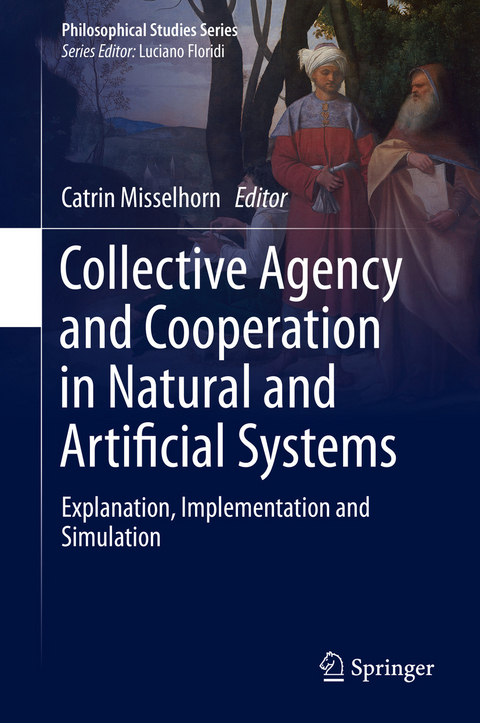
Collective Agency and Cooperation in Natural and Artificial Systems (eBook)
311 Seiten
Springer International Publishing (Verlag)
978-3-319-15515-9 (ISBN)
This book brings together philosophical approaches to cooperation and collective agency with research into human-machine interaction and cooperation from engineering, robotics, computer science and AI. Bringing these so far largely unrelated fields of study together leads to a better understanding of collective agency in natural and artificial systems and will help to improve the design and performance of hybrid systems involving human and artificial agents. Modeling collective agency with the help of computer simulations promises also philosophical insights into the emergence of collective agency.
The volume consists of four sections. The first section is dedicated to the concept of agency. The second section of the book turns to human-machine cooperation. The focus of the third section is the transition from cooperation to collective agency. The last section concerns the explanatory value of social simulations of collective agency in the broader framework of cultural evolution.
Prof. Catrin Misselhorn holds the chair for the philosophy of science and technology at the University of Stuttgart and is the director of the Institute of Philosophy. Her research is situated at the intersection of philosophy, science and technological culture. She has published numerous articles in the area of socio-technical epistemology, the philosophy of mind and the philosophy of robotics in renowned international journals, e.g., The Monist, Minds and Machines. She is directing the project “Simulating Collective Agency and Decision Processes” in the cluster of excellence SimTech (Simulation Technologies) at the University of Stuttgart.
Part I: Concepts of Agency.- Collective Agency and Cooperation in Natural and Artificial Systems.-Cooperation with Robots? A Two-dimensional Approach.- The Participatory Turn – A Multidimensional Gradual Agency Concept for Human and Non-human Actors.- Part II: Human-machine Cooperation.- Embodied Cooperative Systems: From Tool to Partnership.- Historical, Cultural, and Aesthetic Aspects of the Uncanny Valley.- Ethical Implications Regarding Assistive Technology at Workplaces.- Some Sceptical Remarks Regarding Robot Responsibility and a Way Forward.- Part III: Collective Agency.- Planning for Collective Agency.- An Account of Boeschian Cooperative Behavior.- Choosing Appropriate Paradigmatic Examples for Understanding Collective Agency.- Can Artificial Systems be Part of a Collective Action?.- Is Collective Agency a Coherent Idea? Considerations from the Enactive Theory of Agency.- Part IV: Simulating Collective Agency and Cooperation.- Simulation as Research Method: Modeling Social Interactions in Management Science.- How Models Fail? A Critical Look at the History of Computer Simulations of Evolution in Cooperation.- Artificial Intelligence and Pro-social Behavior.
| Erscheint lt. Verlag | 1.9.2015 |
|---|---|
| Reihe/Serie | Philosophical Studies Series | Philosophical Studies Series |
| Zusatzinfo | XII, 311 p. 14 illus., 9 illus. in color. |
| Verlagsort | Cham |
| Sprache | englisch |
| Themenwelt | Geisteswissenschaften ► Philosophie ► Erkenntnistheorie / Wissenschaftstheorie |
| Informatik ► Theorie / Studium ► Künstliche Intelligenz / Robotik | |
| Technik | |
| Schlagworte | Artificial Intelligence • Collective Agency • Collective intentionality • Human-Machine Cooperation • Human-Machine-Interaction • Philosophy of mind |
| ISBN-10 | 3-319-15515-6 / 3319155156 |
| ISBN-13 | 978-3-319-15515-9 / 9783319155159 |
| Informationen gemäß Produktsicherheitsverordnung (GPSR) | |
| Haben Sie eine Frage zum Produkt? |
 PDF (Wasserzeichen)
DRM: Digitales Wasserzeichen
Dieses eBook enthält ein digitales Wasserzeichen und ist damit für Sie personalisiert. Bei einer missbräuchlichen Weitergabe des eBooks an Dritte ist eine Rückverfolgung an die Quelle möglich.
Dateiformat: PDF (Portable Document Format)
Mit einem festen Seitenlayout eignet sich die PDF besonders für Fachbücher mit Spalten, Tabellen und Abbildungen. Eine PDF kann auf fast allen Geräten angezeigt werden, ist aber für kleine Displays (Smartphone, eReader) nur eingeschränkt geeignet.
Systemvoraussetzungen:
PC/Mac: Mit einem PC oder Mac können Sie dieses eBook lesen. Sie benötigen dafür einen PDF-Viewer - z.B. den Adobe Reader oder Adobe Digital Editions.
eReader: Dieses eBook kann mit (fast) allen eBook-Readern gelesen werden. Mit dem amazon-Kindle ist es aber nicht kompatibel.
Smartphone/Tablet: Egal ob Apple oder Android, dieses eBook können Sie lesen. Sie benötigen dafür einen PDF-Viewer - z.B. die kostenlose Adobe Digital Editions-App.
Buying eBooks from abroad
For tax law reasons we can sell eBooks just within Germany and Switzerland. Regrettably we cannot fulfill eBook-orders from other countries.
aus dem Bereich