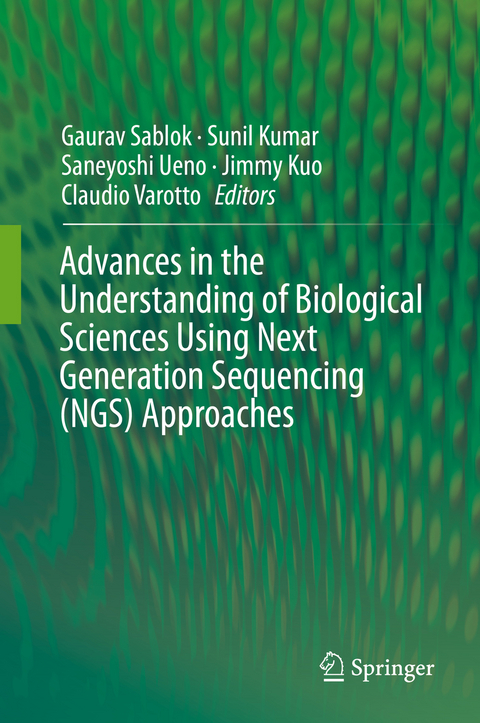
Advances in the Understanding of Biological Sciences Using Next Generation Sequencing (NGS) Approaches (eBook)
XII, 241 Seiten
Springer-Verlag
978-3-319-17157-9 (ISBN)
Guarav Sablok, PhDResearch Fellow, Plant Functional Biology and Climate Change Cluster (C3)University of Technology, SydneyPO Box 123 Broadway NSW 2007 AustraliaT:: 0039-3270484-732Email: sablokg@gmail.comSunil Kumar, M.Sc ,IPR, MCA, Ph.DSenior Scientist, Department of Bioinformatics Institute of Life Sciences Nalco Square, C S PurBhubaneswar, Odisha 275103, India T: 91-6742301500F: 91-6742300728E-mail: skybiotech@gmail.com Jimmy Kuo, Ph.DAssociate Researcher, National Museum of Marine Biology and AquariumGraduate Institute of Marine Biotechnology, National Dong Haw University2 Houwan Road, ChechengPingtung 944, TaiwanTel: 886-8-8825001 ext. 1358Fax: 886-8-8825087E-mail: jimmy@nmmba.gov.twSaneyoshi Ueno, Ph.DDepartment of Forest Genetics 1 Matsunosato, TsukubaIbaraki 3058687, JapanT: +81-29-8733211F: +81-29-8743720Email: saueno@ffpri.affrc.go.jpClaudio Varotto, Msc, Ph.DDepartment of Biodiversity and Molecular Ecology, Research and Innovation CenterFondazione Edmund Mach, Research and Innovation CenterVia E. Mach 1, 38010 San Michele all’Adige (TN), ItalyT: +39 0461 615 108F: +390461650956Email: claudio.varotto@fmach.it
Ch. 1: Expression analysis and genome annotations with RNA sequencing Masaaki Kobayashi, Hajime Ohyanagi, Kentaro Yano Ch. 2: The application of Next Generation Sequencing techniques to Plant Epigenomics Manu J. Dubin Ch. 3: Whole genome sequencing to identify genes and QTL in rice Ryohei Terauchi, Akira Abe, Hiroki Takagi, Muluneh Tamiru, Rym Fekih, Satoshi Natsume, Hiroki Yaegashi, Shunichi Kosugi, Hiroyuki Kanzaki, Hideo Matsumura, Hiromasa Saitoh, Kentaro Yoshida, Liliana Cano, Sophien Kamoun Ch. 4: Variant calling using NGS data in European aspen (Populus tremula) Jing Wang, Douglas Scofield, Nathaniel R. Street, Pär K. Ingvarsson Ch. 5: Leafy Spurge Genomics: A Model Perennial Weed To Investigate Development, Stress Responses, And Invasiveness David Horvath, James Anderson, Wun Chao, Michael Foley, Münevver Doğramaci Ch. 6: Utilization of NGS and proteomic-based approaches to gain insights on cellular responses to singlet oxygen and improve energy yields for bacterial stress adaptation Roger Greenwell, Mobashar Hussain Urf Turabe Fazil, H P Pandey. Ch. 7: Experimental evolution and next generation sequencing illuminate the evolutionary trajectories of microbes Mario Fares Ch. 8: Plant carbohydrate active enzyme (CAZyme) repertoires: a comparative Study Huansheng Cao, Alex Ekstrom, Yanbin Yin Ch. 9: Metagenomics of Plant- Microbe Interactions Riccardo Rosselli, Andrea Squartini Ch. 10: Genes and trans-factors underlying embryogenic transition in plant soma-cells Dhananjay K. Pandey, Bhupendra Chaudhary Ch. 11: Bioinformatics tools to analyze the proteome and genome data Ritesh Kumar, Shalini Singh, Vikash Kumar Dubey Ch. 12: High through-put transcriptome analysis of plant stress responses Hüseyin Tombuloğlu, Güzin Tombuloğlu Ch. 13: CNV and structural variation in plants: prospects of NGS Approaches Enrico Francia, Nicola Pecchioni, Alberto Policriti, Simone Scalabrin
| Erscheint lt. Verlag | 16.7.2015 |
|---|---|
| Zusatzinfo | XII, 241 p. 40 illus., 31 illus. in color. |
| Verlagsort | Cham |
| Sprache | englisch |
| Themenwelt | Naturwissenschaften ► Biologie ► Botanik |
| Technik | |
| Schlagworte | deletion mutants • expressed sequence tags • genome shuffling • insertional mutants • Pathway identification |
| ISBN-10 | 3-319-17157-7 / 3319171577 |
| ISBN-13 | 978-3-319-17157-9 / 9783319171579 |
| Informationen gemäß Produktsicherheitsverordnung (GPSR) | |
| Haben Sie eine Frage zum Produkt? |
 PDF (Wasserzeichen)
DRM: Digitales Wasserzeichen
Dieses eBook enthält ein digitales Wasserzeichen und ist damit für Sie personalisiert. Bei einer missbräuchlichen Weitergabe des eBooks an Dritte ist eine Rückverfolgung an die Quelle möglich.
Dateiformat: PDF (Portable Document Format)
Mit einem festen Seitenlayout eignet sich die PDF besonders für Fachbücher mit Spalten, Tabellen und Abbildungen. Eine PDF kann auf fast allen Geräten angezeigt werden, ist aber für kleine Displays (Smartphone, eReader) nur eingeschränkt geeignet.
Systemvoraussetzungen:
PC/Mac: Mit einem PC oder Mac können Sie dieses eBook lesen. Sie benötigen dafür einen PDF-Viewer - z.B. den Adobe Reader oder Adobe Digital Editions.
eReader: Dieses eBook kann mit (fast) allen eBook-Readern gelesen werden. Mit dem amazon-Kindle ist es aber nicht kompatibel.
Smartphone/Tablet: Egal ob Apple oder Android, dieses eBook können Sie lesen. Sie benötigen dafür einen PDF-Viewer - z.B. die kostenlose Adobe Digital Editions-App.
Buying eBooks from abroad
For tax law reasons we can sell eBooks just within Germany and Switzerland. Regrettably we cannot fulfill eBook-orders from other countries.
aus dem Bereich