Mobile Broadband Communications for Public Safety (eBook)
John Wiley & Sons (Verlag)
978-1-118-83122-9 (ISBN)
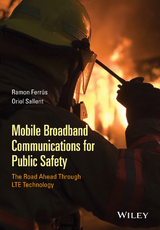
Ramon Ferrús and Oriol Sallent
Universitat Politècnica de Catalunya (UPC), Spain
This book provides a timely and comprehensive overview of the introduction of LTE technology for PPDR communications. It describes the operational scenarios and emerging multimedia and data-centric applications in demand and discusses the main techno-economic drivers that are believed to be pivotal for an efficient and cost-effective delivery of mobile broadband PPDR communications. The capabilities and features of the LTE standard for improved support of mission-critical communications (e.g., proximity services, group communications) are covered in detail. Also, different network implementation options to deliver mobile broadband PPDR communications services over dedicated or commercial LTE-based networks are discussed, including the applicability of the Mobile Virtual Network Operator (MVNO) model and other hybrid models. Radio spectrum matters are also discussed in depth, outlining spectrum needs and providing an outlook into allocated and candidate spectrum bands for PPDR communications and suitable dynamic spectrum sharing solutions in PPDR communications. Explanations are accompanied by a vast collection of references that allow the more intrigued reader to gain further insight into the addressed topics.
Ramon Ferrús and Oriol Sallent Universitat Politècnica de Catalunya (UPC), Spain
Preface
Nowadays, public protection and disaster relief (PPDR) agencies mainly rely on the use of private/professional mobile radio (PMR) technologies (e.g. TETRA, TETRAPOL and Project 25) that were conceived in the 1990s. While PMR systems offer a rich set of voice-centric services, with a number of features matched to the special requirements of PPDR, including push-to-talk and call priority, the data transmission capabilities of these PMR technologies are rather limited and lag far behind the technological advancements made in the commercial wireless domain. In this context, long-term evolution (LTE) technology for mobile broadband PPDR is increasingly backed as the technology of choice for future PPDR communications. Technical work is currently being undertaken within the 3rd Generation Partnership Project (3GPP), the organization in charge of LTE standardization, to add a number of improved capabilities and features to the LTE standard that will further increase its suitability for PPDR and other professional users, by meeting their high demands for reliability and resilience. While the convergence to common technical standards for the PPDR and commercial domains offers significant opportunities for synergies and economies of scale, the delivery of PPDR broadband services demands new approaches in the way that network capacity is deployed and managed. The current paradigm for PPDR communications, based on ‘dedicated technologies, dedicated networks and dedicated spectrum’, is no longer believed to constitute the main approach for the provision of PPDR broadband data communications. On this basis, this book provides a comprehensive view of the introduction of LTE technology for PPDR communications. In particular, the following topics are covered in the book:
- The fundamentals of PPDR services, their operational framework and associated communications systems
- An overview of the main communications technologies and standards used nowadays by PPDR practitioners
- The operational scenarios and emerging multimedia, data-centric applications in growing demand by PPDR practitioners due to their great potential to improve their operational efficiency
- A discussion on the main techno-economic drivers that are believed to be pivotal for a cost-efficient delivery of mobile broadband PPDR communications, such as the use of common technical standards with the commercial domain, the consideration of infrastructure sharing and multi-network-based solutions as well as dynamic spectrum sharing
- The formulation of a comprehensive system view for the delivery of mobile broadband communications for PPDR, including dedicated LTE-based wide area networks, roaming and priority access to commercial networks’ capacity, fast deployable equipment and satellite access as key components
- An analysis of the capabilities and features of the LTE standard that are relevant for an improved support of mission-critical communications, such as group communications enablers and direct mode operation
- A discussion on the different network implementation options to deliver mobile broadband PPDR communications services over dedicated or commercial LTE-based networks, including the applicability of the mobile virtual network operator (MVNO) model and other hybrid models
- A description of the network architecture design and implementation aspects that are central to the realization of the different delivery models, including the interconnection with legacy networks and with deployables (e.g. cells on wheels and system on wheels) and satellite access
- The estimation of spectrum needs for future broadband PPDR systems, a review of the allocated and candidate spectrum bands for PPDR communications and the consideration of dynamic spectrum sharing solutions intended to provide additional capacity to, for example, cope with a surge of PPDR traffic demand
The book is organized into six chapters:
Chapter 1 addresses the fundamentals of PPDR services, their operational framework and associated communications systems. First, the terminology and key definitions of PPDR, public safety (PS) and emergency communications are provided, identifying the scope of these terms and categorizing the different types of communications relationships found in emergencies. Next, the main functions and services delivered by PPDR organizations are introduced, providing a view on the so-called first responder agencies as well as on the role that other entities, such as utilities and telecom operators, could also play in an emergency response. On this basis, a description of the operational framework for PPDR operations is presented. Such a description covers a classification of PPDR operational scenarios, some generic organizational and procedural aspects in incident-response management and the communications’ reference points and key characteristics of the communications services demanded by PPDR practitioners. Following this, a review of the main communications technologies and systems currently in use for PPDR is provided. The review outlines the type of requirements usually bound to PPDR communications systems, describes a common classification of the technologies used within the PPDR sector and provides an overview of the most widely used digital radio communications standards for PPDR communications as of today (TETRA, TETRAPOL, DMR, and Project 25). The review also encompasses the identification of some of the major limitations found in today’s PPDR communications landscape through the analysis of an illustrative, hypothetical incident. Finally, the chapter concludes with a description of the regulatory and standardization framework for PPDR communications.
Chapter 2 describes the various types of data-centric, multimedia applications deemed critical for on-scene PPDR operations. Special attention is given to the ‘Matrix of Applications’ developed by the Law Enforcement Working Party/Radio Communication Expert Group (LEWP/RCEG) of the EU Council, which provides a characterization of technical and operational parameters of a list of PPDR applications agreed by a significant number of European PPDR organizations and recognized by CEPT administrations as being representative in terms of future PPDR applications. Next, the chapter presents various estimates of the throughput requirements for the mobile broadband data applications in demand, outlining typical peak data rates, mean session duration and number of transactions in the busy hour in normal conditions to sustain typical PPDR needs. Finally, the chapter concludes with a quantitative assessment of the overall data capacity needed in a number of representative PPDR operational scenarios within the categories of day-to-day operations, large emergency/public events and disaster scenarios.
Chapter 3 starts with a discussion on the idea that a paradigm change in the delivery of mobile broadband is needed with respect to the prevailing model used nowadays for the provision of voice-centric and narrowband data PPDR services, which is largely characterized by the use of dedicated technologies, dedicated networks and dedicated spectrum. Next, the key techno-economic considerations that are fuelling this paradigm change towards more cost-efficient PPDR communications delivery models are identified and discussed across the dimensions of technology, network and spectrum. Grounded on these techno-economic considerations, a comprehensive system view of the future mobile broadband PPDR communications systems is then described, identifying the key underlying principles and building blocks. Finally, the chapter concludes with a review of some relevant initiatives that are currently shaping the way forward towards the delivery of next-generation mobile broadband PPDR communications.
Chapter 4 provides a description of the new capabilities and features that are being added to the LTE standard. While the LTE standard is already a suitable technology to support a rich number of mobile broadband applications for the PPDR community, including video delivery, work is underway within the 3GPP to improve the standard and turn it into a full mission-critical communications technology. First, the chapter outlines the standardization roadmap established within 3GPP and other relevant standardization bodies in the area of PPDR communications and introduces some of the fundamentals on LTE technology and networks. Next, the enhancements being introduced to fulfil PPDR needs are described, including enhanced group communications enablers and mission-critical push-to-talk (MCPTT) functionality, device-to-device communications (referred to as proximity services in 3GPP specifications), isolated LTE network operation, support of higher transmit power terminals and prioritization and Quality of Service (QoS) control features to cope with capacity congestion. In addition, the enhancements being introduced to LTE with regard to radio access network (RAN) sharing are also described as another potential technology enabler that could facilitate the deployment of shared LTE network models for PPDR and other uses.
Chapter 5 describes the network implementation options to deliver mobile broadband PPDR communications services over dedicated and/or commercial LTE-based networks. First, a number of introductory remarks on the defining elements in current PPDR communications delivery models, the possibility enabled by LTE to provision separately the services from the...
| Erscheint lt. Verlag | 7.8.2015 |
|---|---|
| Sprache | englisch |
| Themenwelt | Technik ► Elektrotechnik / Energietechnik |
| Technik ► Nachrichtentechnik | |
| Schlagworte | Communication Technology - Networks • Drahtlose Kommunikation • Electrical & Electronics Engineering • Elektrotechnik u. Elektronik • Homeland Security • Innere Sicherheit • Kommunikationsnetze • LTE • Mobile & Wireless Communications • Mobile Broadband • PPDR • Public Protection and Disaster Relief (PPDR) • public safety • security management • Sicherheitsmanagement • telecommunications • Wireless Security |
| ISBN-10 | 1-118-83122-5 / 1118831225 |
| ISBN-13 | 978-1-118-83122-9 / 9781118831229 |
| Informationen gemäß Produktsicherheitsverordnung (GPSR) | |
| Haben Sie eine Frage zum Produkt? |
 EPUB (Adobe DRM)
Kopierschutz: Adobe-DRM
Adobe-DRM ist ein Kopierschutz, der das eBook vor Mißbrauch schützen soll. Dabei wird das eBook bereits beim Download auf Ihre persönliche Adobe-ID autorisiert. Lesen können Sie das eBook dann nur auf den Geräten, welche ebenfalls auf Ihre Adobe-ID registriert sind.
Details zum Adobe-DRM
Dateiformat: EPUB (Electronic Publication)
EPUB ist ein offener Standard für eBooks und eignet sich besonders zur Darstellung von Belletristik und Sachbüchern. Der Fließtext wird dynamisch an die Display- und Schriftgröße angepasst. Auch für mobile Lesegeräte ist EPUB daher gut geeignet.
Systemvoraussetzungen:
PC/Mac: Mit einem PC oder Mac können Sie dieses eBook lesen. Sie benötigen eine
eReader: Dieses eBook kann mit (fast) allen eBook-Readern gelesen werden. Mit dem amazon-Kindle ist es aber nicht kompatibel.
Smartphone/Tablet: Egal ob Apple oder Android, dieses eBook können Sie lesen. Sie benötigen eine
Geräteliste und zusätzliche Hinweise
Buying eBooks from abroad
For tax law reasons we can sell eBooks just within Germany and Switzerland. Regrettably we cannot fulfill eBook-orders from other countries.
aus dem Bereich