Unmade in China (eBook)
John Wiley & Sons (Verlag)
978-0-7456-8405-5 (ISBN)
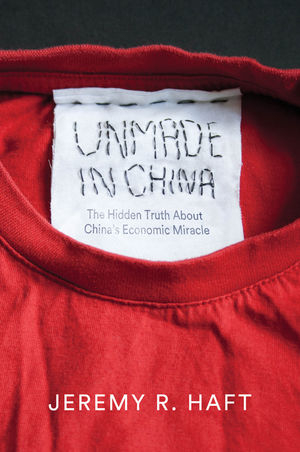
If you look carefully at how things are actually made in China - from shirts to toys, apple juice to oil rigs - you see a reality that contradicts every widely-held notion about the world's so-called economic powerhouse. From the inside looking out, China is not a manufacturing juggernaut. It's a Lilliputian. Nor is it a killer of American jobs. It's a huge job creator. Rising China is importing goods from America in such volume that millions of U.S. jobs are sustained through Chinese trade and investment.
In Unmade in China, entrepreneur and Georgetown University business professor Jeremy Haft lifts the lid on the hidden world of China's intricate supply chains. Informed by years of experience building new companies in China, Haft's unique, insider's view reveals a startling picture of an economy which struggles to make baby formula safely, much less a nuclear power plant. Using firm-level data and recent case studies, Unmade in China tells the story of systemic risk in Chinese manufacturing and why this is both really bad and really good news for America.
Jeremy R. Haft has been starting and building companies in China for two decades across the breadth of China's economy - from light and heavy industries to agriculture. Haft is the author of All the Tea in China: How to Buy, Sell, and Make Money on the Mainland (Penguin, 2007), which presents best practices for importing, exporting, and doing business in China.
An adjunct professor at Georgetown University who lectures in both the Walsh School of Foreign Service and the McDonough School of Business, Haft's analysis on China trade has been featured in such media as National Public Radio, The Wall Street Journal, The Financial Times, Forbes, The Huffington Post, CNN, CNBC, Fox, NBC, CBS, and ABC.
If you look carefully at how things are actually made in China - from shirts to toys, apple juice to oil rigs - you see a reality that contradicts every widely-held notion about the world's so-called economic powerhouse. From the inside looking out, China is not a manufacturing juggernaut. It's a Lilliputian. Nor is it a killer of American jobs. It's a huge job creator. Rising China is importing goods from America in such volume that millions of U.S. jobs are sustained through Chinese trade and investment. In Unmade in China, entrepreneur and Georgetown University business professor Jeremy Haft lifts the lid on the hidden world of China's intricate supply chains. Informed by years of experience building new companies in China, Haft's unique, insider s view reveals a startling picture of an economy which struggles to make baby formula safely, much less a nuclear power plant. Using firm-level data and recent case studies, Unmade in China tells the story of systemic risk in Chinese manufacturing and why this is both really bad and really good news for America.
Jeremy R. Haft has been starting and building companies in China for two decades across the breadth of China's economy - from light and heavy industries to agriculture. Haft is the author of All the Tea in China: How to Buy, Sell, and Make Money on the Mainland (Penguin, 2007), which presents best practices for importing, exporting, and doing business in China. An adjunct professor at Georgetown University who lectures in both the Walsh School of Foreign Service and the McDonough School of Business, Haft's analysis on China trade has been featured in such media as National Public Radio, The Wall Street Journal, The Financial Times, Forbes, The Huffington Post, CNN, CNBC, Fox, NBC, CBS, and ABC.
Chapter One: Three Myths
Chapter Two: Jobs and Jeopardy
Chapter Three: The Bad Earth
Chapter Four: Risky Business
Chapter Five: Chain of Fools
Chapter Six: When Regs are Dregs
Chapter Seven: What to Do
"Unmade in China opens up the black box of China's domestic and political economy and provides a compelling and detailed analysis of how and why China will be unable to surpass the United States. It is essential reading for policy-makers, government officials and businesses, not only in the US and the West, but also across the globe."
International Affairs
"China's economic future will determine the world's future. This important book makes new factually grounded arguments about the challenges China faces. Its arguments deserve attention from anyone with a stake in our economic future."
Lawrence H. Summers, former Treasury Secretary and President Emeritus, Harvard University
"Challenging conventional wisdom of China's economic supremacy, Haft deftly and entertainingly uncovers how systemic risk in China's economy actually creates millions of jobs in the United States. Unmade in China is a must-read for global policy makers, business leaders, and anyone who wants to understand the US.China trade relationship."
Richard Gephardt, former Majority Leader of the US House of Representatives
"A clear-eyed analysis of China's fragile economy and its impact on the USA."
Admiral James Stavridis, USN (Ret) Supreme Allied Commander at NATO 2009.2013 and Dean of the Fletcher School of Law and Diplomacy, Tufts University
"A systematic, mind-changing, and remarkable read which debunks the myths about China's economic supremacy and provides an optimistic rallying cry for US companies. Outstanding!"
Clinton O. Longenecker, Stranahan Distinguished Professor of Leadership and Organizational Excellence, University of Toledo
"Jeremy Haft's "Unmade in China" explains why the idea of Declining America vs Rising China is simplistic at best and downright deceptive at worst. He cuts through the emotional responses to China's "rise" to detail why that country's unregulated manufacturing poses important risks--and big opportunities--for Americans. This is a must read for anyone who dares to look to the trees inside China's expanding forest."
Ian Bremmer - President of Eurasia Group
"A fresh perspective on great risks posed by rampant non-compliance in product quality, process control, management protocols and governance in China dependent global supply chains, which also throws light on the opportunities for US-made products and services in China. An insightful book for anyone interested in doing business in China."
Jayashankar M. Swaminathan, GlaxoSmithKline Distinguished Professor of Global Operations and Associate Dean of UNC-Tsinghua EMBA Program and Director of the Global Business Center, Kenan-Flagler Business School, UNC Chapel Hill
"Finally, a clearheaded book that cuts through the China hype. With refreshing clarity Jeremy Haft challenges the hackneyed narratives about China's economic might to deliver an eye-opening and corrective analysis on what we thought we knew about everything 'Made in China.'"
Jamian Ronca Spadavecchia, president of Oxbow Advisory, a global risk consultancy
"This book is fluent in style and full of informative case studies, making it suitable for the general public as well as researchers and policymakers who are interested in a fair reading of China's economy and its increasing impact on global society."
Political Studies Review
Preface
The proof of China's might is in your waistband. And in the collar of your shirt; the chair you're sitting on. The mug on your desk. The phone in your pocket. The toy your child is chewing on.
Just look around you. Everything seems to be “Made in China” these days. So it must be “the China Century.” And as China rises, America falls.
The logic goes something like this. It's a global economy, a flat world. If China can make anything we can, only cheaper and at the click of a mouse, then we surely haven't a prayer. We're on a race with China to the bottom – in wages and, ultimately, quality of life.
The flat world is tilting east, and all our good jobs are flowing to China.
The pundits agree. Just look at today's paper. There's a story on the front page about surging Chinese imports, flooding our markets with cheap goods and killing US jobs.
Then there's an op-ed on the back page. It says that China is already the world's second-largest economy. And that major financial institutions like the International Monetary Fund predict China will overtake the United States economically in just a few short years.
Politicians agree too. In the 2012 presidential election between Mitt Romney and Barack Obama, both candidates trimmed their sails to the headwinds of China's economic power. In a contest that the pundits still insist had nothing to do with foreign policy – Americans, they claim, were weary of wars in Iraq and Afghanistan and, with unemployment nearing 10 percent, were focused on kitchen-sink issues (like losing the kitchen sink) – the election was actually dominated by foreign policy. The campaigns spent nearly US$50 million on ads about China. And China was a frequent theme on the stump, especially in bellwether Rust Belt states like Ohio hit hard by the recession. The candidates and their surrogates flogged China again and again.
Romney's refrain: Obama is too soft on China's “cheating,” its undervalued currency that keeps the prices of its exports artificially low.
Obama's refrain: Romney is an “outsourcing pioneer,” sending jobs to China while he ran Bain Capital.
The implicit message in both campaign themes? If China can steal our jobs out from under us, through currency manipulation and outsourcing, America must be losing the competition for the next century.
Interestingly enough, before 2012, the typically pro-labor Democratic candidates were the China hardliners and the pro-trade Republicans the China softies. Now, talking tough on China was the bipartisan goose that laid the golden eggs. In both Democratic and Republican campaigns, the focus-group Svengalis told the messaging mavens to hit China early and often.
The polls show why. A recent Pew survey asked which is the world's leading economic superpower – today, not at some point in the future. More Americans than not said China.
Think about that. More Americans today believe that China, not America, is the world's leading economic superpower. You may be nodding your head in agreement. So you probably won't be surprised to learn that nearly 60 percent of British said China, too. And across 21 countries, the majority of respondents voted China over America as the world's leading superpower.1
No surprise, right? China's might, and its dominance in the coming century, are just obvious. The ubiquitous labels on our products are proof enough of this irrefutable truth.
And if you square that truth with America's jobless recovery, our cratered-out industries, shrinking middle class, crumbling infrastructure, paralyzed government, uncompetitive wages, and thicket of regulations, then the corollary to China's rise is also an irrefutable truth. America is in decline.
But you don't need a poll to tell you which way the wind is blowing. At your next family get-together, try saying “My (fill in the blank) was ‘Made in China.’ ”
How did they reply? I'm guessing you didn't all join hands and sing “We are the World…”?
Did you get an earful of invective? Outsourcing, currency-cheating, idea-stealing, cyber-spying Commies!
To be sure, China's rise is an emotional issue. Millions of Americans have lost jobs, homes, and pensions since the Great Recession of 2008. When the news media, politicians, and pundits almost universally blame China, it's hard not to get angry.
But something deeper is at play here, too. There's a thought-provoking psychological study that was conducted during the 2004 US presidential election between George W. Bush and John Kerry. Scientists wired electrodes to the skulls of Republicans and Democrats and showed them left- and right-leaning political statements, monitoring their brain functions. Each time a partisan statement was flashed on the screen, the areas of the subjects' brains that lit up were not the centers of reason, as you'd expect. They were the emotional centers.2 Feelings, not logic, tend to drive our responses to political issues.
So it goes with China. One mention of “Made in China,” and the feelings just come spilling out. The problem with basing beliefs on feelings, of course, is that feelings are sometimes immune to facts. Just ask the Chinese. Remember that Pew poll? The one that asked which is the world's leading superpower? The only country that overwhelmingly replied that China is not the world's leading economic superpower today…was China. They said America.
Could the Chinese know something about their fabled rise that we don't?
Yes. Because to stand on the ground in China and actually make things – make shirts and toys and apples and oil rigs – there is a reality that contradicts every widely held notion about China's so-called rise. Seen from the inside looking out, China is not a manufacturing juggernaut at all. It's a Lilliputian. China is not a lethal competitor. It's an economic helpmeet. China is not a killer of American jobs. It's a big job creator.
That's right. China actually supports millions of jobs in the United States.
But in order to see this, you've got to do more than watch the news or visit a couple of factories or talk to some Chinese businesspeople. You must walk the line where raw materials are formed into products. You must see for yourself how these products are made, step by step, from inputs to outputs. And ideally, you must try to wring safe products out of this system.
What you'd see would surprise you. You'd discover that nearly everything we're told about China's rise is wrong; that, in fact, the very core of China's supposed might – how China makes things – is riddled with risk.
Now in any human endeavor there's always risk. It's a law of nature. Things fall apart. So the science of making things is to minimize risk. Of course, risk can't ever be completely eliminated. But you strive to achieve a successful outcome again and again, reliably, not randomly, as often as possible. An airplane that flies. A bridge that holds firm. A medicine that cures, not kills.
China is deceptive that way. It looks like a manufacturing powerhouse until you draw back the curtain. Then, you see risk everywhere.
Consider the “Made in China” safety scandals. In the past few years, we've seen baby formula spiked with melamine, an industrial chemical that caused renal failure in over 300,000 Chinese infants and killed six. We've seen melamine-laced pet food, too, that killed hundreds and injured thousands of dogs and cats in the United States. We've seen bad batches of the blood thinner, heparin, administered in American hospitals, killing 81 patients and sickening hundreds more. We've seen lead paint on Mattel toys. We've seen rotting Chinese drywall, installed in tens of thousands of US houses. We've seen exploding tires; faulty ignition switches; poison toothpaste and cough syrup; cracked welds on the San Francisco Bay Bridge; even “honey laundering,” in which more than one third of the honey that Americans consume is now deemed counterfeit – smuggled from China and laced with unsafe additives.
Whether it's food, drugs, toys, tires, or bridges – pick any Chinese import – there have been big safety breaches. And this is not to mention the safety lapses in China – which are even more frequent, widespread, and deadly. Exploding watermelons, glow-in-the-dark pork, resold gutter oil, tainted seafood, scraps of animal skin in milk, arsenic in soy sauce, cadmium in rice, paraffin and ink in noodles, bleach in mushrooms, resin and starch to make fake eggs, poison gel caps and lethal antibiotics, collapsing roads and bridges.
There have been thousands of safety scandals in China just over the past few years. You can track them on a popular iPhone app called “The China Survival Guide” and on the website “Throw it out the window” (http://www.zccw.info).
Most of the “Made in China” safety scandals go unnoticed in the United States. But when a story is newsworthy enough, our media tend to seek a villain – a nefarious criminal ring, a factory with lax quality control, a corrupt bureaucrat. When the Mattel lead paint story broke, for...
| Erscheint lt. Verlag | 30.7.2015 |
|---|---|
| Sprache | englisch |
| Themenwelt | Sozialwissenschaften ► Ethnologie |
| Sozialwissenschaften ► Soziologie | |
| Technik | |
| Wirtschaft ► Volkswirtschaftslehre ► Makroökonomie | |
| Wirtschaft ► Volkswirtschaftslehre ► Wirtschaftspolitik | |
| Schlagworte | Asia & Australasia • Asien • Asien u. Australasien / Ãkonomie u. Handel • Asien u. Australasien / Ökonomie u. Handel • Business & Management • Business & Society • Economics • <p>China, GDP, economy, manufacturing, business, economics, politics, supply chain, product recall, risk, safety, hazard, trade</p> • political economics • Politische Ãkonomie • Politische Ökonomie • Volkswirtschaftslehre • Wirtschaft • Wirtschaft u. Gesellschaft • Wirtschaft u. Management |
| ISBN-10 | 0-7456-8405-X / 074568405X |
| ISBN-13 | 978-0-7456-8405-5 / 9780745684055 |
| Informationen gemäß Produktsicherheitsverordnung (GPSR) | |
| Haben Sie eine Frage zum Produkt? |
 EPUB (Adobe DRM)
Kopierschutz: Adobe-DRM
Adobe-DRM ist ein Kopierschutz, der das eBook vor Mißbrauch schützen soll. Dabei wird das eBook bereits beim Download auf Ihre persönliche Adobe-ID autorisiert. Lesen können Sie das eBook dann nur auf den Geräten, welche ebenfalls auf Ihre Adobe-ID registriert sind.
Details zum Adobe-DRM
Dateiformat: EPUB (Electronic Publication)
EPUB ist ein offener Standard für eBooks und eignet sich besonders zur Darstellung von Belletristik und Sachbüchern. Der Fließtext wird dynamisch an die Display- und Schriftgröße angepasst. Auch für mobile Lesegeräte ist EPUB daher gut geeignet.
Systemvoraussetzungen:
PC/Mac: Mit einem PC oder Mac können Sie dieses eBook lesen. Sie benötigen eine
eReader: Dieses eBook kann mit (fast) allen eBook-Readern gelesen werden. Mit dem amazon-Kindle ist es aber nicht kompatibel.
Smartphone/Tablet: Egal ob Apple oder Android, dieses eBook können Sie lesen. Sie benötigen eine
Geräteliste und zusätzliche Hinweise
Buying eBooks from abroad
For tax law reasons we can sell eBooks just within Germany and Switzerland. Regrettably we cannot fulfill eBook-orders from other countries.
aus dem Bereich