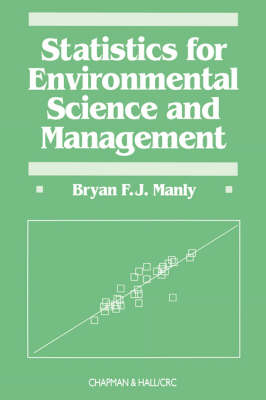
Statistics for Environmental Science and Management
Chapman & Hall/CRC (Verlag)
978-1-58488-029-5 (ISBN)
- Titel erscheint in neuer Auflage
- Artikel merken
The use of appropriate statistical methods is essential when working with environmental data. Yet, many environmental professionals are not statisticians. A ready reference guide to the most common methods used in environmental applications, Statistics for Environmental Science and Management introduces the statistical methods most frequently used by environmental scientists, managers, and students.
Using a non-mathematical approach, the author describes techniques such as: environmental monitoring, impact assessment, assessing site reclamation, censored data, and Monte Carlo risk assessment, as well as the key topics of time series and spatial data. The book shows the strengths of different types of conclusions available from statistical analyses. It contains internet sources of information that give readers access to the latest information on specific topics.
The author's easy to understand style makes the subject matter accessible to anyone with a rudimentary knowledge of the basics of statistics while emphasizing how the techniques are applied in the environmental field. Clearly and copiously illustrated with line drawings and tables, Statistics for Environmental Science and Management covers all the statistical methods used with environmental applications and is suitable as a text for graduate students in the environmental science area.
THE ROLE OF STATISTICS IN ENVIRONMENTAL SCIENCE
Some Examples
The Importance of Statistics in the Examples
ENVIRONMENTAL SAMPLING
Simple Random Sampling
Estimation of Population Means
Estimation of Population Totals
Estimation of Proportions
Sampling and Non-Sampling Errors
Stratified Random Sampling
Post-Stratification
Systematic Sampling
Other Design Strategies
Ratio Estimation
Double Sampling
Choosing Sample Sizes
Unequal Probability Sampling
The Data Quality Objectives Process
MODELS FOR DATA
Statistical Models
Discrete Statistical Distributions
Continuous Statistical Distributions
The Linear Regression Model
Factorial Analysis of Variance
Generalized Linear Models
DRAWING CONCLUSIONS FROM DATA
Observational and Experimental Studies
True Experiments and Quasi-Experiments
Design-Based and Model-Based Inference
Tests of Significance and confidence Intervals
Randomization Tests
Bootstrapping
Pseudoreplication
Multiple Testing
Meta-Analysis
Bayesian Inference
ENVIRONMENTAL MONITORING
Purposely Chosen Monitoring Sites
Two Special Monitoring Designs
Designs Based on Optimization
Monitoring Designs Typically Used
Detection of Changes by Analysis of Variance
Detection of Changes Using Control Charts
Detection of Changes Using CUSUM Charts
Chi-Squared Tests for a Change in a Distribution
IMPACT ASSESSMENT
The Simple Difference Anlysis with BACI Designs
Matched Pairs with a BACI Design
Impact-Control Designs
Before-After Designs
Impact-Gradient Designs
Inferences from Impact Assessment Studies
ASSESSING SITE RECLAMATION
Problems with Tests of Significance
The Concept of Bioequivalence
Two-Sided Tests of Bioequivalence
TIME SERIES ANALYSIS
Components of Time Series
Serial Correlation
Tests for Randomness
Detection of Change Points and trends
More Complicated Time Se
| Erscheint lt. Verlag | 21.9.2000 |
|---|---|
| Reihe/Serie | Chapman & Hall/CRC Applied Environmental Statistics |
| Zusatzinfo | 61 Tables, black and white |
| Sprache | englisch |
| Maße | 156 x 235 mm |
| Gewicht | 476 g |
| Themenwelt | Technik ► Umwelttechnik / Biotechnologie |
| ISBN-10 | 1-58488-029-5 / 1584880295 |
| ISBN-13 | 978-1-58488-029-5 / 9781584880295 |
| Zustand | Neuware |
| Informationen gemäß Produktsicherheitsverordnung (GPSR) | |
| Haben Sie eine Frage zum Produkt? |
aus dem Bereich