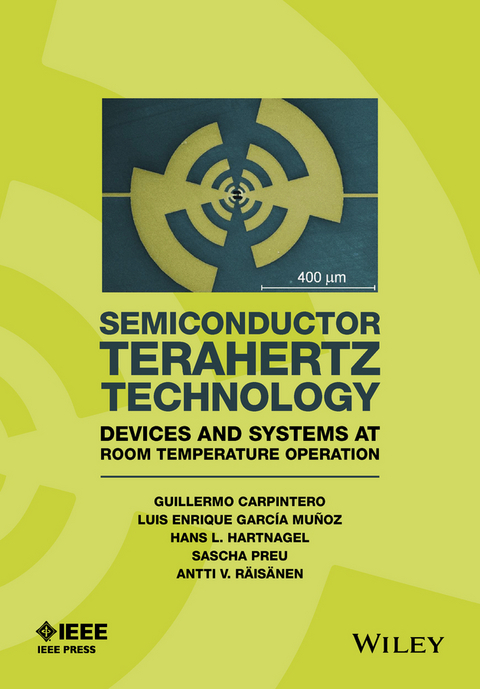
Semiconductor TeraHertz Technology (eBook)
John Wiley & Sons (Verlag)
978-1-118-92039-8 (ISBN)

GUILLERMO CARPINTERO, Universidad Carlos III de Madrid, Spain LUIS ENRIQUE GARCÍA MUÑOZ, Universidad Carlos III de Madrid, Spain HANS L. HARTNAGEL, Technische Universität Darmstadt, Germany SASCHA PREU, Technische Universität Darmstadt, Germany ANTTI V. RÄISÄNEN, Aalto University, Finland
Preface
“Midway upon the journey of our life, I found myself within a forest dark, for the straightforward pathway had been lost.” These words from Dante Aliguieri can summarize the main motivation that we had for writing this book: trying to cover and explain recent advances in THz frequencies from a semiconductor technology perspective. Our motivation started with a meeting in Nürnberg (Germany) in October 2013, where we (all authors of this book) had agreed to meet to discuss the objectives and structure of the book in its present form.
THz frequencies have been investigated for a long time, since the middle of the twentieth century, having coined popular terms such as the “THz gap” to indicate the underdevelopment of this part of the electromagnetic spectrum. However, the technological challenge to develop efficient devices for both generation and detection of THz waves has only recently started to be addressed. The mechanisms that govern the propagation, emission, and characterization at THz frequencies have been studied and developed by both physicists and engineers. We have realized that, very frequently, there is a huge lack of knowledge about the different perspectives that are involved. Let us illustrate this point with an example: the photomixing technique for the generation of THz waves. Photomixing uses two lasers emitting at slightly different wavelengths that beat in a semiconductor device, obtaining the difference of the two lasers as the THz emitted frequency. It must thus be studied, taking semiconductor physics into account. Conversely, the study of the antennas and/or lenses attached for extracting the THz wave generated (or for the propagation and guiding of THz signals) is typically done by the classical approach of macroscopic electrodynamics. Engineers typically treat the photomixing process as a “black box” where they have to insert their antennas to get the best matching. On the other hand, the physicists who developed the device sometimes forget about the technology limits or have modest knowledge about antenna radiation mechanisms, and use classical topologies on the basis that they worked previously, not being aware that more efficient approaches are available. The result is that both research approaches, although totally valid and rigorous, have a lack of knowledge in the other area. In order to optimize the devices, the researchers need to address design issues that lead them into areas of expertise that they do not master. That is what we call entering into “the forest dark” of Dante.
We believe that partnership among researchers is the best approach to explore the new regions. With this spirit in mind, we organized the meeting at Nürnberg, contacting specialists from all the regions of the THz forest. The main objective for this book in the beginning was to shed some light into the different parts of the THz forest. We can affirm that the book is a self-contained manual for both physicists and engineers who are working or starting their research in semiconductor THz technology. The international team of authors, which comes from both areas of knowledge, that is, Physics and Engineering, wrote all the contributions with extreme care, explaining the basic concepts of their areas up to the current state-of-the-art. For this reason, an expert in an area could find a few pages of the book “rather elementary”. These are, however, strictly necessary to provide total consistency and the self-contained aspect of the book, and to cover fully the current state-of-the-art.
In Chapter 2, the theoretical background of terahertz generation by photomixing is discussed in detail. Basic design rules are specified for obtaining highly efficient optical to THz power conversion for both photoconductive and high frequency p-i-n diodes, considering pulsed as well as continuous-wave operation. State-of-the-art realizations of photomixers at 800 and 1550 nm laser wavelengths are shown. Limiting electrical and thermal constraints to the achievable THz power are also addressed. Finally, this chapter gives an overview of electronic means for THz generation, such as Schottky diodes, negative differential resistor oscillators, and plasmonic effects that are used in THz generation. The chapter starts with a quick overview of the most relevant THz generation schemes based on nonlinear media, accelerating electrons, and actual THz lasers. This serves to place in context the two schemes discussed in detail thereafter: photomixing and electronic generation. The chapter goes through the theoretical frameworks, principles of operation, limitations, and reported implementations of both schemes for pulsed and continuous-wave operation when applicable. The chapter also covers to a lesser extent the recently explored use of plasmonics to improve the efficiency of THz generation in photomixing, nonlinear media, and laser schemes.
Chapter 3 presents the theoretical background of antenna theory, tailored to terahertz applications. A general discussion is provided on the issues of THz antennas, especially for matching to the photomixer. Array theory is presented, together with an exhaustive and precise analysis of one of the most promising and new solutions for generating THz emission with high power levels, that is, the large area emitter concept.
In Chapter 4 we first briefly introduce Maxwell's equations and derive the Helmholtz equation, that is, a special case of the wave equation, and introduce its different solutions for fields that may propagate in THz waveguides. The second section describes different waveguides operating at THz frequencies, and the third section is devoted to the beam waveguide and quasi-optics. Material issues related to waveguides and quasi-optical components are also discussed. The chapter concludes with THz wave propagation in free space.
Chapter 5 is a comprehensive review of the physical principles and engineering techniques associated with contemporary room-temperature THz direct detectors. It starts with the basic detection mechanisms: rectification, bolometric, pyroelectric, and plasma waves. Then it addresses the noise mechanisms using both classical and quantum principles, and the THz coupling using impedance-matching and antenna-feed considerations. Fundamental analyses of the noise mechanisms are provided because of insufficient coverage in the popular literature. All THz detectors can then be described with a common performance formalism based on two metrics: noise-equivalent power (NEP) and noise-equivalent temperature difference (NETD). The chapter concludes with a comparison of the best room-temperature THz detector experimental results to date above ∼300 GHz, and suggests that as none of these detector types are operating very close to fundamental theoretical limits there is room for significant performance advances.
Several key topics in THz electronics are discussed in Chapter 6. We describe operating principles, limitations, and state-of-the-art of resonant-tunneling diodes (RTDs) and THz RTD oscillators. Furthermore, THz fundamental or sub-harmonic flip-chip Schottky diode mixer configurations are described. Different measurement techniques are commented and their properties outlined. The chapter also describes the use of advanced mixer configurations. Fabrication technologies for Schottky-diode based structures for THz wave applications are included, together with the low-barrier Schottky diode characterization for millimeter-wave detector design. Finally, low noise amplifiers (LNAs) for sub-millimeter waves are discussed, including up-to-date design approaches and resulting performance, with emphasis on the necessary technological modification to extend monolithic microwave integrated circuit (MMIC) approaches toward the THz region.
The THz spectral range has not yet been fully exploited to its full potential due to the current limitations in sources and detectors. To open the THz frequency range for applications, photonic solutions have been at the technological forefront. For instance, the advances of time domain spectroscopy techniques using short pulse lasers have enabled the provision offull spectroscopy data across the range. There are different types of systems and their development should be governed by the requirements of the potential application. Photonic techniques are desirable solutions for millimeter wave and THz generation in terms of their energy efficiency and, above all, their tuning range. Recent developments in this area target the improvement of optical-to-THz converters as well as enhancing the level of integration of semiconductor laser sources in order to address their main drawbacks, cost, and spectral purity. The purpose of Chapter 7 is to describe the main types of photonically enabled THz systems and the expected performances from their components. A description is provided of the key elements in designing each of the components and their limitations. The final part of the chapter is a discussion on potential future development and the importance of integration.
Finally, Chapter 8 summarizes and explains some novel approaches and applications of THz, such as liquid crystals, graphene technology, or resonator theory based on a nonlinear up-conversion process. This makes the approach very appealing for its use as highly-sensitive receivers.
We expect that the reader will find in the book not only answers but also at least some hints for continuing the advances in THz technology. Of course, we hope that the reader shares the same feeling of satisfaction experienced by the authors when writing and discussing the present book.
Prof. Dr....
| Erscheint lt. Verlag | 14.7.2015 |
|---|---|
| Reihe/Serie | IEEE Press |
| Wiley - IEEE | Wiley - IEEE |
| Sprache | englisch |
| Themenwelt | Technik ► Elektrotechnik / Energietechnik |
| Schlagworte | Coherent THz • Electrical & Electronics Engineering • Elektrotechnik u. Elektronik • Halbleiter • handbook of terahertz technology • IEEE • ieee book • ieee series • Mikrowellen- u. Hochfrequenztechnik u. Theorie • Mixing • Photomixing • Photonics & Lasers • Photonik u. Laser • principles of terahertz • Resonant tunnelling diode • RF / Microwave Theory & Techniques • Room temperature operation • semiconductor • semiconductors • Terahertz • THz • THz Detection • THz Generation • THz System • ultrafast dynamical processes in semiconductors |
| ISBN-10 | 1-118-92039-2 / 1118920392 |
| ISBN-13 | 978-1-118-92039-8 / 9781118920398 |
| Informationen gemäß Produktsicherheitsverordnung (GPSR) | |
| Haben Sie eine Frage zum Produkt? |
 PDF (Adobe DRM)
Größe: 21,4 MB
Kopierschutz: Adobe-DRM
Adobe-DRM ist ein Kopierschutz, der das eBook vor Mißbrauch schützen soll. Dabei wird das eBook bereits beim Download auf Ihre persönliche Adobe-ID autorisiert. Lesen können Sie das eBook dann nur auf den Geräten, welche ebenfalls auf Ihre Adobe-ID registriert sind.
Details zum Adobe-DRM
Dateiformat: PDF (Portable Document Format)
Mit einem festen Seitenlayout eignet sich die PDF besonders für Fachbücher mit Spalten, Tabellen und Abbildungen. Eine PDF kann auf fast allen Geräten angezeigt werden, ist aber für kleine Displays (Smartphone, eReader) nur eingeschränkt geeignet.
Systemvoraussetzungen:
PC/Mac: Mit einem PC oder Mac können Sie dieses eBook lesen. Sie benötigen eine
eReader: Dieses eBook kann mit (fast) allen eBook-Readern gelesen werden. Mit dem amazon-Kindle ist es aber nicht kompatibel.
Smartphone/Tablet: Egal ob Apple oder Android, dieses eBook können Sie lesen. Sie benötigen eine
Geräteliste und zusätzliche Hinweise
Zusätzliches Feature: Online Lesen
Dieses eBook können Sie zusätzlich zum Download auch online im Webbrowser lesen.
Buying eBooks from abroad
For tax law reasons we can sell eBooks just within Germany and Switzerland. Regrettably we cannot fulfill eBook-orders from other countries.
 EPUB (Adobe DRM)
Kopierschutz: Adobe-DRM
Adobe-DRM ist ein Kopierschutz, der das eBook vor Mißbrauch schützen soll. Dabei wird das eBook bereits beim Download auf Ihre persönliche Adobe-ID autorisiert. Lesen können Sie das eBook dann nur auf den Geräten, welche ebenfalls auf Ihre Adobe-ID registriert sind.
Details zum Adobe-DRM
Dateiformat: EPUB (Electronic Publication)
EPUB ist ein offener Standard für eBooks und eignet sich besonders zur Darstellung von Belletristik und Sachbüchern. Der Fließtext wird dynamisch an die Display- und Schriftgröße angepasst. Auch für mobile Lesegeräte ist EPUB daher gut geeignet.
Systemvoraussetzungen:
PC/Mac: Mit einem PC oder Mac können Sie dieses eBook lesen. Sie benötigen eine
eReader: Dieses eBook kann mit (fast) allen eBook-Readern gelesen werden. Mit dem amazon-Kindle ist es aber nicht kompatibel.
Smartphone/Tablet: Egal ob Apple oder Android, dieses eBook können Sie lesen. Sie benötigen eine
Geräteliste und zusätzliche Hinweise
Buying eBooks from abroad
For tax law reasons we can sell eBooks just within Germany and Switzerland. Regrettably we cannot fulfill eBook-orders from other countries.
aus dem Bereich