Quantum Metrology (eBook)
XVI, 232 Seiten
Wiley (Verlag)
978-3-527-68092-4 (ISBN)
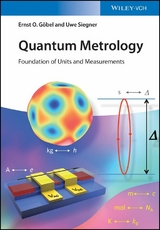
This book introduces and explains the applications of modern physics concepts to metrology, the science and the applications of measurements. A special focus is made on the use of quantum standards for the realization of the forthcoming new SI (the international system of units). The basic physical phenomena are introduced on a level which provides comprehensive information for the experienced reader but also provides a guide for a more intense study of these phenomena for students.
Prof. Ernst O. Göbel was president of the PTB, the German national metrology institute from 1995 until the end of 2011. He obtained his degrees from the Johann-Wolfgang Goethe University Frankfurt (diploma) and University Stuttgart (PhD), Germany. After a postdoctoral stay at Bell Laboratories in Holmdel, USA, he continued his scientific career at Stuttgart University, and subsequently at the Max-Planck-Institut for Solid State Physics in Stuttgart, Germany. In 1985 he was appointed full professor at the Philipps-University in Marburg, Germany. His main areas of expertise are solid state physics, in particular semiconductor physics, laser physics and metrology. He has published more than 350 scientific articles and received several scientific awards such as the Leibnitz-prize of the German Research Ass. (DFG) and the Max-Born Award jointly provided by the Institute of Physics (London) and the German Physical Society (DPG). He is member of several academies, e.g. the Berlin-Brandenburgische Academy of Science, Acatech - the German Academy of Engineering, the National Academy of Science Ukraine, and the Metrology Academy of Russia.
Prof. Ernst O. Göbel was president of the PTB, the German national metrology institute from 1995 until the end of 2011. He obtained his degrees from the Johann-Wolfgang Goethe University Frankfurt (diploma) and University Stuttgart (PhD), Germany. After a postdoctoral stay at Bell Laboratories in Holmdel, USA, he continued his scientific career at Stuttgart University, and subsequently at the Max-Planck-Institut for Solid State Physics in Stuttgart, Germany. In 1985 he was appointed full professor at the Philipps-University in Marburg, Germany. His main areas of expertise are solid state physics, in particular semiconductor physics, laser physics and metrology. He has published more than 350 scientific articles and received several scientific awards such as the Leibnitz-prize of the German Research Ass. (DFG) and the Max-Born Award jointly provided by the Institute of Physics (London) and the German Physical Society (DPG). He is member of several academies, e.g. the Berlin-Brandenburgische Academy of Science, Acatech - the German Academy of Engineering, the National Academy of Science Ukraine, and the Metrology Academy of Russia.
Foreword
Preface
List of Abbreviations
INTRODUCTION
BASICS
Measurement
The SI (Système International d'Unités)
LASER COOLING, ATOMIC CLOCKS, AND THE SECOND
Techniques for Laser Cooling
The Cs-Fountain Clock
Optical Clocks
SUPERCONDUCTIVITY, JOSEPHSON EFFECT, AND FLUX QUANTA
Josephson Effect and Quantum Voltage Standards
Flux Quanta and Superconducting Quantum Interference Devices
QUANTUM HALL EFFECT
Basic Physics of Three- and Two Dimensional Semiconductors
Two-Dimensional Electron Systems in Real Semiconductors
The Hall Effect
Quantum Hall Resistance Standards
SINGLE-CHARGE TRANSFER DEVICES AND THE NEW AMPERE
Basic Physics of Single-Electron Transport
Quantized Current Sources
Consistency Tests: Quantum Metrology Triangle
PLANCK CONSTANT, THE NEW KILOGRAM, AND THE MOLE
The Avogadro Experiment
The Watt Balance Experiment
The Mole, Unit of Amount of Susbstance
BOLTZMAN CONSTANT AND THE NEW KELVIN
Primary Thermometers
Realization and Disseminiation of the New Kelvin
SINGLE-PHOTON METROLOGY AND QUANTUM RADIOMETRY
Single-Photon Sources
Single-Photon Detectors
Metrological Challenge
OUTLOOK
The book "Quantum Metrology: Foundation of Units and Measurements" offers a unique introduction to the planned modifications of our system of units and is recommended for students, scientists and lecturers who are interested in questions of quantum physics and its practical applications in metrology.
Prof. Dr. Klaus von Klitzing, Max-Planck-Institut für Festkörperforschung, Stuttgart
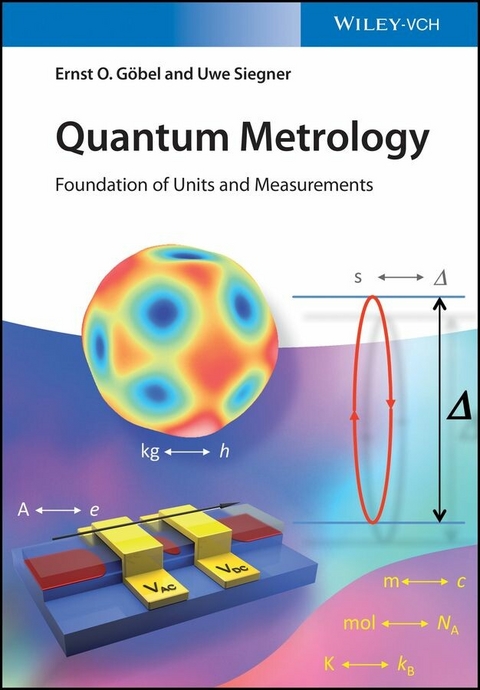
Seit zehn Jahren gibt es intensive Überlegungen, das internationale Einheitensystem zu renovieren. Ausschlaggebend waren Fortschritte in der Präzisionsmesstechnik, welche die Möglichkeit eröffneten, Maßeinheiten festzulegen, die nicht von Raum und Zeit abhängen. Bei der Längeneinheit Meter ist diese Entwicklung schon seit 1983 durch Rückführung auf eine Naturkonstante - die Lichtgeschwindigkeit ? zum Abschluss gekommen. Nicht nur das Meter, sondern auch die anderen Basiseinheiten unseres internationalen Einheitensystems sollen entsprechend einer Empfehlung der Generalkonferenz für Maße und Gewichte durch festgelegte Naturgrößen ersetzt werden. Ein entsprechender Beschluss könnte 2018 gefällt werden. Der Umschlag des vorliegenden Buches verdeutlicht die geplanten Änderungen: Insbesondere soll das Kilogramm über einen festgelegten Wert für die Planck-Konstante h, das Ampere über einen festgelegten Wert für die Elementarladung e und das Kelvin über einen festgelegten Wert für die Boltzmann-Konstante kB definiert werden.
Die Autoren dieses Buches sind bestens geeignet, die geplanten Änderungen unseres SI-Einheitensystems und die entsprechenden physikalischen Grundlagen zu erläutern. Ernst Göbel war mehr als 16 Jahre Präsident der Physikalisch-Technischen Bundesanstalt (PTB) und hat als langjähriges Mitglied des Komitees für Maße und Gewichte die geplanten Umwälzungen von Beginn an miterlebt und gestaltet. Uwe Siegner als Leiter der Abteilung Elektrizität in der PTB ist in besonderem Maße von der geplanten Änderung im SI-Einheitensystem betroffen, da sich die elektrischen Einheiten durch international vereinbarte konventionelle Werte für die Josephson- und von-Klitzing-Konstanten von den offiziellen SI-Einheiten abgekoppelt haben und sich erst durch die geplante Neufestlegung der SI-Basiseinheiten in dieses Einheitensystem integrieren lassen.
Nach einer Einführung in die Grundlagen der Metrologie und in unser jetziges Einheitensystem werden in getrennten Kapiteln die experimentellen Methoden erläutert, die für die Neufestlegung der jeweiligen SI-Basiseinheit von Bedeutung sind. Das führt dem Leser die gesamte Breite der modernen Quantenoptik, Thermodynamik, Supraleitungs- und Festkörper-Nanophysik und deren Anwendung in der Metrologie vor Augen. Mit mehr als 500 Referenzen hat der Leser die Möglichkeit, sich in das jeweilige Fachgebiet zu vertiefen.
Das Buch "Quantum Metrology: Foundation of Units and Measurements" bietet einen hervorragenden Einstieg zum Verständnis der geplanten Änderungen in unserem Einheitensystem und ist Studierenden, Wissenschaftlern und Lehrenden zu empfehlen, die sich für moderne Fragen der Quantenphysik und deren praktischer Anwendung in der Metrologie interessieren.
Prof. Dr. Klaus von Klitzing, Max-Planck-Institut für Festkörperforschung, Stuttgart
2
Some Basics
2.1 Measurement
Measurement is a physical process to determine the value (magnitude) of a quantity. The quantity value can be expressed as
where {q} is the numerical value and [Q] the unit (see following chapter). Repeated measurements of the same quantity, however, generally will result in slightly different results. In addition, systematic effects affecting the measurement result might be present and have to be considered. Thus, any measurement result must be completed by an uncertainty statement. This measurement uncertainty quantifies the dispersion of the quantity values being attributed to a measurand, based on the information used. Measurement uncertainty comprises, in general, many components. Some of these may be evaluated by type A evaluation of measurement uncertainty from the statistical distribution of the quantity values from series of measurements and can be characterized by standard deviations. The other components, which may be evaluated by type B evaluation of measurement uncertainty, can also be characterized by standard deviations, evaluated from probability density functions based on experience or other information. For the evaluation of uncertainties of measurements, an international agreed guide has been published jointly by ISO and the Bureau International des Poids et Mesures (BIPM), the Guide to the Expression of Uncertainty in Measurement (GUM) [1, 2]. Precision measurements generally are those with the smallest measurement uncertainty.
2.1.1 Limitations of Measurement Uncertainty
One might tend to believe that measurement uncertainty can be continuously decreased as more and more effort is put in the respective experiment. However, this is not the case since there are fundamental as well as practical limitations for measurement precision. The fundamental limit is a consequence of the Heisenberg uncertainty principle of quantum mechanics, and the major practical limit is due to noise.
2.1.1.1 The Fundamental Quantum Limit
Note that throughout this book, we will use the letter f to denote technical frequencies, while the Greek letter ν is used to denote optical frequencies.
The Heisenberg uncertainty principle is a fundamental consequence of quantum mechanics stating that there is a minimum value for the physical quantity action, H:
where h is the Planck constant. Action has the dimensions of energy multiplied by time and its unit is joule seconds. From the Heisenberg uncertainty principle, it follows that conjugated variables, like position and momentum or time and energy, cannot be measured with ultimate precision at a time. For example, if Δx and Δp are the standard deviation for position, x, and momentum, p, respectively, the inequality relation
holds (). Applied to measurement, the argument is as follows: in the course of a measurement, an exchange of information takes place between the measurement system and the system under consideration. Related to this is an energy exchange. For a given measurement time, τ, or bandwidth of the measurement system, , the energy which can be extracted from the system is limited according to Eq. (2.2) [3]:
Let us now consider, for example, the relation between inductance, L, and, respectively, magnetic flux, Φ, and current, I (see Figure 2.1). The energy is given by , and consequently,
Figure 2.1 Components and quantities considered (left) and the minimum current, Imin, and the minimum magnetic flux, Φmin, versus inductance, L, for an ideal coil.
(From [3], with kind permission from Wiley-VCH.)
These relations are depicted also in Figure 2.1. The gray area corresponds to the regime which is accessible by measurement. Please note that this is a heuristic approach which does not consider a specific experiment. Nevertheless, it may provide useful conclusions on how to optimize an experiment. For instance, if an ideal coil (without losses) shall be applied to measure a small current, the inductivity should be large (e.g., , , and then ). If instead the coil is applied to measure magnetic flux, L should be small (e.g., , , and then where is the ).
Likewise, for a capacitor with capacitance, C, the energy is given by
and thus,
Finally, for a resistor with resistance, R, the energy is given by
and thus, for the minimum current and voltage, respectively, we obtain
2.1.1.2 Noise
In this chapter, we briefly summarize some aspects of noise theory. For a more detailed treatment of this important and fundamental topic, the reader is referred to, for example, [4].
Noise limits the measurement precision in most practical cases. The noise power spectral density, P(T, f)/Δf, can be approximated by (Planck formula)
where f is the frequency, kB the Boltzmann constant, and T the temperature. Two limiting cases can be considered as follows.
Thermal Noise (Johnson Noise) (kBT ≫ hf)
According to this “Nyquist relation,” the thermal noise power spectral density is independent of frequency (white noise) and increases linearly with temperature. Thermal noise was first studied by Johnson [5]. It reflects the thermal agitation of, for example, carriers (electrons) in a resistor.
Quantum Noise (hf ≫ kBT)
The quantum noise power spectral density in this limit is determined by the zero point energy, hf, and is independent of temperature and increases linearly with frequency.
Thermal noise dominates at high temperatures and low frequencies (see Figure 2.2). The transition frequency, fc(T), where both contributions are equal depends on temperature and is given by
Figure 2.2 Noise power spectral density, P(T, f), versus frequency for different temperatures.
(From [3], with kind permission from Wiley-VCH.)
This transition frequency amounts to 4.3 THz at and 60.6 GHz at the temperature of liquid He at .
The thermal noise in an electrical resistor at temperature T generates under open circuit or shortcut, respectively, a voltage or current with effective values:
To keep the noise level low, the detector equipment should be cooled to low temperatures to reduce thermal noise. Going from room temperature (300 K) to liquid He temperature (4.2 K) actually reduces the thermal noise power by a factor of about 70. In addition, both thermal and quantum noise can be reduced by reducing the bandwidth, that is, integrating over longer times, τ. This, however, requires stable conditions during the measurement time, τ. Unfortunately, however, other noise contributions may take over like shot noise and at low frequencies the so called 1/f noise.
Shot Noise
Shot noise originates from the discrete nature of the species carrying energy (e.g., electrons, photons). It was first discovered by Schottky [6] when studying the fluctuations of current in vacuum tubes. Shot noise is observed when the number of particles is small such that the statistical nature describing the occurrence of independent random events is described by the Poisson distribution. The Poisson distribution transforms into a normal (Gaussian) distribution as the number of particles increases. At low frequencies, shot noise is white, that is, the noise spectral density is independent of frequency and in contrast to the thermal noise also independent of temperature. The shot noise spectral density of an electrical current, Sel, at sufficiently low frequencies is given by
where I is the average current. Likewise, for a monochromatic photon flux, we have for the shot noise spectral density of photon flux, Sopt,
where hν is the photon energy and P the average power.
Low Frequency Noise (1/f Noise)
1/f noise (sometimes also called pink noise or flicker noise) occurs widely in nature but nevertheless might have quite different origin. More precisely, the relation between noise power spectral density and frequency often is given by
with β mostly close to 1. In contrast to thermal or quantum noise, the noise power of 1/f noise decreases with increasing frequency (by 3 dB per octave of frequency). Figure 2.3 shows, for example, the noise power spectral density as measured for a superconducting quantum interference device (SQUID) magnetometer versus frequency [7].
Figure 2.3 Noise power spectral density as measured for a SQUID magnetometer versus frequency.
(From...
| Erscheint lt. Verlag | 10.6.2015 |
|---|---|
| Sprache | englisch |
| Themenwelt | Naturwissenschaften ► Physik / Astronomie ► Theoretische Physik |
| Technik | |
| Schlagworte | Chemie • Chemistry • Electrical & Electronics Engineering • Elektrotechnik u. Elektronik • Manipulation of Nanosystems • Manipulation von Nanosystemen • Nanophysics • Nanophysik • Nanotechnologie • nanotechnology • Physics • Physik • Quantenchemie • Quantenmesstechnik • Quantenphysik • Quantenphysik u. Feldtheorie • Quantum Chemistry • Quantum Physics & Field Theory • Sensoren, Instrumente u. Messung • Sensors, Instrumentation & Measurement |
| ISBN-10 | 3-527-68092-6 / 3527680926 |
| ISBN-13 | 978-3-527-68092-4 / 9783527680924 |
| Informationen gemäß Produktsicherheitsverordnung (GPSR) | |
| Haben Sie eine Frage zum Produkt? |
 EPUB (Adobe DRM)
Kopierschutz: Adobe-DRM
Adobe-DRM ist ein Kopierschutz, der das eBook vor Mißbrauch schützen soll. Dabei wird das eBook bereits beim Download auf Ihre persönliche Adobe-ID autorisiert. Lesen können Sie das eBook dann nur auf den Geräten, welche ebenfalls auf Ihre Adobe-ID registriert sind.
Details zum Adobe-DRM
Dateiformat: EPUB (Electronic Publication)
EPUB ist ein offener Standard für eBooks und eignet sich besonders zur Darstellung von Belletristik und Sachbüchern. Der Fließtext wird dynamisch an die Display- und Schriftgröße angepasst. Auch für mobile Lesegeräte ist EPUB daher gut geeignet.
Systemvoraussetzungen:
PC/Mac: Mit einem PC oder Mac können Sie dieses eBook lesen. Sie benötigen eine
eReader: Dieses eBook kann mit (fast) allen eBook-Readern gelesen werden. Mit dem amazon-Kindle ist es aber nicht kompatibel.
Smartphone/Tablet: Egal ob Apple oder Android, dieses eBook können Sie lesen. Sie benötigen eine
Geräteliste und zusätzliche Hinweise
Buying eBooks from abroad
For tax law reasons we can sell eBooks just within Germany and Switzerland. Regrettably we cannot fulfill eBook-orders from other countries.
aus dem Bereich