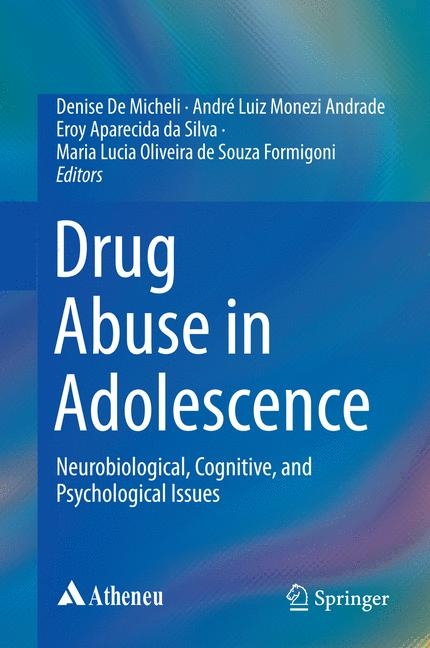
Drug Abuse in Adolescence (eBook)
XXIII, 200 Seiten
Springer International Publishing (Verlag)
978-3-319-17795-3 (ISBN)

Focusing on two central themes--the psychobiological evolution from youth to adult and the effects of drugs on the developing central nervous system--this important reference elucidates the mechanisms of chemical dependency in adolescents. Its multidisciplinary coverage analyzes addiction across major domains of human functioning against the backdrop of hormonal, cognitive, and other changes that accompany the transition to adulthood. Chapters discuss legal as well as illicit drugs, examine age-related social contexts, and present the latest findings on links between drug use and mental disorders.
Throughout, the contributors make clear that education is more valuable to understanding--and preventing--substance abuse than are prohibition and zero-tolerance thinking.
Included among the topics:
- Cognitive development, learning, and drug use.
- Neurobiology of the action of drugs of abuse.
- Findings in adolescents with substance dependence based on neuroimaging tests.
- Alcohol abuse in adolescents: relevance of animal models.
- Effects of chronic drug abuse on the chronobiology of sleep in adolescents.
- Neurological and cognitive disorders arising from the chronic use of drugs of abuse.
The multiple lenses for understanding its subject and the sensitivity with which causal nuances are treated make Neuroscience of Drug Abuse in Adolescence an invaluable resource for clinical and child psychologists, psychiatrists, social workers, and addiction counselors.
Denise De Micheli obtained a bachelor's degree in psychology at Universidade Paulista and masters and doctoral degrees at the Universidade Federal de São Paulo. A professor in the Department of Psychobiology at Universidade Federal de São Paulo, she also serves as chief of the Interdisciplinary Centre of Studies in Neuroscience Adolescent Health and Education and is a member of the Association for Medical Education and Research in Substance Abuse.
André Luiz Monezi Andrade obtained a bachelors degree in psychology at Universidade Positivo and a masters degree at Universidade Federal de São Paulo, and currently is finishing his doctoral studies at Universidade Federal de São Paulo focusing on neurobiology of addiction in adolescence. He is a professor in the Department of Psychology at Universidade Anhembi Morumbi with special focus on psychopathology and psychopharmacology in adolescents.
Eroy Apericida da Silva obtained a bachelors degree in psychology by Universidade Paulistana and masters and doctoral degrees at the Universidade Federal de São Paulo. He is a professor in the Department of Psychology at the Universidade Federal de São Paulo, where he also serves as Chief of Cognitive Therapies on Substance Abuse at Unidade de Dependência de Drogas (UDED).
Maria Lucia Oliveira de Souza Formigoni obtained a bachelors degree in medical biological sciences from Escola Paulista de Medicina (EPM), Universidade Federal de São Paulo (UNIFESP) in 1979, where she also completed her masters and doctoral studies in psychopharmacology and psychobiology, respectively. She is an associate professor and the prorector of post-graduate studies and research of the Universidade Federal de São Paulo.
Denise De Micheli obtained a bachelor's degree in psychology at Universidade Paulista and masters and doctoral degrees at the Universidade Federal de São Paulo. A professor in the Department of Psychobiology at Universidade Federal de São Paulo, she also serves as chief of the Interdisciplinary Centre of Studies in Neuroscience Adolescent Health and Education and is a member of the Association for Medical Education and Research in Substance Abuse. André Luiz Monezi Andrade obtained a bachelors degree in psychology at Universidade Positivo and a masters degree at Universidade Federal de São Paulo, and currently is finishing his doctoral studies at Universidade Federal de São Paulo focusing on neurobiology of addiction in adolescence. He is a professor in the Department of Psychology at Universidade Anhembi Morumbi with special focus on psychopathology and psychopharmacology in adolescents. Eroy Apericida da Silva obtained a bachelors degree in psychology by Universidade Paulistana and masters and doctoral degrees at the Universidade Federal de São Paulo. He is a professor in the Department of Psychology at the Universidade Federal de São Paulo, where he also serves as Chief of Cognitive Therapies on Substance Abuse at Unidade de Dependência de Drogas (UDED). Maria Lucia Oliveira de Souza Formigoni obtained a bachelors degree in medical biological sciences from Escola Paulista de Medicina (EPM), Universidade Federal de São Paulo (UNIFESP) in 1979, where she also completed her masters and doctoral studies in psychopharmacology and psychobiology, respectively. She is an associate professor and the prorector of post-graduate studies and research of the Universidade Federal de São Paulo.
Neural-hormonal system in adolescence. - Cognitive development and substance misuse. - Neurodevelopment during adolescence. - Neural basis of drug addiction. - Neurobiological effects of different types of drug abuse on adolescent brain. - Neuroimaging of the human brain in adolescent substance users. - Animal models of adolescent drug abuse. - Functional magnetic resonance imaging studies of the adolescent reward system: the triadic model perspective. - Chronic effects of drug abuse on sleep and chronibiology in adolescents. - Neurocognitive changes due to chronic adolescents' substance misuse. - Relationship between mood disorders and substance abuse in adolescents. - Substance abuse and ADHD in adolescents. - Future directions for research
| Erscheint lt. Verlag | 3.7.2015 |
|---|---|
| Zusatzinfo | XXIII, 200 p. 40 illus., 13 illus. in color. |
| Verlagsort | Cham |
| Sprache | englisch |
| Themenwelt | Medizin / Pharmazie ► Medizinische Fachgebiete ► Psychiatrie / Psychotherapie |
| Technik | |
| Schlagworte | adolescent drug use and behavior • adolescent drug use and cognitive development • adolescent drug use and mental health • drug abuse and adolescent brain • drug misuse in adolescents • neurobiology of adolescent drug misuse |
| ISBN-10 | 3-319-17795-8 / 3319177958 |
| ISBN-13 | 978-3-319-17795-3 / 9783319177953 |
| Informationen gemäß Produktsicherheitsverordnung (GPSR) | |
| Haben Sie eine Frage zum Produkt? |
 PDF (Wasserzeichen)
DRM: Digitales Wasserzeichen
Dieses eBook enthält ein digitales Wasserzeichen und ist damit für Sie personalisiert. Bei einer missbräuchlichen Weitergabe des eBooks an Dritte ist eine Rückverfolgung an die Quelle möglich.
Dateiformat: PDF (Portable Document Format)
Mit einem festen Seitenlayout eignet sich die PDF besonders für Fachbücher mit Spalten, Tabellen und Abbildungen. Eine PDF kann auf fast allen Geräten angezeigt werden, ist aber für kleine Displays (Smartphone, eReader) nur eingeschränkt geeignet.
Systemvoraussetzungen:
PC/Mac: Mit einem PC oder Mac können Sie dieses eBook lesen. Sie benötigen dafür einen PDF-Viewer - z.B. den Adobe Reader oder Adobe Digital Editions.
eReader: Dieses eBook kann mit (fast) allen eBook-Readern gelesen werden. Mit dem amazon-Kindle ist es aber nicht kompatibel.
Smartphone/Tablet: Egal ob Apple oder Android, dieses eBook können Sie lesen. Sie benötigen dafür einen PDF-Viewer - z.B. die kostenlose Adobe Digital Editions-App.
Buying eBooks from abroad
For tax law reasons we can sell eBooks just within Germany and Switzerland. Regrettably we cannot fulfill eBook-orders from other countries.
aus dem Bereich