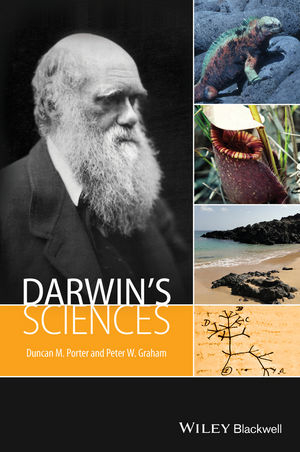
Darwin's Sciences (eBook)
264 Seiten
Wiley-Blackwell (Verlag)
978-1-119-04573-1 (ISBN)
Considered the first book to thoroughly emphasize Darwin's research in various fields of endeavor, what he did, why he did it, and its implications for his time and ours.
Rather than following a strictly chronological approach - a narrative choice that characteristically offers an ascent to On the Origin of Species (1859) with a rapid decline in interest following its publication and reception - this book stresses the diversity and full extent of Darwin's career by providing a series of chapters centering on various intellectual topics and scientific specializations that interested Darwin throughout his life.
Authored by academics with years of teaching and discussing Darwin, Darwin's Sciences is suited to any biologist who is interested in the deeper inplications of Darwin's research.
Duncan M. Porter received his BA and MA from Stanford and PhD from Harvard, all in Biological Sciences. A
Postdoctoral Assistantship at Stanford studying the flora of the Galapagos Islands gave him a life-long interest in Charles Darwin. This led him to follow Darwin’s footsteps in England, Scotland, Wales, France, Ecuador, Chile, and New Zealand, and wish that he could see more of the places the great man visited. Along the way, Porter was on the faculties of the University of San Francisco, Washington University, and Virginia Tech; collected and wrote about plants from Canada to Chile, Morocco, and Oman; worked at the Missouri Botanical Garden, Smithsonian Institution, and National Science Foundation; became a Fellow of the Linnean Society, Clare Hall, University of Canterbury, and American Association for the Advancement of Science; wrote many pages about Darwin; and became Senior Editor and Director of the Darwin Correspondence Project at Cambridge University. He is Professor Emeritus of Biological Sciences at Virginia Tech.
Peter W. Graham’s scholarly interests center on 19th-century British literature and culture, with particular emphasis on the works and lives of Charles Darwin, Jane Austen, and Lord Byron. Educated at Davidson College and Duke University, he has been a Lilly Post-doctoral Fellow, a Mellon Post-Doctoral Fellow, and, since 1978, a faculty member at Virginia Tech, where he’s served as Cutchins Professor of English. Peter is Director of International Relations for the Messolonghi Byron Research Center in Greece, Vice President of the Byron Society of America, a Life Member of the Jane Austen Society of North America, and a member of several editorial boards. He is author of Jane Austen & Charles Darwin- Naturalists and Novelists, Don Juan and Regency England, and other books, he also co-edited The Portable Darwin with Duncan.
Duncan M. Porter received his BA and MA from Stanford and PhD from Harvard, all in Biological Sciences. A Postdoctoral Assistantship at Stanford studying the flora of the Galapagos Islands gave him a life-long interest in Charles Darwin. This led him to follow Darwin's footsteps in England, Scotland, Wales, France, Ecuador, Chile, and New Zealand, and wish that he could see more of the places the great man visited. Along the way, Porter was on the faculties of the University of San Francisco, Washington University, and Virginia Tech; collected and wrote about plants from Canada to Chile, Morocco, and Oman; worked at the Missouri Botanical Garden, Smithsonian Institution, and National Science Foundation; became a Fellow of the Linnean Society, Clare Hall, University of Canterbury, and American Association for the Advancement of Science; wrote many pages about Darwin; and became Senior Editor and Director of the Darwin Correspondence Project at Cambridge University. He is Professor Emeritus of Biological Sciences at Virginia Tech. Peter W. Graham's scholarly interests center on 19th-century British literature and culture, with particular emphasis on the works and lives of Charles Darwin, Jane Austen, and Lord Byron. Educated at Davidson College and Duke University, he has been a Lilly Post-doctoral Fellow, a Mellon Post-Doctoral Fellow, and, since 1978, a faculty member at Virginia Tech, where he's served as Cutchins Professor of English. Peter is Director of International Relations for the Messolonghi Byron Research Center in Greece, Vice President of the Byron Society of America, a Life Member of the Jane Austen Society of North America, and a member of several editorial boards. He is author of Jane Austen & Charles Darwin- Naturalists and Novelists, Don Juan and Regency England, and other books, he also co-edited The Portable Darwin with Duncan.
Preface vii
Acknowledgments xi
1 Introduction 1
2 DarwintheGeologist 12
3 DarwintheZoologist 44
4 DarwintheBotanist 93
5 Darwin the Social Scientist 152
6 Coda: Darwin,Worms, and theWorld 208
Bibliography 218
Index 237
"[An] impressively interdisciplinary biography" (Isis, 2017)
"The book is obviously a labor of love by professors who really care about Darwin and his ideas and want to communicate that love to their students. That for me says a lot positively about the volume. I could really see this work as right for classroom use, perhaps in conjunction with On the Origin of Species itself." (The Quarterly Review of Biology, 2016)
Chapter 1
Introduction
Reflecting back on his childhood while in his sixties, Charles Darwin wrote in his autobiography that by the age of eight “my taste for natural history, and more especially for collecting, was well developed.” He recalled that he “collected all sorts of things, shells, seals, franks, coins, and minerals. The passion for collecting, which leads a man to be a systematic naturalist, a virtuoso or a miser, was very strong in me, and was clearly innate, as none of my sisters or brother ever had this taste” (Autobiography: 22–3). It is clear that this innate trait led him to accumulate during his lifetime not only natural history specimens, but also voluminous notes on them and on relevant subjects, numerous publications, and a vast correspondence with naturalists and others around the world. These documents have left subsequent generations a vast treasure trove of information about Darwin, his interests, and his family that we have mined in producing this book.
Today, many people picture Charles Darwin as a solemn, black-cloaked, gray-bearded Victorian patriarch staring at them with rheumy eyes, as seen in the well-known photographs Julia Margaret Cameron had taken in 1868 (Figure 1.1). However, he was only 22 when he embarked on the life-altering voyage of HMS Beagle in December 1831 and 28 when he began his notebooks on transmutation of species (evolution) in March 1837 (Figure 1.2).
Figure 1.1 Photograph of Charles Darwin at the age of 59, by renowned photographer Julia Margaret Cameron at Freshwater, Isle of Wight, August 1868.
(Courtesy of Google Images, 2013.)
Figure 1.2 Charles Darwin at the age of 22 before he sailed on the Beagle voyage. Sculpture in the new Darwin Garden at Christ's College, Cambridge, where he was a student from 1828 to 1831. Sculpted by Christ's student Anthony Smith, unveiled on Darwin's 200th birthday, 12 February 2009.
(Photo by Duncan M. Porter, 2009.)
The narrative that follows will not be the usual chronologically organized biography about Darwin's life. For comprehensive biographical details, the reader should seek out the recent books by Adrian Desmond and James Moore (Darwin. The Life of a Tormented Evolutionist 1991) or Janet Browne (Charles Darwin. Voyaging 1995; Charles Darwin. The Power of Place 2002). Or, for recent studies of certain aspects of Darwin's life, see Keith Thomson (The Young Charles Darwin 2009), which leads up to his theory of evolution by natural selection; Randal Keynes (Annie's Box 2001) on Darwin's loss of his favorite daughter; or Edna Healey (Emma Darwin 2001) and James and Kent Loy (Emma Darwin. A Victorian Life 2010) on his domestic life; Andrew Pattison (The Darwins of Shrewsbury 2009) and Tim Berra (Darwin and His Children 2013) on the family; Richard Keynes (Fossils, Fishes, and Fuegians 2002) on the Beagle voyage; Thalia Grant and Greg Estes (Darwin in Galápagos 2009) on where he went and what he saw in these islands; Rebecca Stott (Darwin and the Barnacle 2003) on his research with barnacles; Daniel Pauley (Darwin's Fishes 2004) on his research with fishes; and Sandra Herbert (Charles Darwin, Geologist 2005) on his career in geology. All these readable books rely heavily on the definitive, multivolume Correspondence of Charles Darwin (Correspondence 1985–2013), as henceforth must all research on Darwin's life and work. So does our study—which is the first biographical treatment to emphasize his lifelong research in various fields of endeavor, what he did, why he did it, and what its implications were and are for his time and ours. This account, ordered by topic rather than chronology, logically follows our earlier book (The Portable Darwin 1993), which reprinted and discussed a number of his research papers and excerpts from his books. Above all, we aim to help our readers understand that Darwin's career did not build toward—and then subside from—one grand idea (natural selection or evolution) but instead involved many longstanding projects, some distinct and some interrelated, which together served to generate, support, and enrich his understanding of change as the great constant of the natural world.
First, we must set the stage with some family background. Much of the information in the following three paragraphs is from the new, first unabridged, edition of The Life of Erasmus Darwin, written by Charles Darwin in 1879 and edited by King-Hele (2003). The first known Darwin ancestor of Charles Darwin lived in the early sixteenth century, near the River Trent in Lincolnshire, in east-central England. Here, in the village of Marton, just south of Gainsborough near the border with Nottinghamshire, dwelt several generations of Darwins. Through marriage, in the late seventeenth century, the family seat became Elston Hall, Newark, Nottinghamshire. It was here that Robert Darwin, Charles' great-grandfather, was born in 1682.
Robert Darwin and his wife Elizabeth Hill had seven children in seven years. The youngest of these was the famous physician, poet, and philosopher Erasmus Darwin, born at Elston Hall in 1731. In 1750, Erasmus entered Cambridge University, as did his older brother John, but left without receiving his Bachelor of Arts degree. He entered Edinburgh Medical School in autumn 1753 and returned to Cambridge in 1755 to take a Bachelor of Medicine degree. Although Erasmus apparently never completed his M.D. (King-Hele 1999), until the fame of his grandson outstripped his own a century later, when one spoke of “Dr. Darwin”, one referred to Erasmus, not Charles.
Erasmus Darwin first attempted to practice medicine in Nottingham, where as a fledgling physician, he attracted no patients. Several months later, he moved to Lichfield in Staffordshire, where he was more successful, and in 1781, to the city of Derby in Derbyshire. He eventually became so successful that King George III is reported to have asked, “Why does not Dr. Darwin come to London? He shall be my physician if he comes” (King-Hele 2003: 69).
Erasmus was married twice and fathered 14 children, five by his first wife Mary Howard, two after she died by his son's nursemaid Mary Parker, and seven by his second wife Elizabeth Pole. The fourth child of his first marriage was Robert Waring Darwin, Charles' father, born in Lichfield in 1766. Like his father, Robert became a physician, studying medicine at Edinburgh Medical School, probably beginning in 1782 (King-Hele 1999), and receiving his M.D. from the University of Leiden in 1785. He returned to Edinburgh for another year, and in 1786, Erasmus settled him in the market town of Shrewsbury, county seat of Shropshire, in northwestern England, where he soon became even more financially successful than his father. In 1796, Robert married Susannah Wedgwood, the eldest child of the renowned potter Josiah Wedgwood, founder of the famed ceramics firm of Josiah Wedgwood & Sons Ltd. and a good friend of Erasmus Darwin.
Six children resulted from this first Darwin–Wedgwood union: Marianne (1798–1858), Caroline Sarah (1800–1888), Susan Elizabeth (1803–1866), Erasmus Alvey (1804–1881), Charles Robert (1809–1882), and Emily Catherine (1810–1866). Marianne married Dr. Henry Parker in 1824, Caroline her first cousin Josiah Wedgwood III in 1837, and Catherine the Rev. Charles Langton in 1863; Susan never married. Erasmus, who also never married, trained as a physician at Edinburgh University like his father and grandfather, but never practiced. Charles, of course, is the main subject of our story.
Charles, to whom we will subsequently refer as CD, following the Darwin Correspondence Project's usage, was born at the Mount, Robert and Susannah's substantial house on the edge of Shrewsbury on the 12th of February 1809. This auspicious day was also the birth date of Abraham Lincoln, born on a farm near Hodgenville, Hardin County, Kentucky, under rather different circumstances. Lincoln's parents were illiterate farmers, whereas CD was from the start of life securely situated in the rich and privileged British upper middle class. Both grandfathers were members of the free-thinking Lunar Society of Birmingham, and Dr. Erasmus Darwin articulated—in such works as The Loves of the Plants, Zoonomia, and The Temple of Nature (E. Darwin 1789, 1794–1796, 1803)—the most prominent eighteenth-century English case for evolutionary development. For a fascinating look at the Lunar Society see Uglow (2002), and for more on CD's grandfathers see Wedgwood and Wedgwood (1980), and King-Hele (1999).
In his Autobiography and elsewhere, CD disavowed the influence of his grandfather Erasmus's transformationist speculations on his own. However, CD's first Transmutation Notebook (Notebooks), “commenced about July 1837” (170), began with the title “Zoonomia” and with a discussion of asexual and sexual generation and references to that earlier book. Despite his apparent reluctance to acknowledge Erasmus's influence on him, CD recapitulated a family pattern in his choice of problems and projects, if not in his particular conclusions, just as his...
| Erscheint lt. Verlag | 8.6.2015 |
|---|---|
| Sprache | englisch |
| Themenwelt | Naturwissenschaften ► Biologie ► Evolution |
| Technik | |
| Schlagworte | Ãkologie • Ãkologie u. Biologie der Organismen • Biowissenschaften • Charles Darwin • Ecology & Organismal Biology • Evolution • history of botany • History of Geology • History of the social sciences • history of zoology • Life Sciences • Natural selection • Ökologie • Ökologie u. Biologie der Organismen • Origin of Species • Victorian science • voyage of the beagle |
| ISBN-10 | 1-119-04573-8 / 1119045738 |
| ISBN-13 | 978-1-119-04573-1 / 9781119045731 |
| Informationen gemäß Produktsicherheitsverordnung (GPSR) | |
| Haben Sie eine Frage zum Produkt? |
 EPUB (Adobe DRM)
Kopierschutz: Adobe-DRM
Adobe-DRM ist ein Kopierschutz, der das eBook vor Mißbrauch schützen soll. Dabei wird das eBook bereits beim Download auf Ihre persönliche Adobe-ID autorisiert. Lesen können Sie das eBook dann nur auf den Geräten, welche ebenfalls auf Ihre Adobe-ID registriert sind.
Details zum Adobe-DRM
Dateiformat: EPUB (Electronic Publication)
EPUB ist ein offener Standard für eBooks und eignet sich besonders zur Darstellung von Belletristik und Sachbüchern. Der Fließtext wird dynamisch an die Display- und Schriftgröße angepasst. Auch für mobile Lesegeräte ist EPUB daher gut geeignet.
Systemvoraussetzungen:
PC/Mac: Mit einem PC oder Mac können Sie dieses eBook lesen. Sie benötigen eine
eReader: Dieses eBook kann mit (fast) allen eBook-Readern gelesen werden. Mit dem amazon-Kindle ist es aber nicht kompatibel.
Smartphone/Tablet: Egal ob Apple oder Android, dieses eBook können Sie lesen. Sie benötigen eine
Geräteliste und zusätzliche Hinweise
Buying eBooks from abroad
For tax law reasons we can sell eBooks just within Germany and Switzerland. Regrettably we cannot fulfill eBook-orders from other countries.
aus dem Bereich