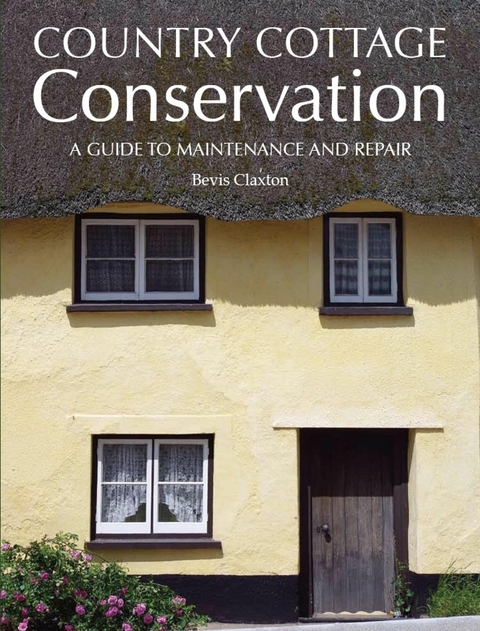
Country Cottage Conservation (eBook)
208 Seiten
Crowood (Verlag)
978-1-84797-967-4 (ISBN)
Introduction
WHAT THIS BOOK IS ABOUT
The information
This book sets out practical information that can help owners to keep their cottages viable and attractive. It aims to help bridge the information gap – between recognizing the need for action and deciding on what action to take – by providing some understanding of the special nature of cottages and how repairs and redecorations may affect them for good or ill. This information can be of help to owners whether they propose to carry out work themselves or engage others to do it for them. Cottages were designed cleverly to keep themselves intact despite dampness and movement. This technical performance is due to the way in which they were designed to use natural, sustainable materials, and it was also linked to the way in which people lived in their cottages. The visual appeal of cottages follows naturally from the authentic materials and their technical design. This book explains how some of this original look and function might be restored and preserved for the future.
Identifying the problems faced now
This book also looks at the condition in which most cottages have arrived in the twenty-first century. In addition to the problems of time and wear, cottages have not been served particularly well by many of the industrialized products and building methods of the twentieth century that have been, mainly innocently, applied to them. Most country cottages have been through several rounds of refurbishment since rural workers began to leave them a century ago. Books published since the 1950s have often tended to address bringing cottages up to contemporary standards of comfort, ‘doing them up’, frequently involving extreme rebuilding in the twentieth-century manner.
But the problems faced by a new owner today are much more likely to be about whether those twentieth-century repairs are mismatched with the original construction, and failing in some way, and whether recent refurbishments have also robbed the cottage of the character that once made it so attractive. What can be left of a cottage in many cases is not so much cottage, more a poor imitation of a modern house.
HOW THIS BOOK IS ORGANIZED
The chapters are organized within five sections, each identified by coloured pages:
The first section, ‘OLD AND WISE – A cottage is not a modern house’, introduces some essential information about taking on a cottage today and where help can be found in assessing a property for purchase or repair. It also explains in a straightforward way the big differences between a cottage and a modern house in terms of how damp and movement is managed. The persistent and continuing misunderstanding of these important qualities by owners, builders and professionals has arguably been responsible for the advancement of decay in countless cottages during much of the last century – so it’s worth knowing before considering new work on any cottage.
The second section, ‘THE WAY WE WERE – Cottages as they were built’, examines some of the more common constructions used in cottage building, including some principal variations of materials used for roofs, walls, doors and windows as found in different regions of Britain. This section also looks at how those traditional constructions emerged from the necessity to make use of what the countryside was able to provide, and the limitations imposed by lack of transport and machinery at the time. These intrinsically sustainable methods and materials should, nowadays, also be of use, informing modern environmentally conscious design in new housing.
The fourth section, ‘IN THE YEAR 2525 – Preparing for the future’, imagines the cottage in the future. Cottages can offer practical lessons to the twenty-first century on how to build durable, sustainable and beautiful low-impact dwellings from what was once immediately available, all without using up fossil fuels or industrial quantities of energy. Cottages were highly sustainable when their occupants had no choice but to live sustainably themselves. But now we have become used to living unsustainably, and because most people in Britain are likely to continue to feel that they deserve more than nineteenth-century levels of comfort, this section looks at how we can try to match our own unsustainable needs with a cottage’s sustainable heritage – including insulating cottages appropriately.
Section three is ‘THE PRESENT – And what the twentieth century did’. For the best part of a hundred years now, most cottages have not been used or repaired in the ways that were originally intended. In many cases cottages were cast off as slums and then perhaps taken on by wealthier people to use as holiday homes; some have survived as permanent homes, most have been ‘modernized’. Like many a collectable antique item or classic vehicle, they have passed through a period of being underestimated before they emerged as desirable survivors. This section looks at appropriate maintenance and repairs, and also what might be done to redress past works that may have been inappropriate.
Finally section five, ‘STYLE COUNSEL – Keeping the look alive’, offers some ideas on presentation, inside and out. This is not intended to impose any particular ‘period lifestyle’ but rather to highlight how easy it is to over-dress a cottage and to lose the simplicity that is, after all, the essence of a cottage’s attraction. This section also examines a few of the practical problems often faced, including getting a fireplace to work properly, extending a cottage sensitively, and incorporating kitchens and bathrooms.
ABOUT TO BUY A COTTAGE?
Cottages are often less convenient to live in and more expensive to buy than the equivalent modern house, so there is something that puts them into a similar category to antiques and classic cars. The owners of those items happily accept some limitations in performance in return for the interest they give and the attention they attract. Those owners also tend to take great care to use only authentic materials in their repair. The same is reasonable for a cottage – but the message that one day a cottage could be worth less if it has been poorly ‘modernized’ has to fight to be heard above the clamour of sales pitches for home improvement products. Owning a cottage can present an opportunity to engage with a different sector of the economy, one that is involved with natural materials and ancient crafts.
THEN, WHAT IS A COTTAGE?
This book assumes that a country cottage was built for rural workers any time up to the modern period, when modern industrialized building materials took over. This ‘modern period’ was a result of the nineteenth-century’s industrial revolution, but there were still country cottages being put up with basically mediaeval technology for some time after, perhaps as late as the 1930s. Estate agents sometimes like to extend the term ‘cottage’ to urban terraces and ‘artisans’ dwellings’, and indeed some of those built in the late nineteenth century and early twentieth will owe much more to the traditional construction that this book is concerned with, than to the newer conventional ‘modern house’ methods.
It took some time for industrialized materials to displace old habits. Those late Victorian, Edwardian and later urban ‘cottages’ are, however, likely to exhibit ‘hybrid’ constructions – blends of ancient and modern. In a similar way many ‘genuine’ country cottages will have become hybrids in that they have been extensively altered in the modern period. But even in those cases an understanding of traditional building ideas is still very useful in making decisions on future repairs.
Country cottages may be grouped in a hamlet…
… or equally in a village or country town and then, when do they become houses?
Perhaps the typical country cottage stands alone in the countryside. Its accommodation may often have been tied to a particular job of work …
… or cottages may have served other needs such as almshouses; sometimes a larger house was subdivided into cottages, or the other way round, and back again.
The nineteenth century produced the ‘cottage orné’, an elaborate and probably quite expensively embellished version motivated either by a desire to improve the lot of tenants or to make a country estate look more jolly. By the end of the cottage era, cottages were more often designed by draughtsmen than by the ‘builder’s eye’, and their technology and function were often assimilated into the council house.
RESPECT FOR THE PAST
Gone …
Too much has been done to most cottages to ‘turn back the clock’ and recreate an authentic restoration of their past, either in technical function or in visual appearance. A full restoration would anyway be more appropriate to a museum because it would have to reflect the life of people living perhaps six to a bedroom with one main wood fire that had to be tended all day, every day. Some of those folk lived in the shadow of perpetual fear of eviction, disease, starvation and infant mortality – the echoes of that way of life are still remembered by some. Needless to say there were no bathrooms, no indoor WCs, no electricity, no central heating and often no piped water. Cottagers were poor, way beyond the scope of modern British definitions, and cottage life itself was nearly drawing to an end before most were allowed any political voice or offered any significant state safety net.
… But not forgotten
We may have a romantic vision of cheery ploughmen and rosy-cheeked milkmaids,...
| Erscheint lt. Verlag | 30.11.2014 |
|---|---|
| Verlagsort | London |
| Sprache | englisch |
| Themenwelt | Sachbuch/Ratgeber ► Freizeit / Hobby ► Hausbau / Einrichten / Renovieren |
| Sachbuch/Ratgeber ► Freizeit / Hobby ► Heimwerken / Do it yourself | |
| Technik ► Bauwesen | |
| ISBN-10 | 1-84797-967-X / 184797967X |
| ISBN-13 | 978-1-84797-967-4 / 9781847979674 |
| Informationen gemäß Produktsicherheitsverordnung (GPSR) | |
| Haben Sie eine Frage zum Produkt? |
 EPUB (Wasserzeichen)
DRM: Digitales Wasserzeichen
Dieses eBook enthält ein digitales Wasserzeichen und ist damit für Sie personalisiert. Bei einer missbräuchlichen Weitergabe des eBooks an Dritte ist eine Rückverfolgung an die Quelle möglich.
Dateiformat: EPUB (Electronic Publication)
EPUB ist ein offener Standard für eBooks und eignet sich besonders zur Darstellung von Belletristik und Sachbüchern. Der Fließtext wird dynamisch an die Display- und Schriftgröße angepasst. Auch für mobile Lesegeräte ist EPUB daher gut geeignet.
Systemvoraussetzungen:
PC/Mac: Mit einem PC oder Mac können Sie dieses eBook lesen. Sie benötigen dafür die kostenlose Software Adobe Digital Editions.
eReader: Dieses eBook kann mit (fast) allen eBook-Readern gelesen werden. Mit dem amazon-Kindle ist es aber nicht kompatibel.
Smartphone/Tablet: Egal ob Apple oder Android, dieses eBook können Sie lesen. Sie benötigen dafür eine kostenlose App.
Geräteliste und zusätzliche Hinweise
Buying eBooks from abroad
For tax law reasons we can sell eBooks just within Germany and Switzerland. Regrettably we cannot fulfill eBook-orders from other countries.
aus dem Bereich