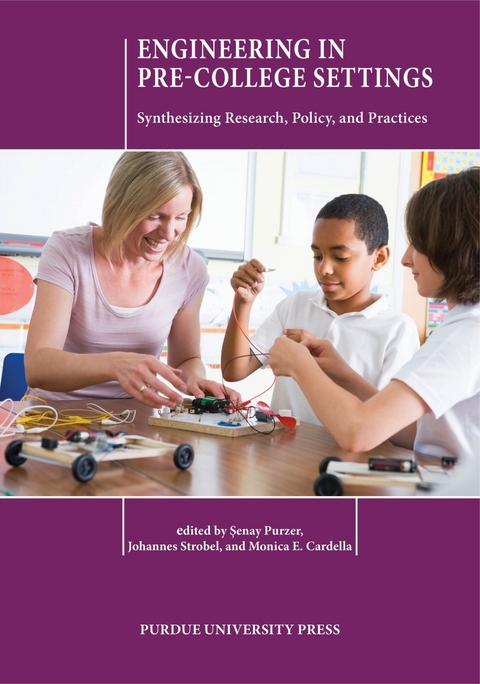
Engineering in Pre-College Settings (eBook)
470 Seiten
Purdue University Press (Verlag)
978-1-61249-358-9 (ISBN)
Şenay Purzer is an assistant professor in the School of Engineering Education and is the director of Assessment Research for the Institute for P-12 Engineering Research and Learning (INSPIRE) at Purdue University. She received an NSF CAREER award in 2012. Her research focuses on assessment of skills, such as engineering design creativity and information literacy.
Foreword, by Greg Pearson
Preface
Part I. Current State of Engineering Education Research and Practice
Chapter 1: The Rising Profile of STE M Literacy Through National Standards and Assessments, by Cary Sneider and Şenay Purzer
Chapter 2: K–12 Engineering: The Missing Core Discipline, by Ioannis Miaoulis
Chapter 3: Implementation and Integration of Engineering in K–12 STEM Education, by Tamara J. Moore, Micah S. Stohlmann, Hui-Hui Wang, Kristina M. Tank, Aran W. Glancy, and Gillian H. Roehrig
Chapter 4: Engineering in Elementary Schools, by Cathy P. Lachapelle and Christine M. Cunningham
Chapter 5: Engineering Education in the Middle Grades, by Tirupalavanam G. Ganesh and Christine G. Schnittka
Chapter 6: Designing Engineering Experiences to Engage All Students, by Christine M. Cunningham and Cathy P. Lachapelle
Part II. Research Studies with Teachers and Students
Chapter 7: Embedding Elementary School Science Instruction in Engineering Design Problem Solving, by Kristen Wendell, Amber Kendall, Merredith Portsmore, Christopher G. Wright, Linda Jarvin, and Chris Rogers
Chapter 8: Teachers’ Concerns in Implementing Engineering into Elementary Classrooms and the Impact of Teacher Professional Development, by Jeongmin Lee and Johannes Strobel
Chapter 9: Bridges and Barriers to Constructing Conceptual Cohesion Across Modalities and Temporalities: Challenges of STE M Integration in the Pre-College Engineering Classroom, by Candace A. Walkington, Mitchell J. Nathan, Matthew Wolfgram, Martha W. Alibali, and Rachaya Srisurichan
Chapter 10: High School Pre-Engineering Curricula: Assessing Teacher Beliefs, Intended Curriculum, and Enacted Instruction, by Amy C. Prevost, Mitchell J. Nathan, and L. Allen Phelps
Part III. Reviews and Synthesis of Research in Teacher Education
Chapter 11: In-Service Teacher Professional Development in Engineering Education: Early Years, by Heidi A. Diefes-Dux
Chapter 12: High School Teacher Professional Development in Engineering: Research and Practice, by Jenny L. Daugherty and Rodney L. Custer
Chapter 13: Engineering in Pre-Service Teacher Education, by Steve O'Brien, John Karsnitz, Suriza Van Der Sandt, Laura Bottomley, and Elizabeth Parry
Part IV. Assessing Design, Creativity, and Interest in Engineering
Chapter 14: Assessing Design, by Ming-Chien Hsu, Monica E. Cardella, and Şenay Purzer
Chapter 15: Creativity Assessment: A Necessary Criterion in K–12 Engineering Education, by Eric L. Mann
Chapter 16: Assessing Engineering Knowledge, Attitudes, and Behaviors for Research and Program Evaluation Purposes, by Monica E. Cardella, Noah Salzman, Şenay Purzer, and Johannes Strobel
Part V. Engineering Beyond the Classroom
Chapter 17: Engineering at Home, by Brianna Dorie and Monica E. Cardella
Chapter 18: Engineering Learning in Museums: Current Trends and Future Directions, by Gina N. Svarovsky
Chapter 19: P–12 Robotics Competitions: Building More than Just Robots— Building 21st-Century Thinking Skills, by Anita G. Welch and Douglas Huffman
Chapter 20: Engineering Kids’ Lives: The Art of Delivering Messages, by Nancy Linde, Marisa Wolsky, and Tamecia Jones
Part VI. The Future of Pre-College Engineering Education
Chapter 21: Looking Ahead, by Monica E. Cardella, Şenay Purzer, and Johannes Strobel
Contributors
Index
| Erscheint lt. Verlag | 15.11.2014 |
|---|---|
| Verlagsort | West Lafayette |
| Sprache | englisch |
| Themenwelt | Schulbuch / Wörterbuch ► Schulbuch / Allgemeinbildende Schulen |
| Geisteswissenschaften | |
| Naturwissenschaften | |
| Sozialwissenschaften ► Pädagogik ► Allgemeines / Lexika | |
| Sozialwissenschaften ► Pädagogik ► Bildungstheorie | |
| Sozialwissenschaften ► Pädagogik ► Schulpädagogik / Grundschule | |
| Sozialwissenschaften ► Pädagogik ► Schulpädagogik / Sekundarstufe I+II | |
| Technik | |
| ISBN-10 | 1-61249-358-0 / 1612493580 |
| ISBN-13 | 978-1-61249-358-9 / 9781612493589 |
| Informationen gemäß Produktsicherheitsverordnung (GPSR) | |
| Haben Sie eine Frage zum Produkt? |
 EPUB (Adobe DRM)
Kopierschutz: Adobe-DRM
Adobe-DRM ist ein Kopierschutz, der das eBook vor Mißbrauch schützen soll. Dabei wird das eBook bereits beim Download auf Ihre persönliche Adobe-ID autorisiert. Lesen können Sie das eBook dann nur auf den Geräten, welche ebenfalls auf Ihre Adobe-ID registriert sind.
Details zum Adobe-DRM
Dateiformat: EPUB (Electronic Publication)
EPUB ist ein offener Standard für eBooks und eignet sich besonders zur Darstellung von Belletristik und Sachbüchern. Der Fließtext wird dynamisch an die Display- und Schriftgröße angepasst. Auch für mobile Lesegeräte ist EPUB daher gut geeignet.
Systemvoraussetzungen:
PC/Mac: Mit einem PC oder Mac können Sie dieses eBook lesen. Sie benötigen eine
eReader: Dieses eBook kann mit (fast) allen eBook-Readern gelesen werden. Mit dem amazon-Kindle ist es aber nicht kompatibel.
Smartphone/Tablet: Egal ob Apple oder Android, dieses eBook können Sie lesen. Sie benötigen eine
Geräteliste und zusätzliche Hinweise
Buying eBooks from abroad
For tax law reasons we can sell eBooks just within Germany and Switzerland. Regrettably we cannot fulfill eBook-orders from other countries.
aus dem Bereich