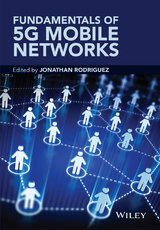
Edited by Jonathan Rodriguez
Senior Research Fellow, Instituto de Telecomunicações, Aveiro, Portugal
Fundamentals of 5G Mobile Networks provides an overview of the key features of the 5th Generation (5G) mobile networks, discussing the motivation for 5G and the main challenges in developing this new technology. This book provides an insight into the key areas of research that will define this new system technology paving the path towards future research and development. The book is multi-disciplinary in nature, and aims to cover a whole host of intertwined subjects that will predominantly influence the 5G landscape, including the future Internet, cloud computing, small cells and self-organizing networks (SONs), cooperative communications, dynamic spectrum management and cognitive radio, Broadcast-Broadband convergence , 5G security challenge, and green RF. This book aims to be the first of its kind towards painting a holistic perspective on 5G Mobile, allowing 5G stakeholders to capture key technology trends on different layering domains and to identify potential inter-disciplinary design aspects that need to be solved in order to deliver a 5G Mobile system that operates seamlessly.
Edited by Jonathan Rodriguez Senior Research Fellow, Instituto de Telecomunicações, Aveiro, Portugal
Contributor Biographies xiii
Preface xxix
Acknowledgements xxxi
Introduction xxxiii
1 Drivers for 5G: The 'Pervasive Connected World' 1
1.1 Introduction 1
1.2 Historical Trend of Wireless Communications 2
1.3 Evolution of LTE Technology to Beyond 4G 4
1.4 5G Roadmap 5
1.5 10 Pillars of 5G 6
1.5.1 Evolution of Existing RATs 6
1.5.2 Hyperdense Small?]Cell Deployment 7
1.5.3 Self?]Organising Network 8
1.5.4 Machine Type Communication 8
1.5.5 Developing Millimetre?]Wave RATs 8
1.5.6 Redesigning Backhaul Links 9
1.5.7 Energy Efficiency 9
1.5.8 Allocation of New Spectrum for 5G 10
1.5.9 Spectrum Sharing 10
1.5.10 RAN Virtualisation 10
1.6 5G in Europe 11
1.6.1 Horizon 2020 Framework Programme 11
1.6.2 5G Infrastructure PPP 12
1.6.3 METIS Project 13
1.6.4 5G Innovation Centre 14
1.6.5 Visions of Companies 14
1.7 5G in North America 15
1.7.1 Academy Research 15
1.7.2 Company R&D 15
1.8 5G in Asia 16
1.8.1 5G in China 16
1.8.2 5G in South Korea 19
1.8.3 5G in Japan 21
1.9 5G Architecture 23
1.10 Conclusion 24
Acknowledgements 25
References 25
2 The 5G Internet 29
2.1 Introduction 29
2.2 Internet of Things and Context?]Awareness 32
2.2.1 Internet of Things 33
2.2.2 Context?]Awareness 34
2.3 Networking Reconfiguration and Virtualisation Support 35
2.3.1 Software Defined Networking 36
2.3.2 Network Function Virtualisation 38
2.4 Mobility 40
2.4.1 An Evolutionary Approach from the Current Internet 40
2.4.2 A Clean?]Slate Approach 45
2.5 Quality of Service Control 47
2.5.1 Network Resource Provisioning 47
2.5.2 Aggregate Resource Provisioning 49
2.6 Emerging Approach for Resource Over?]Provisioning 50
2.6.1 Control Information Repository 53
2.6.2 Service Admission Control Policies 53
2.6.3 Network Resource Provisioning 53
2.6.4 Control Enforcement Functions 54
2.6.5 Network Configurations 54
2.6.6 Network Operations 55
2.7 Summary 57
Acknowledgements 57
References 58
3 Small Cells for 5G Mobile Networks 63
3.1 Introduction 63
3.2 What are Small Cells? 64
3.2.1 WiFi and Femtocells as Candidate Small?]Cell Technologies 66
3.2.2 WiFi and Femto Performance - Indoors vs Outdoors 70
3.3 Capacity Limits and Achievable Gains with Densification 73
3.3.1 Gains with Multi?]Antenna Techniques 73
3.3.2 Gains with Small Cells 76
3.4 Mobile Data Demand 81
3.4.1 Approach and Methodology 81
3.5 Demand vs Capacity 81
3.6 Small?]Cell Challenges 93
3.7 Conclusions and Future Directions 97
References 99
4 Cooperation for Next Generation Wireless Networks 105
4.1 Introduction 105
4.2 Cooperative Diversity and Relaying Strategies 107
4.2.1 Cooperation and Network Coding 107
4.2.2 Cooperative ARQ MAC Protocols 108
4.3 PHY Layer Impact on MAC Protocol Analysis 110
4.3.1 Impact of Fast Fading and Shadowing on Packet Reception for QoS Guarantee 111
4.3.2 Impact of Shadowing Spatial Correlation 112
4.4 Case Study: NCCARQ 113
4.4.1 NCCARQ Overview 113
4.4.2 PHY Layer Impact 114
4.5 Performance Evaluation 116
4.5.1 Simulation Scenario 116
4.5.2 Simulation Results 117
4.6 Conclusion 122
Acknowledgements 122
References 122
5 Mobile Clouds: Technology and Services for Future Communication Platforms 125
5.1 Introduction 125
5.2 The Mobile Cloud 127
5.2.1 User Resources 129
5.2.2 Software Resources 130
5.2.3 Hardware Resources 131
5.2.4 Networking Resources 132
5.3 Mobile Cloud Enablers 133
5.3.1 The Mobile User Domain 133
5.3.2 Wireless Technologies 135
5.3.3 Software and Middleware 139
5.4 Network Coding 140
5.5 Summary 145
References 145
6 Cognitive Radio for 5G Wireless Networks 149
6.1 Introduction 149
6.2 Overview of Cognitive Radio Technology in 5G Wireless 150
6.3 Spectrum Optimisation using Cognitive Radio 152
6.4 Relevant Spectrum Optimisation Literature in 5G 152
6.4.1 Dynamic Spectrum Access 152
6.4.2 Spectrum Regulatory Policy 153
6.4.3 Marketing Policy and Model 154
6.5 Cognitive Radio and Carrier Aggregation 154
6.6 Energy?]Efficient Cognitive Radio Technology 155
6.7 Key Requirements and Challenges for 5G Cognitive Terminals 156
6.7.1 5G Devices as Cognitive Radio Terminals 157
6.7.2 5G Cognitive Terminal Challenges 159
6.8 Summary 162
References 162
7 The Wireless Spectrum Crunch: White Spaces for 5G? 165
7.1 Introduction 165
7.2 Background 168
7.2.1 Early Spectrum Management 168
7.2.2 History of TV White Spaces 169
7.2.3 History of Radar White Spaces 171
7.3 TV White Space Technology 171
7.3.1 Standards 172
7.3.2 Approaches to White Space 173
7.4 White Space Spectrum Opportunities and Challenges 175
7.5 TV White Space Applications 178
7.5.1 Fixed Wireless Networking 180
7.5.2 Public Safety Applications 181
7.5.3 Mobile Broadband 182
7.6 International Efforts 185
7.7 Role of WS in 5G 186
7.8 Conclusion 186
References 187
8 Towards a Unified 5G Broadcast?]Broadband Architecture 191
8.1 Introduction 191
8.2 Background 192
8.3 Challenges to Be Addressed 195
8.3.1 The Spectrum Dimension 195
8.3.2 The Risk of Fragmentation of the Terminal Market 196
8.3.3 The Change in TV Consumer Patterns and the Need for a Flexible Approach 197
8.3.4 Business?]Related Hurdles 198
8.3.5 Societal Requirement: TV Broadcasting as a Public Service Media in Europe 198
8.4 Candidate Network Architectures for a BC?]BB Convergent Solution 199
8.4.1 Solution 1: Cellular Broadcasting in the TV Spectrum 200
8.4.2 Solution 2: Hybrid Network Approach - Using DVB?]T2 FEFs for LTE Transmission 201
8.4.3 Solution 3: Next Generation Common Broadcasting System 201
8.5 The BC?]BB Study: What Needs to Be Done 204
8.5.1 TV and Video Future Consumption Models in Europe 204
8.5.2 BC?]BB Architecture Options 204
8.5.3 Large?]Scale Simulation and Assessment of BC?]BB Convergent Options 204
8.5.4 Feasibility Study 205
8.6 Conclusion 205
References 206
9 Security for 5G Communications 207
9.1 Introduction 207
9.2 Overview of a Potential 5G Communications System Architecture 208
9.3 Security Issues and Challenges in 5G Communications Systems 209
9.3.1 User Equipment 210
9.3.2 Access Networks 212
9.3.3 Mobile Operator's Core Network 216
9.3.4 External IP Networks 217
9.4 Summary 218
References 219
10 SON Evolution for 5G Mobile Networks 221
10.1 Introduction 221
10.2 SON in UMTS and LTE 222
10.3 The Need for SON in 5G 231
10.4 Evolution towards Small?]Cell Dominant HetNets 236
10.4.1 Towards a New SON Architecture for 5G 237
10.5 Conclusion 239
References 240
11 Green Flexible RF for 5G 241
11.1 Introduction 241
11.2 Radio System Design 242
11.2.1 Antenna Design for 5G 242
11.2.2 Passive Front?]End Design Using SIW for 5G Application 254
11.2.3 RF Power Amplifiers 257
11.3 Nonlinear Crosstalk in MIMO Systems 264
11.4 Summary 269
Acknowledgements 269
References 270
12 Conclusion and Future Outlook 273
12.1 Design Drivers for Next?]Generation Networks 273
12.2 5G: A Green Inter?]networking Experience 274
12.2.1 Emerging Approaches to Allow Drastic Reduction in the Signalling Overhead 278
12.3 A Vision for 5G Mobile 278
12.3.1 Mobile Small Cells the Way Forward? 279
12.4 Final Remarks 282
References 282
Index 285
Contributor Biographies
Raed A. Abd-Alhameed is Professor of Electromagnetic and Radio Frequency Engineering at the University of Bradford, United Kingdom. He has many years’ research experience in the areas of radio frequency, signal processing, propagations, antennas and electromagnetic computational techniques, and has published over 400 academic journal and conference papers, in addition to three books and several book chapters. He is a Fellow of the Institution of Engineering and Technology, a Fellow of the Higher Education Academy and a Chartered Engineer.
Abdulkareem S. Abdullah is associate professor at the Electrical Engineering department of the College of Engineering, Basrah University, Iraq. He has worked in this department since 1986 and was the head of the department for over seven years. He was appointed as a research visitor at Bradford University in November 2013, working on DRA antennas. He has published over 40 journals and conference papers and his current research interests include smart antenna design and analysis, microwaves technology and radio waves propagation.
Olayinka Adigun is a researcher at Kingston University, London. He holds a BSc in Electrical and Electronics Engineering from the University of Ibadan, Nigeria (2004), an MSc in Networking and Data Communication with Management Studies and a PhD in Wireless Communications from Kingston University (2008 and 2013, respectively). Prior to his research activities, he has worked in different capacities in the field of Information and Communication Technology and as a Telecommunication Engineer at Zain Telecoms. His research interests include 5G and future wireless networks, cognitive radio and spectrum management, emergency communications, Mobile Ad-hoc Networks, green communication and energy efficiency in wireless networks, cross-layer design and performance measurements. Olayinka has a good number of publications in top conferences and journals and he is a member of the IEEE society.
Rui L. Aguiar received a PhD degree in electrical engineering in 2001 from the University of Aveiro. He is currently a professor at the University of Aveiro and has previously been an adjunct professor at the INI, Carnegie Mellon University. He is leading a research team at ITAV on next-generation network architectures and protocols. His current research interests are centred on the implementation of advanced wireless networks and systems, with special emphasis on QoS and mobility aspects for the Future Internet. He has more than 400 published papers in those areas. He has served as technical and general chair of several conferences, such as (recently) Monami 2012, NTMS 2014, ISCC 2014 and MobiArch 2014, and is regularly invited for keynotes on 5G networks. He has extensive participation in national and international projects, and was Chief Architect of the IST Daidalos project. He is currently on the Steering Board of the 5G PPP Association.
Bo Ai received his MSc and PhD degrees from Xidian University in China. He graduated from Tsinghua University with the honor of Excellent Postdoctoral Research Fellow at Tsinghua University in 2007. He is now working in the State Key Laboratory of Rail Traffic Control and Safety at Beijing Jiaotong University as a full professor and PhD candidate advisor. He is the Deputy Director of the State Key Laboratory of Rail Traffic Control and Safety and the Deputy Director of the Modern Telecommunication Institute. He is one of the main people responsible for Beijing’s ‘Urban rail operation control system’ International Science and Technology Cooperation Base, and the backbone member of the Innovative Engineering Base jointly granted by the Chinese Ministry of Education and the State Administration of Foreign Experts Affairs. He has authored/co-authored six books and published over 160 academic research papers in his research area. He has held 13 national invention patents and one US patent. He has been the research team leader for 21 national projects and has won some important scientific research prizes. He has been notified by the Council of Canadian Academies (CCA) that, based on the Scopus database, he has been listed as one of the top 1% of authors in his field all over the world. Professor Bo Ai has also been featured interviewed by IET Electronics Letters. His interests include the research and applications of channel measurement and channel modelling, and dedicated mobile communications for rail traffic. Professor Bo Ai is a Fellow of The Institution of Engineering and Technology (IET) and a senior member of IEEE. He is an editor of IEEE Transactions on Consumer Electronics and an Editorial Committee Member of the Wireless Personal Communications journal. He has received many awards, such as the Qiushi Outstanding Youth Award by the Hong Kong Qiushi Foundation, the New Century Talents award by the Chinese Ministry of Education, the Zhan Tianyou Railway Science and Technology Award by the Chinese Ministry of Railways, and the Science and Technology New Star by the Beijing Municipal Science and Technology Commission.
Selim Akl holds a PhD degree from McGill University, Canada. He is a professor of computing at Queen’s University, Kingston, Ontario, Canada, where he currently serves as director of the Queen’s School of Computing. His research interests are in parallel and unconventional computation, including quantum and biomolecular computers, and non-standard computational problems. He is the author of Parallel Sorting Algorithms (Academic Press, 1985), The Design and Analysis of Parallel Algorithms (Prentice Hall, 1989), and Parallel Computation: Models and Methods (Prentice Hall, 1997), and a co-author of Parallel Computational Geometry (Prentice Hall, 1992) and Adaptive Cryptographic Access Control (Springer, 2010). He is a former editor of the Journal of Cryptology, Information Processing Letters, and Parallel Algorithms and Applications. At present he is Editor-in-Chief of Parallel Processing Letters and Unconventional Computation and an Area Editor for Scalable Computing and Communications. He also currently serves on the editorial boards of Computational Geometry, Communications in Applied Geometry, the International Journal of Parallel, Emergent, and Distributed Systems, the International Journal of Unconventional Computing, and the International Journal of High Performance Computing and Networking.
Luis Alonso received his PhD in the Department of Signal Theory and Communications of the Universitat Politècnica de Catalunya (UPC) in 2001. He currently belongs to and is co-founder (2009) of the Wireless Communications and Technologies Research Group (WiComTec). Since January 2014, he has been the Dean of the Telecommunications and Aerospace Engineering School of Castelldefels at UPC-BarcelonaTECH. He participates in several research programmes, networks of excellence, Cooperation in Science and Technology (COST) actions and integrated projects funded by the European Union and the Spanish government, while he is external audit expert for TUV Rheinland. He is currently the Project Coordinator of two European Projects (Marie Curie ITN and IAPP) and he has been the Project Coordinator of another three European projects. He is author of more than 40 research papers in international journals and magazines, one book, 12 chapters of books, and more than a hundred papers in international congresses and symposiums. His current research interests are still within the field of medium access protocols, radio resource management, cross-layer optimisation, cooperative transmissions, cognitive radio, network coding and QoS features for all kinds of wireless communications systems.
Angelos Antonopoulos received his PhD degree (cum laude) from the Signal Theory and Communications (TSC) Department of the Technical University of Catalonia (UPC) in December 2012, while he holds an MEng degree from the Information and Communication Systems Engineering Department of the University of the Aegean (2007). His main research interests include cooperative communications, MAC protocols, network coding and energy-efficient network planning. He has participated in several European and Spanish national projects (e.g. GREENET, Green-T, CO2GREEN, etc.) and has served as an expert evaluator of research projects funded by the Romanian government through the National Council for Scientific Research. He has been granted three annual scholarships by the Greek State Scholarships Foundation (IKY) and, recently, he has been awarded the First Polytechnic Graduates Prize by the Technical Chamber of Greece (TEE-TGC).
Lisa Blumensaadt is an attorney whose experience includes telecom federal regulatory law, writing portions of regulation and monitoring policy while at the Federal Communications Commission. She was also a government relations analyst at the global government relations headquarters of Nortel Networks, tracking and analyzing federal telecom policy and international trade, representing Nortel in industry working groups, with various government agencies and Congress. Before law school, she was a regional recruiter for a mid-sized business technology company. While earning her J.D. she was selected for publication in law journal, and then held senior positions both at law journal and moot court. Her undergraduate studies were in Biology and Neuroscience. She currently sits on the board of a school nationally ranked in the top 100 in the U.S.
Daniel Corujo is...
| Erscheint lt. Verlag | 27.4.2015 |
|---|---|
| Sprache | englisch |
| Themenwelt | Technik ► Elektrotechnik / Energietechnik |
| Technik ► Nachrichtentechnik | |
| Schlagworte | 5G • Communication Technology - Networks • Drahtlose Kommunikation • Electrical & Electronics Engineering • Elektrotechnik u. Elektronik • Kommunikationsnetz • Kommunikationsnetze • Mobile & Wireless Communications • mobile networks • Signal Processing • Signalverarbeitung • wireless communications |
| ISBN-13 | 9781118867471 / 9781118867471 |
| Informationen gemäß Produktsicherheitsverordnung (GPSR) | |
| Haben Sie eine Frage zum Produkt? |
 EPUB (Adobe DRM)
Kopierschutz: Adobe-DRM
Adobe-DRM ist ein Kopierschutz, der das eBook vor Mißbrauch schützen soll. Dabei wird das eBook bereits beim Download auf Ihre persönliche Adobe-ID autorisiert. Lesen können Sie das eBook dann nur auf den Geräten, welche ebenfalls auf Ihre Adobe-ID registriert sind.
Details zum Adobe-DRM
Dateiformat: EPUB (Electronic Publication)
EPUB ist ein offener Standard für eBooks und eignet sich besonders zur Darstellung von Belletristik und Sachbüchern. Der Fließtext wird dynamisch an die Display- und Schriftgröße angepasst. Auch für mobile Lesegeräte ist EPUB daher gut geeignet.
Systemvoraussetzungen:
PC/Mac: Mit einem PC oder Mac können Sie dieses eBook lesen. Sie benötigen eine
eReader: Dieses eBook kann mit (fast) allen eBook-Readern gelesen werden. Mit dem amazon-Kindle ist es aber nicht kompatibel.
Smartphone/Tablet: Egal ob Apple oder Android, dieses eBook können Sie lesen. Sie benötigen eine
Geräteliste und zusätzliche Hinweise
Buying eBooks from abroad
For tax law reasons we can sell eBooks just within Germany and Switzerland. Regrettably we cannot fulfill eBook-orders from other countries.
aus dem Bereich