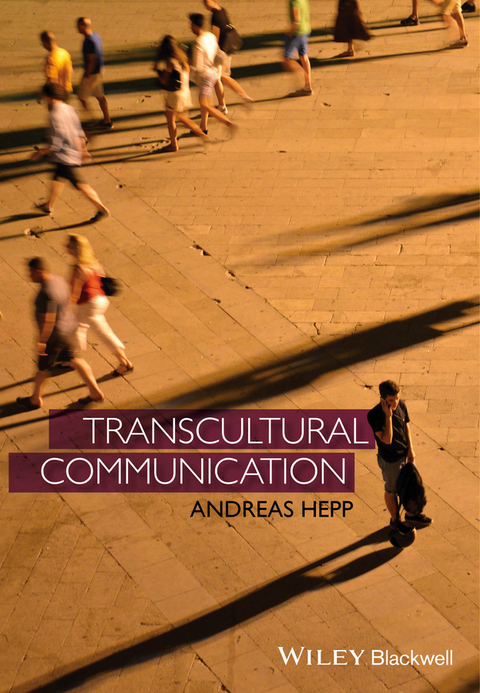
Transcultural Communication (eBook)
John Wiley & Sons (Verlag)
978-1-118-88592-5 (ISBN)
- Includes examples of mediatization and transcultural communication from a variety of cultural contexts
- Covers an array of different types of media, including mass media and digital media
- Incorporates discussion of transcultural communication in media regulation, media production, media products and platforms, and media appropriation
Andreas Hepp is Professor of Media and Communication Studies in the Centre for Media, Communication and Information Research (ZeMKI) at the University of Bremen, Germany. He is the author of Cultures of Mediatization (2013), co-editor, with Friedrich Krotz, of Mediatized Worlds: Culture and Society in a Media Age (2014), and co-editor, with Nick Couldry and Friedrich Krotz, of Media Events in a Global Age (2010).
Andreas Hepp is Professor of Media and Communication Studies in the Centre for Media, Communication and Information Research (ZeMKI) at the University of Bremen, Germany. He is the author of Cultures of Mediatization (2013), co-editor, with Friedrich Krotz, of Mediatized Worlds: Culture and Society in a Media Age (2014), and co-editor, with Nick Couldry and Friedrich Krotz, of Media Events in a Global Age (2010).
1 Introduction 1
2 Approaches to Transcultural Communication 10
2.1 Consequences of Globalization 13
2.2 Postcolonial Critique 18
2.3 Methodological Reflections 22
2.4 Integrative Analyses 28
3 The Regulation of Transcultural Communication 35
3.1 Global Commercialization and Communicative Infrastructure 39
3.2 State Regulation 51
3.3 From the Free Flow of Communication to the Regulation of Globalization 59
3.4 The Global Governance of Media 73
4 The Production of Media and their Transcultural Contexts 82
4.1 The Cultures of Production within Global Media Businesses 88
4.2 The Transculturality of Journalistic Practice 98
4.3 Alternative Forms of Media Production 104
4.4 Media Cities as Transcultural Locations 113
5 The Transculturality of Media Products 124
5.1 Hollywood, Bollywood, and Nollywood 128
5.2 The Import of Programs and the Adaptation of Formats 140
5.3 The Articulation of News 154
5.4 Media Events 168
6 The Appropriation of Media and Transculturation 179
6.1 The Appropriation of Media as Cultural Localization 181
6.2 Media Disjunctions in a Mediatized Everyday World 193
6.3 Communities and Communitization 205
6.4 Media Identity and Citizenship 216
7 Perspectives on Transcultural Communication 226
Acknowledgements 231
References 234
Index 270
"...an engaging and well-balanced introduction to contemporary developments in global media communication from a transcultural perspective...a highly stimulating read for students and novice scholars alike." - Communications - The European Journal of Communication Research
1
Introduction
In his wide-ranging history of communication, Marshall T. Poe has almost euphorically described the present as an epoch of mediatized transculturality. While the eras of the printing press and audiovisual media were characterized by tolerance and multiculturalism, Poe argues that we are now moving into an era that is “beyond culture” (Poe 2011: 240). He suggests that, in the future, identities will no longer be so firmly linked to historical (national) cultures, but instead to a mix of diverse historical and new, invented cultures. An example of this is what he calls the transnational identities of different subcultures. These already existed outside the Internet (and are lived beyond it) but the emergence of the latter made access to them much easier. Hence the current transformation of media furthers the emergence of a transcultural everyday life. Poe cites, as proof of this, the book Transculturalism, a collection edited by Claude Grunitsky, a creative entrepreneur and son of the Togolese ambassador. Here transculturalism is described as a way of life within which “some individuals find ways to transcend their initial culture, in order to explore, examine and infiltrate foreign cultures” (Grunitzky 2004 : 25). The ongoing transformation of the media is therefore associated with an entirely new way of living and experiencing culture, and this new way of life is captured by the concept of transculturalism.
If we pay attention to the media we might detect other aspects of transculturality. Among these are the transcultural conflicts that organizations have to confront and manage, but also the transcultural conflicts between the “West” and the “Rest” (Hall 1992a). We are not only aware of such transcultural conflicts through various forms of media, from the World Wide Web to more traditional forms of mass media such as television and newspapers; media can themselves become driving forces in transcultural conflicts. One leading example of this was the uproar created in 2006 by the publication of cartoons of the prophet Mohammed (Eide et al. 2008), followed by protests in the so-called Arab world and a subsequent public discussion of Islam and religious values in Europe. The cartoons were published by the Danish newspaper Jyllands-Posten with the deliberate intention of creating controversy. This incident serves to illustrate the perspective of a certain media outlet on a “foreign culture.” People in the Arab world found out about these cartoons, likewise—from a critical dossier circulated among Islamic preachers, from the Internet, from reports by Al Jazeera—and various forms of protest followed. These were then the subject of reporting by European mass media, coupled with commentary that, in some cases, sought to distance itself from the issue. The transcultural communication made possible by the globalization of media thus led to conflicts between religions and cultures, and did not necessarily enhance mutual understanding.
This and similar examples make clear how complex and many layered the phenomenon of transcultural communication is. They draw attention to the need for differentiated knowledge of the possibilities and limits of processes of transcultural media communication if one is to give due regard to the ongoing globalization of media communication. Transcultural communication affects us all when we are confronted with media products on television, in the cinema and in the press that “travel” beyond the bounds of different cultures. It affects us when we come into contact with people of different cultures over the Internet. In what way, and by which businesses, are these transculturally accessible media products produced? What is the relationship between media policy and the activity of global media corporations? What is the nature of transcultural media products? How are they taken up and appropriated? How does this all relate to the way we communicate across cultures using social media? What kinds of theories and approaches can help us develop a critical perspective on that? These are the questions that I hope I can at least begin to answer in this book; but before I provide a brief overview of the book as a whole, I would like to make a few remarks about the concept of transcultural communication.
As will be seen in the following pages, the concept of transcultural communication is part of a continuing academic discussion of globalization and mediatization. It cannot therefore be adequately defined in two or three sentences. Here in this introduction we can offer at most a degree of orientation. It should already be clear that the objects of analysis here are mediated forms of transcultural communication, and not face-to-face interactions between individuals. This is because transcultural communication typically takes place through media. Unlike intercultural and international communication, which takes place between individuals or groups of individuals belonging to distinct cultures or nation states, the concept of transcultural communication involves processes of communication that transcend individual cultures. Examples are our day-to-day involvement with the Internet, reading online newspapers from other parts of the world (insofar as one understands the language), or downloading images and music from different cultural contexts. There are also Hollywood, Bollywood or Nollywood films that appeal to people of the most diverse cultures. We use the specific concept of transcultural communication so that we can approach phenomena on different levels—something that is not demanded when talking of intercultural or international communication. We cannot approach this subject by comparing different national cultural patterns of communication, as is possible with intercultural or international communication. Differences of this kind are of course also dealt with when analyzing transcultural communication. But this also involves patterns that promote differences that transcend various traditional cultures. For example, formats such as Who Wants to be a Millionaire? can be found in different national media cultures while being defined as the same broadcast across them. Therefore, developing a conception of transcultural communication involves the specification of particular national cultures, but also examines how these particularities are taken up in communication processes that transcend cultures, without at the same time assuming that in this process we are dealing with the development of a standardized and uniform global culture, the “McDonaldization” (Ritzer 1998) of the world.
This makes it clear that the concept of transcultural communication has close links with two other conceptions: mediatization and globalization. Both relate to long-term processes of change. Let us start with the first: mediatization. As I have shown in detail elsewhere (Hepp 2013a : 29–68), this idea seeks to identify the reciprocal relationship between changes in media and communication on the one hand, and changes in culture and society on the other. In the course of human history not only has there been considerable development in the number of technical media for communication, but existing cultures and societies have played a major role in determining how we communicate. Mediatization has quantitative aspects: an increasing number of media have become available for longer (a temporal dimension) at ever more locations (a spatial dimension) in ever more situations (a social dimension). It also has qualitative aspects: media “mold” (Hepp 2013a : 90) our communication, and so how we create or construct our cultures and societies through communicating with one another.
This brings us back to the remarks made by Poe, which I cited above, who emphasizes the way in which transculturality is closely related to the way in which Internet-based media mold our communication today. But things are more complex than he makes them seem; for one thing, the manner in which media exert their molding effects is much more diverse than he supposes. It is not only the “ought” of the Internet (Poe 2011: 240) that furthers worldwide transculturalization. The general idea of the molding forces of the media conceals two very important factors. The first of these is that media institutionalize the way in which we communicate with each other. Email, television, Internet radio, mobile phones and so on—these are not simple pieces of equipment, but each involves particular forms and patterns of communication. Secondly, media reify our communication, since particular elements, apparatus and infrastructure are involved. This reification, in turn, makes any change costly. To take a historical example: once the centralized network of radio broadcasting had become established, it was no longer possible to use it for decentralized communication, even though this might have originally been a technical possibility (Brecht 1932).
Today most people live in what can be called “mediatized worlds” (Hepp 2013a, b: 69; Hepp and Krotz 2014). Technical means of communication are central to the construction of their “small life-worlds” (Luckmann 1970), or “social worlds” (Strauss 1978), which are molded by these means of communication as outlined above. For example, today no school can do without media; and this not only involves textbooks, but, increasingly, computers and the Internet. The political world is mediatized by virtue of the fact that the form of...
| Erscheint lt. Verlag | 27.4.2015 |
|---|---|
| Sprache | englisch |
| Themenwelt | Naturwissenschaften |
| Sozialwissenschaften ► Kommunikation / Medien ► Allgemeines / Lexika | |
| Sozialwissenschaften ► Kommunikation / Medien ► Kommunikationswissenschaft | |
| Sozialwissenschaften ► Kommunikation / Medien ► Medienwissenschaft | |
| Sozialwissenschaften ► Politik / Verwaltung | |
| Technik ► Elektrotechnik / Energietechnik | |
| Schlagworte | Communication & Media Studies • Kommunikation • Kommunikationswissenschaften • Kommunikation u. Medienforschung • <p>Global communication, global media, mass media, digital media, mediatization, media theory, communication theory, media sociology, transnational communication, cultural studies, globalization, postcolonialism, media production, journalism, global media, international communication, intercultural communication, transcultural communication, mediatization, transculturality, globalisation, transnationalism</p> • Mass Communication & The Media • Massenkommunikation, Massenmedien • Media Studies • Medienforschung |
| ISBN-10 | 1-118-88592-9 / 1118885929 |
| ISBN-13 | 978-1-118-88592-5 / 9781118885925 |
| Informationen gemäß Produktsicherheitsverordnung (GPSR) | |
| Haben Sie eine Frage zum Produkt? |
 EPUB (Adobe DRM)
Kopierschutz: Adobe-DRM
Adobe-DRM ist ein Kopierschutz, der das eBook vor Mißbrauch schützen soll. Dabei wird das eBook bereits beim Download auf Ihre persönliche Adobe-ID autorisiert. Lesen können Sie das eBook dann nur auf den Geräten, welche ebenfalls auf Ihre Adobe-ID registriert sind.
Details zum Adobe-DRM
Dateiformat: EPUB (Electronic Publication)
EPUB ist ein offener Standard für eBooks und eignet sich besonders zur Darstellung von Belletristik und Sachbüchern. Der Fließtext wird dynamisch an die Display- und Schriftgröße angepasst. Auch für mobile Lesegeräte ist EPUB daher gut geeignet.
Systemvoraussetzungen:
PC/Mac: Mit einem PC oder Mac können Sie dieses eBook lesen. Sie benötigen eine
eReader: Dieses eBook kann mit (fast) allen eBook-Readern gelesen werden. Mit dem amazon-Kindle ist es aber nicht kompatibel.
Smartphone/Tablet: Egal ob Apple oder Android, dieses eBook können Sie lesen. Sie benötigen eine
Geräteliste und zusätzliche Hinweise
Buying eBooks from abroad
For tax law reasons we can sell eBooks just within Germany and Switzerland. Regrettably we cannot fulfill eBook-orders from other countries.
aus dem Bereich