


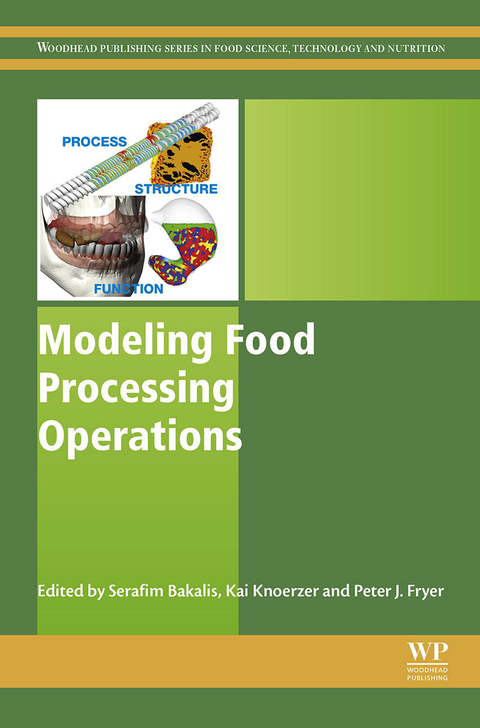
Modeling Food Processing Operations (eBook)
372 Seiten
Elsevier Science (Verlag)
978-1-78242-296-9 (ISBN)
Computational modeling is an important tool for understanding and improving food processing and manufacturing. It is used for many different purposes, including process design and process optimization. However, modeling goes beyond the process and can include applications to understand and optimize food storage and the food supply chain, and to perform a life cycle analysis. Modeling Food Processing Operations provides a comprehensive overview of the various applications of modeling in conventional food processing. The needs of industry, current practices, and state-of-the-art technologies are examined, and case studies are provided. Part One provides an introduction to the topic, with a particular focus on modeling and simulation strategies in food processing operations. Part Two reviews the modeling of various food processes involving heating and cooling. These processes include: thermal inactivation; sterilization and pasteurization; drying; baking; frying; and chilled and frozen food processing, storage and display. Part Three examines the modeling of multiphase unit operations such as membrane separation, extrusion processes and food digestion, and reviews models used to optimize food distribution. - Comprehensively reviews the various applications of modeling in conventional food processing- Examines the modeling of multiphase unit operations and various food processes involving heating and cooling- Analyzes the models used to optimize food distribution
Different modelling and simulation approaches for food processing operations
C. Rauh1 cornelia.rauh@tu-berlin.de; A. Delgado2 antonio.delgado@fau.de 1 Institute of Food Biotechnology and Food Process Engineering, Berlin, Germany
2 Friedrich-Alexander University of Erlangen-Nuremberg, Erlangen, Germany
Abstract
This chapter discusses modelling and simulation strategies in food science and technology. To this end, it focuses on the selection of models based on available system knowledge and complexity. First, the chapter presents some basic aspects of food processing with particular relevance for modelling and simulation. Then it introduces various balancing, knowledge-oriented and hybrid approaches to modelling and simulating food processing. In order to illustrate these approaches, the authors provide examples of state-of-the-art and emerging technologies, such as ultra-high-pressure processing and pulsed electric fields processing. The chapter's final section summarises up-to-date methods and discusses the most promising future modelling and simulation approaches.
Keywords
Modelling and simulation strategies for food processing
Limitations of modelling and simulation
Computational fluid mechanics
Cognitive algorithms
Hybrid methods
1.1 Introduction and intended contribution
In the scientific literature, the term modelling possesses different meanings. In experiments model systems offer researchers the opportunity to study the behaviour of another system expected to be similar in terms of the properties under consideration. In contrast, the modelling discussed in this chapter means the action of theoretically abstracting the behaviour of cause-and-effect chains and expressing it using mathematical terminology.
In this sense modelling is very similar to simulation. Of course, the behaviour of systems can be simulated experimentally. However, this chapter focuses on dealing with data management procedures (e.g. algorithms and data-storing and parallel processing procedures) for mimicking the behaviour of a given system starting from theoretical models previously constructed. Unfortunately, although the different tasks, approaches and goals of modelling and simulation are obvious, the literature often treats both terms as synonymous. This interpretation is a source of the severe misunderstandings persisting in many publications.
Similar misunderstandings exist regarding the difference between systems and processing. Given that this chapter discusses food processing, we should address this point, at least briefly. While a system may consist of a diversity of material and nonmaterial components, the physicochemical and biological interactions of these components and the corresponding storage, transportation and transformation of mass, momentum and energy lead to a process. Thus, modelling and simulation of food processing must include approaches that adequately account for the conservation of mass, momentum and energy. Successful models and simulations must also include physical, chemical and biological reactions.
Despite the confusion over the terminology, modelling and simulation have proven to be very powerful and even essential tools for describing and mimicking a wide spectrum of natural and technical processes. To a large extent, progress in disciplines such as physics, chemistry and applied mathematics, and in particular in engineering, has resulted from the unique possibilities offered by these research instruments (see, e.g., Ferziger and Perić, 2002). In addition, food science and technology have been increasingly discovering these possibilities in the last two decades (see Nirschl and Delgado, 1998; Denys et al., 2000b; Hartmann et al., 2003; Kilimann et al., 2006; Delgado et al., 2008; Chen et al., 2007; Díez et al., 2011; Sun, 2007).
As researchers focus more and more on modelling and simulation, the unique aspects and challenges of food processing are becoming more and more evident. For example, food processing is characterised by both structures with a wide variety of specific length scales and mechanisms that require very different time scales due to the physicochemical properties of the particular food material under consideration. As Figure 1.1 illustrates, in food processing, the length scales change from the molecular level to production level by over 10 orders of magnitude.
This variation in scale results in enormous challenges for modelling and simulating food processing. Yet, progress in modelling and simulation has only been achieved by considering further peculiarities that demand responses beyond transferring knowledge and tools from other application fields. In fact, the appropriate modelling and simulation of food processing first requires the knowledge that food is biomatter, or matter of biological origin. Although the literature does not provide a conclusive definition (see also Bahadir et al., 2000, for the definition in ecology), biomatter is generally conceptualised as a substance comprising biotic and abiotic components. Here, biotic components are material systems showing biological, biochemical or living activity (e.g. the metabolism of microorganisms; the biocatalytic activity of enzymes). In contrast, abiotic components are not biologically or biochemically active, and they are not living matter (e.g. gaseous matter such as methane or carbon dioxide generated through fermentation). Nevertheless, abiotic components might participate in physical, chemical and biological reactions.
The effect of processing biomatter other than food, such as biotechnological, pharmaceutical and medical substances, is currently the object of comprehensive investigations. Much of this research is driven by the industry's desire to maintain the safety and quality of bulk products during their production, while reducing resource demands and their related ecological and economical impacts. The material complexity of biomatter makes gaining new knowledge on its behaviour extremely difficult, however. It is often composed of different biotic and abiotic components with varying levels of thermal, chemical and biological potentials. In addition, the material components may exhibit different states of aggregation (gaseous, liquid and solid states) that often result in soft-matter behaviour with high sensitivity to mechanical loads.
In total, whether intentional or incidental, mechanical, thermal, biological and chemical stimuli related to the treatment processes generate an overlapping response in the food materials. This corresponds to a substantial increase in the demands connected to modelling and simulation in comparison to other fields. In addition, complex structure–process interactions often lead to a substantial gap in knowledge. Unfortunately, this gap can have a considerable impact on modelling and simulation. The missing knowledge removes the possibility of using classical mathematical treatments based on balancing equations (in general, algebraic, ordinary and partial differential equations). Numerical simulation tools require basically balancing equations as starting point (Ferziger and Perić, 2002), but, in the absence of information, they cannot be adequately formulated (Delgado et al., 2008).
Consequently, describing, diagnosing, predicting and optimising food processing require more than equation-based models. This chapter reviews the diversity of modelling and simulation methods related to the complexity of the particular food processing technology and the associated knowledge base (see Figure 1.2). Thus, in addition to dealing with classical numerical simulation procedures (mostly based on finite discretisation procedures) and advanced numerical methods (lattice-Boltzmann approach) for high-performance computing, it covers statistical, data mining and cognitive methods (artificial neural networks and fuzzy logic). Also, we explore hybrid methods aimed at overcoming restrictions of single methods by using them synergistically.
For the sake of convenience, we first consider modelling and simulation as they relate to the mechanical and thermal effects occurring during the thermal treatment of food, which is currently the most widespread processing method. This discussion focuses on modelling and simulations; in other words, we do not provide a complete description of the background of the thermal processes, because this task is neither achievable nor appropriate for the purposes of this chapter. Instead, by concentrating on selected aspects of the modelling and simulation, we try to maximise the chapter's topicality. Given the well-known restrictions imposed by classical thermal treatment, emerging techniques are geared toward affecting the food matter in a specific way. In most processing scenarios, these technologies should increase the biological and chemical safety of the product (Ananta et al., 2001; Margosch et al., 2004;...
| Erscheint lt. Verlag | 28.4.2015 |
|---|---|
| Sprache | englisch |
| Themenwelt | Technik ► Lebensmitteltechnologie |
| ISBN-10 | 1-78242-296-X / 178242296X |
| ISBN-13 | 978-1-78242-296-9 / 9781782422969 |
| Informationen gemäß Produktsicherheitsverordnung (GPSR) | |
| Haben Sie eine Frage zum Produkt? |
 EPUB (Adobe DRM)
Kopierschutz: Adobe-DRM
Adobe-DRM ist ein Kopierschutz, der das eBook vor Mißbrauch schützen soll. Dabei wird das eBook bereits beim Download auf Ihre persönliche Adobe-ID autorisiert. Lesen können Sie das eBook dann nur auf den Geräten, welche ebenfalls auf Ihre Adobe-ID registriert sind.
Details zum Adobe-DRM
Dateiformat: EPUB (Electronic Publication)
EPUB ist ein offener Standard für eBooks und eignet sich besonders zur Darstellung von Belletristik und Sachbüchern. Der Fließtext wird dynamisch an die Display- und Schriftgröße angepasst. Auch für mobile Lesegeräte ist EPUB daher gut geeignet.
Systemvoraussetzungen:
PC/Mac: Mit einem PC oder Mac können Sie dieses eBook lesen. Sie benötigen eine
eReader: Dieses eBook kann mit (fast) allen eBook-Readern gelesen werden. Mit dem amazon-Kindle ist es aber nicht kompatibel.
Smartphone/Tablet: Egal ob Apple oder Android, dieses eBook können Sie lesen. Sie benötigen eine
Geräteliste und zusätzliche Hinweise
Buying eBooks from abroad
For tax law reasons we can sell eBooks just within Germany and Switzerland. Regrettably we cannot fulfill eBook-orders from other countries.
aus dem Bereich


