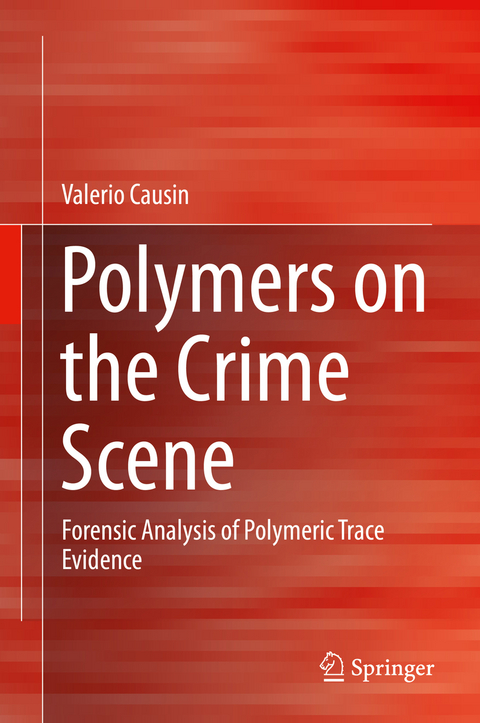
Polymers on the Crime Scene (eBook)
XI, 356 Seiten
Springer International Publishing (Verlag)
978-3-319-15494-7 (ISBN)
Born in 1975, Valerio Causin received in 2004 a PhD in Chemical Sciences at the University of Padova. From 2001 to 2003 he was First Lieutenant at the Chemistry, Explosives and Flammables section of the Forensic Branch of Carabinieri in Rome. Since 2015 he works as a researcher at the Department of Chemical Sciences at the University of Padova. His research interests are focused on the application of polymer characterization techniques to forensic sciences, in collaboration with Carabinieri in Rome, Messina, and Verona. He served as a forensic consultant for the Court, for the Prosecutor and for the Defense in over 100 civil and criminal cases. In 2009 he was awarded the AIM prize for young researchers in polymer science, and in 2011 he was elected a member of the Scientific Committee of POLYCHAR World Forum on Advanced Materials. An author of 75 papers in international journals, he was invited or keynote speaker at a number of international conferences and in universities and research centers worldwide.
Born in 1975, Valerio Causin received in 2004 a PhD in Chemical Sciences at the University of Padova. From 2001 to 2003 he was First Lieutenant at the Chemistry, Explosives and Flammables section of the Forensic Branch of Carabinieri in Rome. Since 2015 he works as a researcher at the Department of Chemical Sciences at the University of Padova. His research interests are focused on the application of polymer characterization techniques to forensic sciences, in collaboration with Carabinieri in Rome, Messina, and Verona. He served as a forensic consultant for the Court, for the Prosecutor and for the Defense in over 100 civil and criminal cases. In 2009 he was awarded the AIM prize for young researchers in polymer science, and in 2011 he was elected a member of the Scientific Committee of POLYCHAR World Forum on Advanced Materials. An author of 75 papers in international journals, he was invited or keynote speaker at a number of international conferences and in universities and research centers worldwide.
1. Introduction
References
2. Polymers: an overview
2.1 Why polymers need their own science?
2.2 A short history of polymers
2.3 The fundamentals of polymer science: some definitions
2.4 Polymerisation reactions
2.5 Average molecular weight and molecular weight distribution
2.6 Classification of polymers
2.6.1. Source-based classification
2.6.2 Organic and inorganic polymers
2.6.3. Thermoplastic and thermosetting polymers
2.6.4. Application-based classification
2.7 Describing polymers: constitution, configuration, conformation
2.7.1. Constitution
2.7.2. Configuration
2.7.3. Conformation
2.8 Commercial polymers: a round up
2.8.1. Polyethylene
2.8.2. Polypropylene
2.8.3. Polystyrene
2.8.4. Polyacrylonitrile
2.8.5. Polyacrylates
2.8.6. Polyesters
2.8.7. Polyoxymethylene, polyoxyethylene, poly(ethylene glycol) and poly(propylene glycol)
2.8.8. Polycarbonates
2.8.9. Polysulphone
2.8.10. Polyamides
2.8.11. Polyurethanes
2.8.12. Poly(vinyl acetate) and poly(vinyl alcohol)
2.8.13. Poly(vinyl chloride) and other chlorinated polymers
2.8.14. Fluorinated polymers
2.8.15. Polyisobutylene
2.8.16. Polyisoprene: natural rubber and gutta percha
2.8.17. Elastomers derived from butadiene and its derivatives
2.8.18. Polychloroprene
2.8.19. Formaldehyde-based resins
2.8.20. Epoxy polymers
2.8.21. Silicone polymers
2.8.22. Cellulose and derivatives of cellulose
2.8.23. Rayon
2.8.24. Cellulose acetate
2.8.25. Other cellulose derivatives
2.8.24. Proteins
References
Suggested readings
3. Polymeric traces: transfer, persistence, recovery, analysis and interpretation of analytical data
3.1 Polymers as sources of evidence: transfer, persistence, recovery
3.2 The development of an analytical method
3.3. The statistical treatment of analytical data
3.3.1 Comparisons
3.3.2. Principal component analysis: the basics
3.3.3. Principal Component Analysis: some examples
3.3.4. Clustering
3.4. The interpretation of evidence
3.4.1. The frequency of traces: population and target studies
3.4.2. The levels of proposition [78-80]
3.4.3. The Bayesian analysis of the results
References
4. Polymers on the crime scene
4.1. Textile fibres
4.1.1. A classification of fibres
4.1.2. Technological requirements for textile fibres
4.2.3. Transfer and persistence of fibres
4.1.4. Recovery of fibres
4.1.5. The characterisation of textile fibres
4.2. Paints
4.2.1. The composition of paints
4.2.2. Automotive paints
4.2.3. Recovery and sampling of paints
4.2.4. The characterisation of paint evidence
4.3 Adhesive tapes
4.3.1. The composition of adhesive tapes
4.3.2. Recovery and sampling of adhesive tapes
4.3.3. The characterisation of adhesive tape
4.4. Rubber gloves
4.4.1. The manufacturing of rubber gloves
4.4.2. Recovery and handling of gloves
4.4.3. Characterisation of latex gloves
4.5. Tyre rubber traces
4.5.1. Manufacturing of tyres
4.5.2. Sampling of tyre rubber traces
4.5.3. Characterisation of tyre rubber traces
4.6. Condom lubricants
4.6.1. The composition of condoms and lubricants
4.6.2. Collection and handling of condom related traces
4.6.3. The characterisation of condom-related traces
4.7. Foam fragments
4.7.1. The composition of foams
4.7.2. Collection and handling of foam traces
4.7.3. Characterisation of foam traces
4.8. Plastic bags
4.8.1. Composition of plastic bags
4.8.2. Sampling and handling of plastic films
4.8.3. Characterisation of plastic films
4.9. Polymers in documents: paper and toner
4.9.1. Paper
4.9.2. Toner
4.10. Post-fire traces
4.10.1. The identification of pyrolysis products in fire debris
4.10.2. Post fire materials identification
References
5. Formulation: polymer matrix, fillers, dyes, pigments and other additives
5.1 The techniques: spectroscopy
5.1.1. UV-Visible Spectroscopy
5.1.2. Infrared (IR) Spectroscopy
5.1.3. Raman Spectroscopy
5.2 The techniques: atomic spectrometry
5.2.1. Optical atomic spectrometry
5.2.2. Atomic mass spectrometry
5.2.3. X-ray fluorescence
5.3. The techniques: chromatography
5.4. The techniques: pyrolysis
5.5. The techniques: mass spectrometry
5.6. The techniques: thermogravimetric analysis
5.7. The characterisation of the matrix
5.8. The characterisation of the fillers
5.9. The characterisation of dyes and pigments
5.10. Characterisation of other additives
References
6. Synthesis-dependent parameters: molecularweight, constitution and configuration
6.1 Average molecular weight and molecular weight distribution
6.1.1. The techniques: size exclusion chromatography
6.1.2. Size exclusion chromatography: the forensic applications
6.1.3. The techniques: mass spectrometry for measuring high molecular weights
6.1.4. Other methods for molecular weight determination
6.2 Comonomers
6.3 Isotacticity
6.4 Stereoregularity
References
7. Processing-dependent parameters: structure and morphology of polymeric materials
7.1 Morphology
7.2 Semicristallinity
7.2.1. The techniques: X-ray diffraction
7.2.2. The techniques: thermal analysis–differential scanning calorimetry
7.2.3. Other methods for the determination of the degree of crystallinity
7.3. The mobility of macromolecule
7.3.1. The glass transition temperature
7.3.2. The techniques: Time Domain Nuclear Magnetic Resonance
7.4. Orientation
References
| Erscheint lt. Verlag | 20.4.2015 |
|---|---|
| Zusatzinfo | XI, 356 p. 217 illus., 73 illus. in color. |
| Verlagsort | Cham |
| Sprache | englisch |
| Themenwelt | Medizin / Pharmazie |
| Naturwissenschaften ► Chemie ► Organische Chemie | |
| Technik ► Maschinenbau | |
| Schlagworte | Comonomers • Crime Scene Polymers • Forensic Science • Isotacticity • Locard Principle • Polymer characterization • Polymers in Forensics • Semicrytallinity |
| ISBN-10 | 3-319-15494-X / 331915494X |
| ISBN-13 | 978-3-319-15494-7 / 9783319154947 |
| Informationen gemäß Produktsicherheitsverordnung (GPSR) | |
| Haben Sie eine Frage zum Produkt? |
 PDF (Wasserzeichen)
DRM: Digitales Wasserzeichen
Dieses eBook enthält ein digitales Wasserzeichen und ist damit für Sie personalisiert. Bei einer missbräuchlichen Weitergabe des eBooks an Dritte ist eine Rückverfolgung an die Quelle möglich.
Dateiformat: PDF (Portable Document Format)
Mit einem festen Seitenlayout eignet sich die PDF besonders für Fachbücher mit Spalten, Tabellen und Abbildungen. Eine PDF kann auf fast allen Geräten angezeigt werden, ist aber für kleine Displays (Smartphone, eReader) nur eingeschränkt geeignet.
Systemvoraussetzungen:
PC/Mac: Mit einem PC oder Mac können Sie dieses eBook lesen. Sie benötigen dafür einen PDF-Viewer - z.B. den Adobe Reader oder Adobe Digital Editions.
eReader: Dieses eBook kann mit (fast) allen eBook-Readern gelesen werden. Mit dem amazon-Kindle ist es aber nicht kompatibel.
Smartphone/Tablet: Egal ob Apple oder Android, dieses eBook können Sie lesen. Sie benötigen dafür einen PDF-Viewer - z.B. die kostenlose Adobe Digital Editions-App.
Buying eBooks from abroad
For tax law reasons we can sell eBooks just within Germany and Switzerland. Regrettably we cannot fulfill eBook-orders from other countries.
aus dem Bereich