Stereoselective Multiple Bond-Forming Transformations in Organic Synthesis (eBook)
John Wiley & Sons (Verlag)
978-1-119-00642-8 (ISBN)
• Combines the important research topic of multiple bond-forming transformations with green chemistry and sustainable development
• Offers a valuable resource for preparing compounds with multiple stereogenic centers, an important field for synthetic chemists
• Organizes chapters by molecular structure of final products, making for a handbook-style resource
• Discusses applications of the synthesis of natural products and of drug intermediates
• Brings together otherwise-scattered information about a number of key, efficient chemical reactions
Jean Rodriguez is Professor and Director of the 'Institut des Sciences Moléculaires de Marseille' at Aix-Marseille Université, with research interests including the development of new stereoselective domino and multicomponent reactions and their applications. He was awarded the ACROS prize in Organic Chemistry (1998) and the prize of the Division of Organic Chemistry (2009) from the French Chemical Society and was named a Distinguished Senior Member (2013) of the French Chemical Society.
Damien Bonne is an assistant professor at Aix-Marseille Université, with research interests including the development of new asymmetric organocatalyzed methodologies and their application in stereoselective synthesis.
Combining the important research topic of multiple bond-forming transformations with green chemistry, this book helps chemists identify recent sustainable stereoselective synthetic sequences. Combines the important research topic of multiple bond-forming transformations with green chemistry and sustainable development Offers a valuable resource for preparing compounds with multiple stereogenic centers, an important field for synthetic chemists Organizes chapters by molecular structure of final products, making for a handbook-style resource Discusses applications of the synthesis of natural products and of drug intermediates Brings together otherwise-scattered information about a number of key, efficient chemical reactions
Jean Rodriguez is Professor and Director of the "Institut des Sciences Moléculaires de Marseille" at Aix-Marseille Université, with research interests including the development of new stereoselective domino and multicomponent reactions and their applications. He was awarded the ACROS prize in Organic Chemistry (1998) and the prize of the Division of Organic Chemistry (2009) from the French Chemical Society and was named a Distinguished Senior Member (2013) of the French Chemical Society. Damien Bonne is an assistant professor at Aix-Marseille Université, with research interests including the development of new asymmetric organocatalyzed methodologies and their application in stereoselective synthesis.
1
DEFINITIONS AND CLASSIFICATIONS OF MBFTs
Damien Bonne and Jean Rodriguez
Aix Marseille Université, CNRS, Marseille, France
1.1 INTRODUCTION
The selective formation of covalent bonds, especially carbon–carbon and carbon–heteroatom bonds, is at the heart of synthetic organic chemistry. From the very beginning, researchers have developed many ingenious methodologies able to create one specific chemical bond at a time, and this has led to very significant advances in the total synthesis of complex natural or nonnatural molecules. Past decades have seen an impressive development of this “step-by-step” approach, notably with the help of efficient catalytic systems, allowing the discovery of new, powerful reactions. This huge investment has been recently rewarded with two Nobel Prizes in chemistry, in 2005 and 2010 [1]. The arsenal of modern organic synthesis is now deep enough for answering “yes” to the question: “can we make this molecule?” provided that sufficient manpower, money, and time are available. However, today's societal economic and ecologic concerns have raised the contemporaneous question: “can we make this molecule efficiently?” This small upgrade places the efficiency of a synthetic pathway in a central position both for academic developments or potential industrial applications. The efficiency of a chemical process is now evaluated not only from the overall yield and selectivity issues but also in terms of the control of waste generation, toxicity and hazard of the chemicals, the level of human resources needed, and the overall time and energy involved: in simple words, “how to make more with less”? How to render a synthesis “greener”?
Clearly, the iterative “step-by-step” approach does not fulfill all these emerging economic and environmental concerns, but it appears that significantly reducing the overall number of synthetic events required to access a defined compound can be a simple strategy to combine together all the above criteria of efficiency. Therefore, “step economy” becomes one of the most important concepts to deal with for the development of efficient modern organic synthetic chemistry.
Usually, the total synthesis of a target of interest, even if the total number of steps is limited (around 10–15), requires the use of multi-gram quantities of starting materials to afford milligrams of the desired target. Of course, different strategies have been employed over the years to reduce the total number of steps in a synthesis, such as, for example, the development of highly chemoselective transformations (protecting-group-free syntheses [2] and redox economy [3]). An alternative way to shorten a synthetic plan is the development of new sequences that allow the creation of several covalent carbon–carbon or carbon–heteroatom bonds in a single chemical transformation. This powerful strategy is referred to as “multiple bond-forming transformations” (MBFTs), which is precisely the topic of this book (Scheme 1.1) [4].
Scheme 1.1 A three-event process either by a “step-by-step” approach or a MBFT.
This simple intuitive idea has its roots in Nature, which, with the help of biological systems and billions of years of practice, can produce high levels of structural complexity and functional diversity by means of elegant and spectacular MBFTs. A magnificent example is the biosynthesis of steroids from squalene epoxides, which is converted in cells to lanosterol and then to cholesterol (Scheme 1.2) [5]. This transformation occurs with high stereoselectivity for the formation of four C—C bonds and six stereogenic carbon atoms.
Scheme 1.2 Biosynthesis of lanosterol.
MBFTs make chemical processes more efficient by reducing the total number of steps and improve atom economy while maximizing structural complexity and functional diversity. In consequence, the amount of waste generated, money, the manpower needed, and the negative environmental impact are greatly reduced. One of the first examples of such a reaction proposed by a synthetic chemist goes back to the middle of the nineteenth century with the work of Adolf Strecker in 1850. He was able to synthesize α-amino cyanides, precursors of α-amino acids, by the one-pot concomitant creation of one C—C and one C—N bond from an aldehyde, ammonia, and hydrogen cyanide (Scheme 1.3) [6].
Scheme 1.3 The Strecker reaction, one of the first MBFTs.
Since then, this field of research has grown rapidly with the help of metal catalysis, and even more in the last decade with the spectacular advent of organocatalysis that perfectly fits with the criteria of efficiency for a synthesis to be viable.
1.2 DEFINITIONS
It seems highly desirable to introduce a clear definition of the different types of MBFTs. First, MBFTs do not include concerted transformations such as cycloadditions (e.g., Diel–Alder reaction) or metal-catalyzed cycloisomerization (e.g., Pauson–Khand reaction), even though, strictly speaking, two or more bonds are created in these transformations. MBFTs can be roughly categorized according to the protocol used and the number of functional components involved. Therefore, one-, two-, and multicomponent sequences can be envisioned, and following the definitions proposed by Tietze [7], we distinguish domino reactions and consecutive reactions as the two main classes of nonconcerted MBFTs. Domino (or cascade) reactions are MBFTs that take place under the same reaction conditions without adding extra reagents and catalysts, and in which the subsequent reactions result as a consequence of the functionality formed in the previous step. A very elegant example of a unimolecular transformation is the two-directional epoxide-opening reaction in the total synthesis of the natural product glabrescol reported by Corey and Xiong, where four C—O bonds were created by simple acidic treatment of a tetraepoxide precursor (Scheme 1.4a) [8].
Scheme 1.4 (a) Domino MBFTs with one component. (b) Consecutive MBFTs with two components. (c) Domino MBFTs with three components.
In comparison, consecutive reactions describe MBFTs in which the introduction of the reagent(s) and/or additional solvent(s) and substrate(s) is performed in a stepwise manner to a single reaction mixture from which nothing is removed. Strictly speaking, sequences involving even a limited and operationally simple change of the reaction conditions such as an elevation of temperature should not be denoted as domino reactions but preferably as consecutive reactions. The example displayed in Scheme 1.4b has been described by Rueping's group for the enantioselective synthesis of polycyclic heterocycles with the concomitant formation of one C—C and two C—N bonds [9]. The first step of the sequence involves two components and is catalyzed by diarylprolinol silyl ethers. It leads to a transient cyclic hemiacetal, which is not isolated and can react with a third component, for example, a functionalized primary amine, in a second consecutive step via intramolecular capture of an iminium ion intermediate.
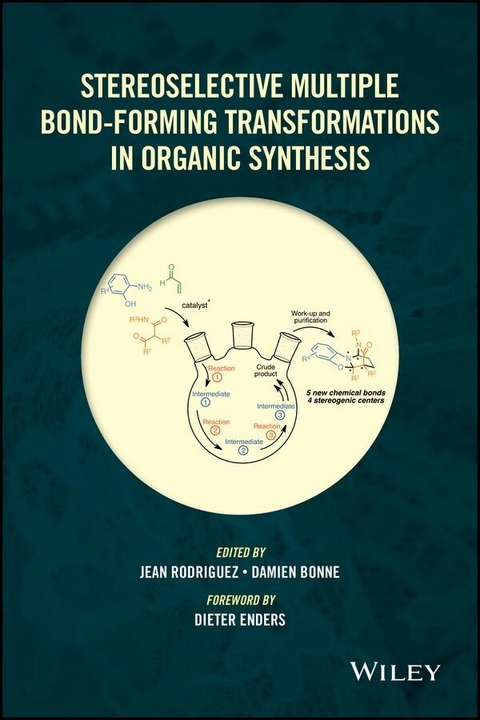
Finally, multicomponent reactions (MCRs) are a subclass of domino reactions and can be defined as processes in which three or more starting materials react to form a product, where basically all or most of the atoms contribute to the newly formed product [10]. A recent example reported by our group (Scheme 1.4c) involves the reaction between β-ketoamides, acrolein, and aminophenols, allowing the preparation of an enantioenriched diazabicyclo[2.2.2]octanone (2,6-DABCO) scaffold [11]. The chemoselective reaction sequence installs five new bonds and three stereocenters, with excellent yields and high levels of stereocontrol.
Practically, the design of new MBFTs requires the use or the synthesis of substrates displaying several complementary reactive sites, which can be exploited successively in the transformation. Some families of densely functionalized small molecules are particularly well adapted to serve as substrates for these reactions. We can cite, for example, isocyanides [12] and dicarbonyl compounds [13], which have led to the discovery of important MBFTs owing to the presence of multiple reaction sites with both electrophilic and nucleophilic characters, which could be modulated by the nature of the substituents.
On the basis of these considerations, this book will focus on modern tools for efficient stereoselective synthesis proceeding exclusively with MBFTs including selected examples of domino, multicomponent, or consecutive sequences that have been described in the last 10 years. In this book, we highlight the best of these methodologies with criteria of efficiency in terms of chemical yield, selectivity, width of scope, and ease to perform. Moreover, the control of the chirality is essential in academic research, and is becoming also of primary importance in the industrial context such as medicinal chemistry or agrochemical research. For this reason, we decided to focus only on stereoselective methodologies involving either metallic or organic catalysis and to present some selected current synthetic applications in the fields of total synthesis or in the elaboration of biologically relevant targets. In addition, for practical matters, we feel that an...
| Erscheint lt. Verlag | 8.4.2015 |
|---|---|
| Vorwort | Dieter Enders |
| Sprache | englisch |
| Themenwelt | Naturwissenschaften ► Chemie ► Organische Chemie |
| Technik | |
| Schlagworte | acyclic compounds • Carbocycles • Chemie • Chemistry • Heterocycles • multiple bond-forming transformations (MBFTs) • Nachhaltige u. Grüne Chemie • Nachhaltige u. Grüne Chemie • Natural Products Synthesis • Organic Chemistry • Organische Chemie • Pharmaceutical & Medicinal Chemistry • Pharmazeutische u. Medizinische Chemie • spirocyclic compounds • Stereoselective Synthesis • Sustainable chemistry • Sustainable Chemistry & Green Chemistry |
| ISBN-10 | 1-119-00642-2 / 1119006422 |
| ISBN-13 | 978-1-119-00642-8 / 9781119006428 |
| Informationen gemäß Produktsicherheitsverordnung (GPSR) | |
| Haben Sie eine Frage zum Produkt? |
 EPUB (Adobe DRM)
Kopierschutz: Adobe-DRM
Adobe-DRM ist ein Kopierschutz, der das eBook vor Mißbrauch schützen soll. Dabei wird das eBook bereits beim Download auf Ihre persönliche Adobe-ID autorisiert. Lesen können Sie das eBook dann nur auf den Geräten, welche ebenfalls auf Ihre Adobe-ID registriert sind.
Details zum Adobe-DRM
Dateiformat: EPUB (Electronic Publication)
EPUB ist ein offener Standard für eBooks und eignet sich besonders zur Darstellung von Belletristik und Sachbüchern. Der Fließtext wird dynamisch an die Display- und Schriftgröße angepasst. Auch für mobile Lesegeräte ist EPUB daher gut geeignet.
Systemvoraussetzungen:
PC/Mac: Mit einem PC oder Mac können Sie dieses eBook lesen. Sie benötigen eine
eReader: Dieses eBook kann mit (fast) allen eBook-Readern gelesen werden. Mit dem amazon-Kindle ist es aber nicht kompatibel.
Smartphone/Tablet: Egal ob Apple oder Android, dieses eBook können Sie lesen. Sie benötigen eine
Geräteliste und zusätzliche Hinweise
Buying eBooks from abroad
For tax law reasons we can sell eBooks just within Germany and Switzerland. Regrettably we cannot fulfill eBook-orders from other countries.
aus dem Bereich