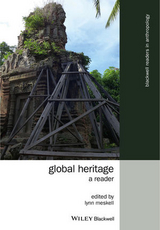
Global Heritage (eBook)
John Wiley & Sons (Verlag)
978-1-118-76910-2 (ISBN)
- Focuses on ethnographic and embedded perspectives, as well as a commitment to ethical engagement
- Appeals to a broad audience, from archaeologists to heritage professionals, museum curators to the general public
- The contributors comprise an outstanding team, representing some of the most prominent scholars in this broad field, with a combination of senior and emerging scholars, and an emphasis on international contributions
Lynn Meskell is Professor of Anthropology and Director of the Archaeology Center at Stanford University. Before coming to Stanford in 2005 she was Professor of Anthropology at Columbia University. She is Honorary Professor at the University of the Witwatersrand, Johannesburg. Some of her recent books and edited collections include Cosmopolitan Archaeologies (2009) and The Nature of Culture: The New South Africa (Blackwell, 2011). Her new research focuses on the role of UNESCO in terms of heritage rights, sovereignty and international politics.
Examines the social, cultural and ethical dimensions of heritage research and practice, and the underlying international politics of protecting cultural and natural resources around the globe. Focuses on ethnographic and embedded perspectives, as well as a commitment to ethical engagement Appeals to a broad audience, from archaeologists to heritage professionals, museum curators to the general public The contributors comprise an outstanding team, representing some of the most prominent scholars in this broad field, with a combination of senior and emerging scholars, and an emphasis on international contributions
Lynn Meskell is Professor of Anthropology and Director of the Archaeology Center at Stanford University. Before coming to Stanford in 2005 she was Professor of Anthropology at Columbia University. She is Honorary Professor at the University of the Witwatersrand, Johannesburg. Some of her recent books and edited collections include Cosmopolitan Archaeologies (2009) and The Nature of Culture: The New South Africa (Blackwell, 2011). Her new research focuses on the role of UNESCO in terms of heritage rights, sovereignty and international politics.
Notes on Contributors Introduction: Globalizing Heritage 1
Lynn Meskell
1 UNESCO and New World Orders 22
Lynn Meskell and Christoph Brumann
2 Neoliberalism, Heritage Regimes, and Cultural Rights 43
Rosemary J. Coombe and Lindsay M. Weiss
3 Civil Societies? Heritage Diplomacy and Neo-Imperialism 70
Morag M. Kersel and Christina Luke
4 Bridging Cultural and Natural Heritage 94
Denis Byrne and Gro Birgit Ween
5 Communities and Ethics in the Heritage Debates 112
Chip Colwell and Charlotte Joy
6 Heritage Management and Conservation: From Colonization to Globalization 131
Webber Ndoro and Gamini Wijesuriya
7 Heritage and Violence 150
Alfredo González-Ruibal and Martin Hall
8 Urban Heritage and Social Movements 171
Chiara De Cesari and Michael Herzfeld
9 Sustainable Development: Heritage, Community, Economics 196
Sophia Labadi and Peter G. Gould
10 Transnationalism and Heritage Development 217
Kathryn Lafrenz Samuels and Ian Lilley
11 Heritage and Tourism 240
Noel B. Salazar and Yujie Zhu
Index 259
Notes on Contributors
Christoph Brumann is Head of Research Group at the Max Planck Institute for Social Anthropology, Halle, and Honorary Professor of Anthropology at Martin Luther University Halle-Wittenberg in Germany. He is the author of Tradition, Democracy and the Townscape of Kyoto (2012) and co-editor of Making Japanese Heritage (2010) and Urban Spaces in Japan (2012). He has published widely on urban anthropology, the concept of culture, globalization, utopian communes, and Japanese gift exchange. Alongside his ethnographic study of the UNESCO World Heritage arena, he is currently preparing a new project on Buddhist temple economies in urban Asia.
Denis Byrne is Senior Research Fellow at the Institute for Culture and Society, University of Western Sydney, Australia. He has worked in both government and academic spheres of heritage conservation and has contributed to critical debates on heritage issues in Southeast Asia and indigenous Australia. He is author of Counterheritage: Critical Perspectives on Heritage Conservation in Asia (2013) and Surface Collection: Archaeological Travels in Southeast Asia (2007).
Chiara De Cesari is an anthropologist and Assistant Professor in European Studies and Cultural Studies at the University of Amsterdam. Her research focuses on heritage, memory, and cultural politics and how these change under conditions of globalization. She has published articles in American Anthropologist, Memory Studies, and Studies in Ethnicity and Nationalism, among others. She co-edited Transnational Memory (2014, with Ann Rigney) and is currently finishing a book entitled, Heritage and the Struggle for Palestine. Her most recent project explores the making of a new European collective memory in relation to its blind spots, particularly the carceral heritage of colonialism.
Chip Colwell is Curator of Anthropology at the Denver Museum of Nature and Science. He has written and edited ten books, and more than forty articles and book chapters. His research has been highlighted in such venues as Archaeology Magazine, Indian Country Today, the Huffington Post, and the New York Times.
Rosemary J. Coombe holds the Tier One Canada Research Chair in Law, Communication and Culture at York University in Toronto, where she is cross-appointed to the Departments of Anthropology and Social Science. Until 2000 she was Full Professor of Law at the University of Toronto. Her award-winning book, The Cultural Life of Intellectual Properties was reprinted in 2008. She publishes in the fields of anthropology, cultural studies, and legal studies on the politics of cultural property and heritage management at the intersections of neoliberalism, informational capital, and human rights.
Alfredo González-Ruibal is Staff Scientist with the Institute of Heritage Sciences of the Spanish National Research Council (Incipit-CSIC). His work focuses on the archaeology of the contemporary past and the negative heritage of modernity (war, dictatorship, colonialism). He has recently co-edited the collection Ethics and the Archaeology of Violence (with Gabriel Moshenska, 2014). His recent book, An Archaeology of Resistance: Materiality and Time in an African Borderland (2014) deals with his other research interests: resistance, egalitarianism, and the material culture of indigenous communities.
Peter G. Gould is a consulting scholar at the Penn Cultural Heritage Center of the University of Pennsylvania Museum of Archaeology and Anthropology and an Adjunct Professor of Archaeology at the American University of Rome. After a career as an economist and business executive, he received his Ph.D. from University College London, for which his research in Belize, Peru and Ireland concerned the governance features of sustainable community economic development projects associated with heritage sites. He is a founding director of the Sustainable Preservation Initiative, which supports community economic development projects associated with archaeological sites, initially in Peru.
Martin Hall is Vice Chancellor (President) of the University of Salford, Manchester and Professor Emeritus at the University of Cape Town (UCT). He was previously Professor of Historical Archaeology, inaugural Dean of Higher Education Development, and then Deputy Vice-Chancellor at UCT. He is a Fellow of the Royal Society of Arts, a Fellow of the Royal Society of South Africa, a Life Fellow of the University of Cape Town, and past President of the World Archaeological Congress. Martin Hall has published extensively on pre-colonial, colonial, and historical archaeology, and on the representation of the past in the present.
Michael Herzfeld is the Ernest E. Monrad Professor of the Social Sciences in the Department of Anthropology at Harvard University. Over his long career, he has authored ten books – including A Place in History (1991), Cultural Intimacy (2nd edition, 2005), and Evicted from Eternity (2009) – and numerous articles and reviews, and has also produced two ethnographic films about Rome. A former editor of American Ethnologist (1995–1998), he is Senior Advisor to the Critical Heritage Studies Initiative of the International Institute for Asian Studies (Leiden). His research in Greece, Italy, and Thailand encompasses historic conservation and gentrification, crypto-colonialism, nationalism and cultural intimacy, and artisanship and apprenticeship.
Charlotte Joy is a Lecturer in Social Anthropology at Goldsmiths College, University of London. She carried out fieldwork in Djenné, Mali, and at UNESCO in Paris and is the author of The Politics of Heritage Management in Mali (2013). Her research is concerned with developing an ethnographic approach to understanding the politics of cultural heritage and the links between cultural heritage, rights, and the ethics of the uses of the past in the present. Her new research documents the destruction and rehabilitation of cultural heritage during the current conflict in Mali.
Morag M. Kersel is Assistant Professor in the Department of Anthropology at DePaul University and affiliated faculty with the Center for Art, Museum, and Cultural Heritage Law at DePaul College of Law. She co-directs the archaeological and ethnographic “Follow the Pots Project” in Jordan (http://followthepotsproject.org/). She is a co-author (with Christina Luke) of U.S. Cultural Diplomacy and Archaeology: Soft Power, Hard Heritage (2013) and a co-editor of the volume Archaeology, Cultural Heritage and the Trade in Antiquities (2006). Her research interests include the prehistory of the Levant, cultural heritage policy and law, and the trade in archaeological artifacts.
Sophia Labadi is a Lecturer in Heritage and Director of the Centre for Heritage at the University of Kent. She has a Ph.D. and a Masters in Cultural Heritage Studies from the Institute of Archaeology, University College London and graduated from the Institute of Political Sciences in Grenoble (France). Since 2001, she has worked for a number of regional and international organizations. For UNESCO, she has worked in the Secretariat of the 1972 World Heritage Convention and the 2003 Intangible Cultural Heritage Convention. She was a Getty Conservation Guest Scholar in 2006–2007, the recipient of the Cultural Policy Research Award in 2008, a Senior Research Fellow at Durham University in 2012, and a fellow at the National Gallery of Denmark in 2014.
Kathryn Lafrenz Samuels is an Assistant Professor of Anthropology at the University of Maryland, whose research examines cultural heritage in the transnational sphere, in the ambit of international economic development, democracy promotion, human rights, and global climate change. In 2013–2014 she was a Fulbright fellow in Tromsø, Norway with the Norwegian Institute for Cultural Heritage Research (NIKU). She is co-editor of Cultures of Contact: Archaeology, Ethics, and Globalization (2007) with Sebastian De Vivo and Darian Totten, Making Roman Places: Past and Present (2012) with Darian Totten, and Heritage Keywords: Rhetoric and Redescription in Cultural Heritage (2015) with Trinidad Rico.
Ian Lilley is a Professor at the University of Queensland. He has worked in Australasian and Indo-Pacific archaeology and cultural heritage for thirty-five years. He currently does fieldwork in Australia and New Caledonia, and has just begun a major project examining Indigenous issues in World Heritage management. He is Secretary-General of the ICOMOS International Scientific Committee on Archaeological Heritage Management and also serves on two IUCN Commissions. His most recent books are a heritage management volume on Early Human Expansion and Innovation in the Pacific (2010) and the university textbook, Archaeology of Oceania: Australia and the Pacific Islands (2006).
Christina Luke teaches at Boston University, where she also serves as editor of the Journal of Field Archaeology. She works closely with US embassies and foreign ministries in various countries to explore the pivotal place of heritage in social life and personal experience. Her recent publications include U.S. Cultural Diplomacy and Archaeology (2013) and several articles focused on cultural policy and sovereignty. Her current research focuses on heritage studies, international development,...
| Erscheint lt. Verlag | 8.4.2015 |
|---|---|
| Reihe/Serie | Blackwell Readers in Anthropology |
| Blackwell Readers in Anthropology | Wiley Blackwell Readers in Anthropology |
| Sprache | englisch |
| Themenwelt | Kunst / Musik / Theater |
| Geisteswissenschaften ► Archäologie | |
| Geisteswissenschaften ► Geschichte ► Hilfswissenschaften | |
| Sozialwissenschaften ► Kommunikation / Medien ► Buchhandel / Bibliothekswesen | |
| Sozialwissenschaften ► Soziologie | |
| Technik | |
| Schlagworte | Anthropologie • Anthropology • Archäologie • archaeology • Archäologie • Art & Applied Arts • Cultural heritage studies, heritage preservation, heritage violence, post-conflict archaeologies, global heritage development, global heritage internationalism, liberation heritage, heritage ethics, collaborative archaeologies, indigenous heritage, global agencies, natural heritage, heritage diplomacy, neo imperialism, UNESCO, New World Orders, spatial cleansing, social movement, global heritage tourism • Kulturanthropologie • Kunst • Kunst u. Angewandte Kunst • Museen u. Kulturerbe • Museum & Heritage Studies • Social & Cultural Anthropology • Social Archaeology • Sozialarchäologie • Sozialarchäologie • Soziale u. kulturelle Anthropologie |
| ISBN-10 | 1-118-76910-4 / 1118769104 |
| ISBN-13 | 978-1-118-76910-2 / 9781118769102 |
| Informationen gemäß Produktsicherheitsverordnung (GPSR) | |
| Haben Sie eine Frage zum Produkt? |
 EPUB (Adobe DRM)
Kopierschutz: Adobe-DRM
Adobe-DRM ist ein Kopierschutz, der das eBook vor Mißbrauch schützen soll. Dabei wird das eBook bereits beim Download auf Ihre persönliche Adobe-ID autorisiert. Lesen können Sie das eBook dann nur auf den Geräten, welche ebenfalls auf Ihre Adobe-ID registriert sind.
Details zum Adobe-DRM
Dateiformat: EPUB (Electronic Publication)
EPUB ist ein offener Standard für eBooks und eignet sich besonders zur Darstellung von Belletristik und Sachbüchern. Der Fließtext wird dynamisch an die Display- und Schriftgröße angepasst. Auch für mobile Lesegeräte ist EPUB daher gut geeignet.
Systemvoraussetzungen:
PC/Mac: Mit einem PC oder Mac können Sie dieses eBook lesen. Sie benötigen eine
eReader: Dieses eBook kann mit (fast) allen eBook-Readern gelesen werden. Mit dem amazon-Kindle ist es aber nicht kompatibel.
Smartphone/Tablet: Egal ob Apple oder Android, dieses eBook können Sie lesen. Sie benötigen eine
Geräteliste und zusätzliche Hinweise
Buying eBooks from abroad
For tax law reasons we can sell eBooks just within Germany and Switzerland. Regrettably we cannot fulfill eBook-orders from other countries.
aus dem Bereich