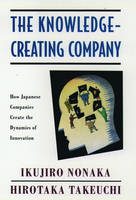
How have Japanese companies become world leaders in the automotive and electronics industries, among others? What is the secret of their success? Two leading Japanese business experts, Ikujiro Nonaka and Hirotaka Takeuchi, are the first to tie the success of Japanese companies to their ability to create new knowledge and use it to produce successful products and technologies. In The Knowledge-Creating Company, Nonaka and Takeuchi provide an inside look at how Japanese companies go about creating this new knowledge organizationally. The authors point out that there are two types of knowledge: explicit knowledge, contained in manuals and procedures, and tacit knowledge, learned only by experience, and communicated only indirectly, through metaphor and analogy. U.S. managers focus on explicit knowledge. The Japanese, on the other hand, focus on tacit knowledge. And this, the authors argue, is the key to their success--the Japanese have learned how to transform tacit into explicit knowledge. To explain how this is done--and illuminate Japanese business practices as they do so--the authors range from Greek philosophy to Zen Buddhism, from classical economists to modern management gurus, illustrating the theory of organizational knowledge creation with case studies drawn from such firms as Honda, Canon, Matsushita, NEC, Nissan, 3M, GE, and even the U.S. Marines. For instance, using Matsushita's development of the Home Bakery (the world's first fully automated bread-baking machine for home use), they show how tacit knowledge can be converted to explicit knowledge: when the designers couldn't perfect the dough kneading mechanism, a software programmer apprenticed herself with the master baker at Osaka International Hotel, gained a tacit understanding of kneading, and then conveyed this information to the engineers. In addition, the authors show that, to create knowledge, the best management style is neither top-down nor bottom-up, but rather what they call "e;middle-up-down,"e; in which the middle managers form a bridge between the ideals of top management and the chaotic realities of the frontline. As we make the turn into the 21st century, a new society is emerging. Peter Drucker calls it the "e;knowledge society,"e; one that is drastically different from the "e;industrial society,"e; and one in which acquiring and applying knowledge will become key competitive factors. Nonaka and Takeuchi go a step further, arguing that creating knowledge will become the key to sustaining a competitive advantage in the future. Because the competitive environment and customer preferences changes constantly, knowledge perishes quickly. With The Knowledge-Creating Company, managers have at their fingertips years of insight from Japanese firms that reveal how to create knowledge continuously, and how to exploit it to make successful new products, services, and systems.
 EPUB (Adobe DRM)
Kopierschutz: Adobe-DRM
Adobe-DRM ist ein Kopierschutz, der das eBook vor Mißbrauch schützen soll. Dabei wird das eBook bereits beim Download auf Ihre persönliche Adobe-ID autorisiert. Lesen können Sie das eBook dann nur auf den Geräten, welche ebenfalls auf Ihre Adobe-ID registriert sind.
Details zum Adobe-DRM
Dateiformat: EPUB (Electronic Publication)
EPUB ist ein offener Standard für eBooks und eignet sich besonders zur Darstellung von Belletristik und Sachbüchern. Der Fließtext wird dynamisch an die Display- und Schriftgröße angepasst. Auch für mobile Lesegeräte ist EPUB daher gut geeignet.
Systemvoraussetzungen:
PC/Mac: Mit einem PC oder Mac können Sie dieses eBook lesen. Sie benötigen eine Adobe-ID und die Software Adobe Digital Editions (kostenlos). Von der Benutzung der OverDrive Media Console raten wir Ihnen ab. Erfahrungsgemäß treten hier gehäuft Probleme mit dem Adobe DRM auf.
eReader: Dieses eBook kann mit (fast) allen eBook-Readern gelesen werden. Mit dem amazon-Kindle ist es aber nicht kompatibel.
Smartphone/Tablet: Egal ob Apple oder Android, dieses eBook können Sie lesen. Sie benötigen eine Adobe-ID sowie eine kostenlose App.
Geräteliste und zusätzliche Hinweise
Buying eBooks from abroad
For tax law reasons we can sell eBooks just within Germany and Switzerland. Regrettably we cannot fulfill eBook-orders from other countries.