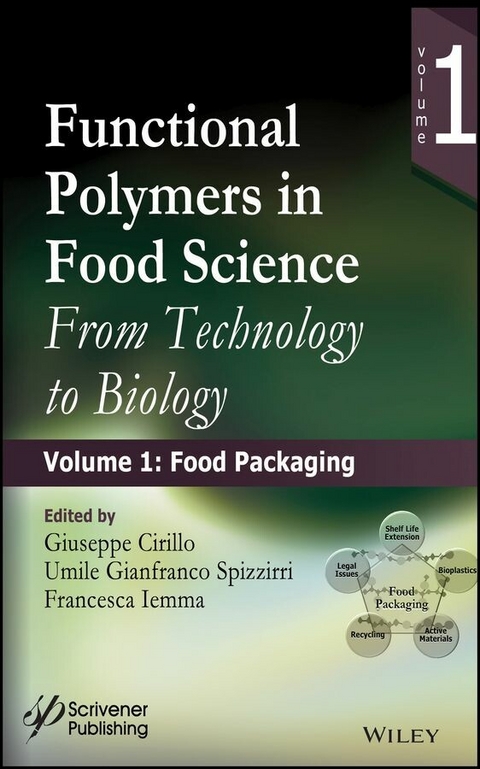
Functional Polymers in Food Science (eBook)
456 Seiten
Wiley-Scrivener (Verlag)
978-1-119-10977-8 (ISBN)
Polymers are an important part in everyday life; products made from polymers range from sophisticated articles, such as biomaterials, to aerospace materials. One of the reasons for the great popularity exhibited by polymers is their ease of processing. Polymer properties can be tailored to meet specific needs by varying the 'atomic composition' of the repeat structure, by varying molecular weight and by the incorporation (via covalent and non-covalent interactions) of an enormous range of compounds to impart specific activities.
In food science, the use of polymeric materials is widely explored, from both an engineering and a nutraceutical point of view. Regarding the engineering application, researchers have discovered the most suitable materials for intelligent packaging which preserves the food quality and prolongs the shelf-life of the products. Furthermore, in agriculture, specific functionalized polymers are used to increase the efficiency of treatments and reduce the environmental pollution. In the nutraceutical field, because consumers are increasingly conscious of the relationship between diet and health, the consumption of high quality foods has been growing continuously. Different compounds (e.g. high quality proteins, lipids and polysaccharides) are well known to contribute to the enhancement of human health by different mechanisms, reducing the risk of cardiovascular disease, coronary disease, and hypertension.
This first volume, of this two volume book, concerns the application of polymers in food packaging.
Giuseppe Cirillo received his PhD in 2008 from the University of Calabria, Italy, where he is currently in a post-doctoral position. His research interests are in the development of functional polymers with tailored biological activity, antioxidant, antimicrobial, and anticancer chelating,, the design of smart hydrogels for drug delivery, the study of the activity of innovative functional foods and nutraceuticals, and the synthesis and functionalization of carbon nanotubes, based devices for biomedical applications. He is the author and coauthor of more than 100 publications, including four edited books with Wiley Scrivener. Umile Gianfranco Spizzirri obtained his PhD in 2005 from the University of Calabria. He is currently a member of the Technical Staff at the Department of Pharmacy, Nutrition and Health Science of the same university. His research activities are mainly related to the polymer chemistry and technology for the preparation of stimuli-responsive drug delivery system, functional polymers for food industry, and new analytical methodologies for the food quality and safety assessment. He is the author and coauthor of more than 100 publications, including three edited books with Wiley Scrivener.
Chapter 1
Polymers and Food Packaging: A Short Overview
Umile Gianfranco Spizzirri*, Giuseppe Cirillo and Francesca Iemma
Department of Pharmacy, Health and Nutritional Sciences, University of Calabria, Rende, Italy
*Corresponding author: g.spizzirri@unical.it
Abstract
A discussion on the state-of-the-art performance of biopolymers and functional biopolymers, focusing on food packaging applications, is presented in this chapter. An overview is given of the most important materials used for producing biobased films, their limitations, recycling pattern, and solutions thereof. Furthermore, transport phenomena and regulation concerns are extensively treated.
Keywords: Food packaging, functional biopolymers, environmental concerns, regulation issues
1.1 Introduction
Packaging materials are widely used to protect the product from its surroundings, retard food product deterioration, and extend shelf life, producing a positive effect on the food quality and safety [1]. A number of packaging materials have been developed to meet these objectives, and considerable efforts have been made to develop the most efficient materials from both a mechanical and a functional point of view.
Apart from the materials used, packaging technology is of great importance. Among the different technologies, High Pressure Processing of Foods is an innovative technology applied for safety assurance, shelf-life extension, and nutrient preservation, and it is known for its potential in manufacturing value-added foods, retaining heat-labile nutrients, flavors, and aromas [2].
When considering any potential materials used for packaging, the direct contact between food substances and materials should be tightly controlled, since the migration of low molecular weight additives from packaging material into foodstuffs can occur [3,4]. Several different scientific reports and articles have investigated the migration of compounds such as solvents, reaction byproducts, additives, and monomers from packaging polymers into food [5]. Similarly, considerable attention and concern have been devoted to the evaluation of loss of low molecular weight compounds (including volatile and nonvolatile substances) from a food into polymeric packaging materials [6]. This is of particular importance, since the nonvolatiles, such as fats and pigments, can affect the package itself, while sorption of volatiles (flavors and aromas) more directly affects food quality, such as loss of aroma intensity [7].
Due to its deliberate interaction with the food and/or its environment, the migration of substances could represent a food safety concern, and most active and intelligent concepts that are on the market in the USA and Australia could not be introduced in Europe due to more stringent EU legislation. With regard to this, repealing of the EU Framework Directive 89/109/EEC for food contact materials, resulted firstly in the adoption of a Framework Regulation 1935/2004/EC [8] in which the use of active and intelligent packaging systems are now included. It was only in 2009 that Regulation 450/2009/EC [9] was considered to be a specific measure that laid down rules ad hoc for active and intelligent materials and articles to be applied in addition to the general requirements established in Regulation 1935/2004/EC for their safe use.
Commonly used petroleum-based materials show disposability, easily controlled gas permeability, and durability. On the other hand, these materials are not easy to biodegrade, and generate much heat and exhaust gases when burned, thus posing a global issue of environmental pollution [10].
Analysis of the life cycle of petrochemically-based products allows the understanding of waste management, which is an important issue to every material. After consumer use, the product eventually becomes waste which is either landfilled or recovered in the form of secondary product or by means of energy recovery from an incinerator. Obviously if a product remains in the landfill it contributes to its expansion and to environmental pollution. A new portion of raw material must be extracted from the Earth in order to meet the requirements of consumers or industry. However, recovery gives waste products a chance for a “second life,” thus both saving raw material resources and keeping the environment clean and healthy. Packaging is a product with a very short lifetime, counted frequently in weeks. Sixty percent of all packaging is for food products, helping to save large quantities of food which would otherwise be wasted (in some developing countries even 50%) [11].
In addition, petroleum resources are not infinite, and prices are likely to rise in the future. Joint efforts by the packaging and food industries have reduced the amount of packaging, however, packaging creates disposal problems. In the food packaging industry, the use of proper packaging materials and methods to minimize food losses and provide safe and wholesome food products has always been the main interest. Environmental issues have been attracting consumers’ attention. Consequently, consumer pressure and rising petroleum prices are encouraging the use of environmentally friendly biodegradable packaging as an alternative to materials produced from nonrenewable resources. Because of this, efforts have been made to utilize raw materials originating from agricultural sources. The use of edible films and coatings is an environmentally friendly technology that offers substantial advantages for an increase in the shelf life of many food products [12].
Biopolymer or biodegradable plastics are polymeric materials in which at least one step in the degradation process is through metabolism of naturally occurring organisms [13]. According to the European Bioplastics Organization, bioplastics can be defined as plastics based on renewable resources or as plastics which are biodegradable and/or compostable. Under appropriate conditions of moisture, temperature, and oxygen availability, biodegradation leads to fragmentation or disintegration of plastics with no toxic or environmentally harmful residue [14,15]. Biopolymers can be broadly divided into different categories based on the origin of the raw materials and their manufacturing processes. They include:
- Biopolymers produced by microbial fermentation like microbial polyesters such as poly(hydroxyalkanoates) including poly(-hydroxybutyrate), poly(3-hydroxybutyrate-co-3-hydroxyvalerate);
- Synthetic biodegradable polymers such as poly(l-lactide), poly(glycolic acid), poly(ε-caprolactone), poly(butylenes succinate), poly(vinyl alcohol), etc.;
- Natural biopolymers such as plant carbohydrates like starch, cellulose, chitosan, alginate, agar, carrageenan, etc., and animal or plant origin proteins like soy protein, corn zein, wheat gluten, gelatin, collagen, whey protein, and casein.
At present, biodegradable packaging materials have some limitations: for example, they cannot fully match the characteristics similar to petroleum-based materials, and costs are high. Biopolymers alone do not form films with adequate mechanical properties unless they are first treated by either plasticizers, blending with other materials, genetic or chemical modification or combinations of the above approaches. Blends of biopolymers with other biodegradable polymers have been considered a promising avenue for preparing polymers with “tailor-made” properties (functional physical properties and biodegradability). Incorporating relatively low-cost natural biopolymers into biodegradable synthetic polymers provides a way to reduce the overall cost of the material and offers a method of modifying both properties and degradation rates. Food grade plasticizers include glycerol and sorbitol, with glycerol being the most popular plasticizer used in film-making techniques, due to stability and compatibility with the hydrophilic biopolymeric packaging chain.
Recently, a new class of materials represented by bionanocomposites, consisting of a biopolymer matrix reinforced with particles (nanoparticles), with enhanced barrier, mechanical and thermal properties has been considered as a promising option in improving the properties of these biopolymer-based packaging materials [16]. Enhanced barrier properties of the bionanocomposites against O2, CO2, water vapor, and flavor compounds would have a major impact on extending the shelf life of various fresh and processed foods. In addition, biodegradability of the bionanocomposites can be finely tuned through the proper choice of polymer matrix and nanoparticles, which is also a driver for the use of bionanocomposites in food packaging.
In the last decades the concept of an “active food packaging system” represents an innovative aspect for packaging materials with respect to some other roles such as an inert barrier to external conditions. Active packaging system involves a positive interaction between the packaging material and the foodstuffs in order to provide desirable effects.
The food package interaction is achieved by the addition of certain additives into the packaging film to enhance the performance of the packaging system [17]. Active packaging techniques can be divided into three categories: absorbers, releasing systems and other systems [18]. Scavenging systems remove undesired components such as oxygen, carbon dioxide, ethylene, humidity. Releasing systems actively add or emit compounds to the packaged food or into the headspace of the package, such as carbon dioxide, antioxidants and preservatives.
The most interesting and promising components of active packaging are antimicrobial and antioxidant...
| Erscheint lt. Verlag | 10.3.2015 |
|---|---|
| Reihe/Serie | Polymer Science and Plastics Engineering | Polymer Science and Plastics Engineering |
| Sprache | englisch |
| Themenwelt | Naturwissenschaften ► Chemie ► Organische Chemie |
| Technik ► Lebensmitteltechnologie | |
| Schlagworte | Food Science & Technology • Lebensmittelforschung u. -technologie • Polymer Science & Technology • Polymerwissenschaft u. -technologie |
| ISBN-10 | 1-119-10977-9 / 1119109779 |
| ISBN-13 | 978-1-119-10977-8 / 9781119109778 |
| Informationen gemäß Produktsicherheitsverordnung (GPSR) | |
| Haben Sie eine Frage zum Produkt? |
 EPUB (Adobe DRM)
Kopierschutz: Adobe-DRM
Adobe-DRM ist ein Kopierschutz, der das eBook vor Mißbrauch schützen soll. Dabei wird das eBook bereits beim Download auf Ihre persönliche Adobe-ID autorisiert. Lesen können Sie das eBook dann nur auf den Geräten, welche ebenfalls auf Ihre Adobe-ID registriert sind.
Details zum Adobe-DRM
Dateiformat: EPUB (Electronic Publication)
EPUB ist ein offener Standard für eBooks und eignet sich besonders zur Darstellung von Belletristik und Sachbüchern. Der Fließtext wird dynamisch an die Display- und Schriftgröße angepasst. Auch für mobile Lesegeräte ist EPUB daher gut geeignet.
Systemvoraussetzungen:
PC/Mac: Mit einem PC oder Mac können Sie dieses eBook lesen. Sie benötigen eine
eReader: Dieses eBook kann mit (fast) allen eBook-Readern gelesen werden. Mit dem amazon-Kindle ist es aber nicht kompatibel.
Smartphone/Tablet: Egal ob Apple oder Android, dieses eBook können Sie lesen. Sie benötigen eine
Geräteliste und zusätzliche Hinweise
Buying eBooks from abroad
For tax law reasons we can sell eBooks just within Germany and Switzerland. Regrettably we cannot fulfill eBook-orders from other countries.
aus dem Bereich