


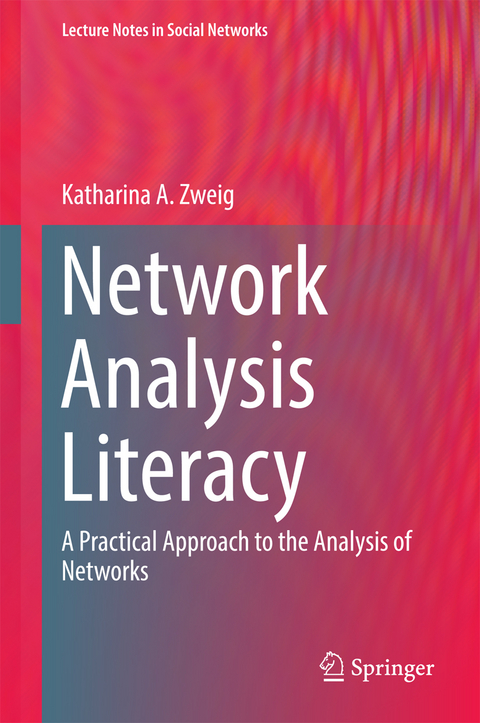
Network Analysis Literacy (eBook)
XXIII, 535 Seiten
Springer Wien (Verlag)
978-3-7091-0741-6 (ISBN)
This book presents a perspective of network analysis as a tool to find and quantify significant structures in the interaction patterns between different types of entities. Moreover, network analysis provides the basic means to relate these structures to properties of the entities. It has proven itself to be useful for the analysis of biological and social networks, but also for networks describing complex systems in economy, psychology, geography, and various other fields. Today, network analysis packages in the open-source platform R and other open-source software projects enable scientists from all fields to quickly apply network analytic methods to their data sets. Altogether, these applications offer such a wealth of network analytic methods that it can be overwhelming for someone just entering this field. This book provides a road map through this jungle of network analytic methods, offers advice on how to pick the best method for a given network analytic project, and how to avoid common pitfalls. It introduces the methods which are most often used to analyze complex networks, e.g., different global network measures, types of random graph models, centrality indices, and networks motifs. In addition to introducing these methods, the central focus is on network analysis literacy - the competence to decide when to use which of these methods for which type of question. Furthermore, the book intends to increase the reader's competence to read original literature on network analysis by providing a glossary and intensive translation of formal notation and mathematical symbols in everyday speech. Different aspects of network analysis literacy - understanding formal definitions, programming tasks, or the analysis of structural measures and their interpretation - are deepened in various exercises with provided solutions. This text is an excellent, if not the best starting point for all scientists who want to harness the power of network analysis for their field of expertise.
Katharina A. Zweig has studied biochemistry and bioinformatics at the University Tübingen, Germany (1996-2006). In her doctoral studies, she was concerned with the relation of local structure and global behavior in the evolution of complex networks (2007, University Tübingen, Germany). Her postdoc was done in statistical physics at ELTE University, Hungary (2008-09); after that she lead an independent junior research group at University Heidelberg, Germany (2009-2012). Since 2012, she is a professor for 'Graph Theory and Complex Network Analysis' at TU Kaiserslautern, Germany. She is a Junior Fellow of the German Society of Computer Science and was elected as one of 39 Digital Thinkers ('Digitale Köpfe') in 2014 in Germany. Since she started to work on the use of centrality indices in network analysis in 2003, network analysis literacy has been her main concern. Currently, her research is focused on the more general question of how to make algorithms accountable, i.e., how to make sure that an algorithm's numerical answer matches the intuition behind the problem modeled by it. In 2016, she co-founded Algorithm Watch, a non-profit organisation to hold algorithms accountable and to consult society, politics, industry and public institutions about all questions concerning algorithm accountability.
Katharina A. Zweig has studied biochemistry and bioinformatics at the University Tübingen, Germany (1996-2006). In her doctoral studies, she was concerned with the relation of local structure and global behavior in the evolution of complex networks (2007, University Tübingen, Germany). Her postdoc was done in statistical physics at ELTE University, Hungary (2008-09); after that she lead an independent junior research group at University Heidelberg, Germany (2009-2012). Since 2012, she is a professor for „Graph Theory and Complex Network Analysis“ at TU Kaiserslautern, Germany. She is a Junior Fellow of the German Society of Computer Science and was elected as one of 39 Digital Thinkers („Digitale Köpfe“) in 2014 in Germany. Since she started to work on the use of centrality indices in network analysis in 2003, network analysis literacy has been her main concern. Currently, her research is focused on the more general question of how to make algorithms accountable, i.e., how to make sure that an algorithm’s numerical answer matches the intuition behind the problem modeled by it. In 2016, she co-founded Algorithm Watch, a non-profit organisation to hold algorithms accountable and to consult society, politics, industry and public institutions about all questions concerning algorithm accountability.
Dedication.- Preface.- Part I Introduction.- A First Encounter.- Graph Theory, Social Network Analysis, and Network Science.- Definitions.- Part II Methods.- Classic Network Analytic Measures.- Network Representations of Complex Systems.- Random Graphs and Network Models.- Random Graphs as Null Models.- Understanding and Designing Network Measures.- Centrality Indices.- Part III Literacy.- Literacy: Data Quality, Entities and Nodes.- Literacy: Relationships and Relations.- Literacy: When is a Network Model Explanatory?.- Literacy: Choosing the Best Null Model.- Literacy Interpretation.- Ethics in Network Analysis.- Appendix A - The structure and typical outlets of network analytic papers.- Appendix B - Glossary.- Appendix C - Solutions to the Problems.- Name Index.- Subject Index.
| Erscheint lt. Verlag | 26.10.2016 |
|---|---|
| Reihe/Serie | Lecture Notes in Social Networks | Lecture Notes in Social Networks |
| Zusatzinfo | XXIII, 535 p. 126 illus., 14 illus. in color. |
| Verlagsort | Vienna |
| Sprache | englisch |
| Themenwelt | Mathematik / Informatik ► Informatik ► Datenbanken |
| Mathematik / Informatik ► Informatik ► Web / Internet | |
| Technik | |
| Schlagworte | Centrality in netowrks • Complexity • Complex network analysis • Data-driven Science, Modeling and Theory Building • Ethics of complex networks analysis • Network analytic measures • network motifs • network science • random graph models |
| ISBN-10 | 3-7091-0741-5 / 3709107415 |
| ISBN-13 | 978-3-7091-0741-6 / 9783709107416 |
| Informationen gemäß Produktsicherheitsverordnung (GPSR) | |
| Haben Sie eine Frage zum Produkt? |
 PDF (Wasserzeichen)
DRM: Digitales Wasserzeichen
Dieses eBook enthält ein digitales Wasserzeichen und ist damit für Sie personalisiert. Bei einer missbräuchlichen Weitergabe des eBooks an Dritte ist eine Rückverfolgung an die Quelle möglich.
Dateiformat: PDF (Portable Document Format)
Mit einem festen Seitenlayout eignet sich die PDF besonders für Fachbücher mit Spalten, Tabellen und Abbildungen. Eine PDF kann auf fast allen Geräten angezeigt werden, ist aber für kleine Displays (Smartphone, eReader) nur eingeschränkt geeignet.
Systemvoraussetzungen:
PC/Mac: Mit einem PC oder Mac können Sie dieses eBook lesen. Sie benötigen dafür einen PDF-Viewer - z.B. den Adobe Reader oder Adobe Digital Editions.
eReader: Dieses eBook kann mit (fast) allen eBook-Readern gelesen werden. Mit dem amazon-Kindle ist es aber nicht kompatibel.
Smartphone/Tablet: Egal ob Apple oder Android, dieses eBook können Sie lesen. Sie benötigen dafür einen PDF-Viewer - z.B. die kostenlose Adobe Digital Editions-App.
Buying eBooks from abroad
For tax law reasons we can sell eBooks just within Germany and Switzerland. Regrettably we cannot fulfill eBook-orders from other countries.
aus dem Bereich


