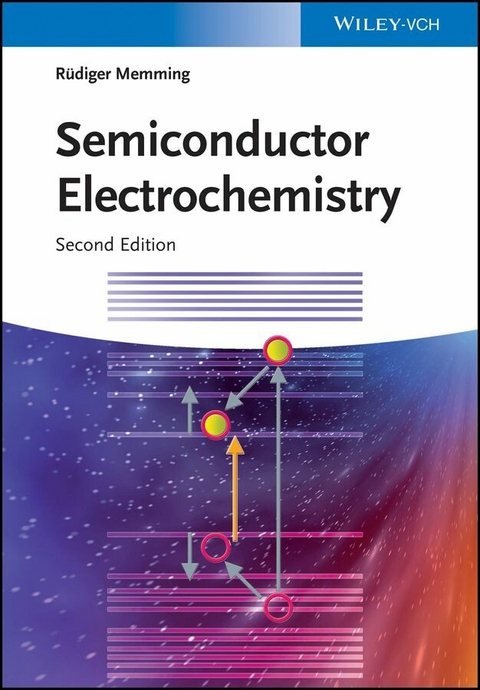
Semiconductor Electrochemistry (eBook)
Wiley-VCH (Verlag)
978-3-527-68870-8 (ISBN)
After gaining his doctorate in Stuttgart, Rudiger Memming spent three years as a post-doctorate fellow under Prof. Livingston at the School of Chemistry, University of Minnesota, USA, before joining Philips in 1960, where he worked at their research laboratories in Hamburg. In 1974 he gained his lecturing qualification in physical chemistry at Hamburg University, where he remained as professor until his retirement in 1994. From 1987 to 1994 he also headed the newly founded Institute for Solar Energy Research in Hanover, and was awarded grants to research at several institutes in Japan and the USA. Professor Memming lives in Hamburg where he still actively participates in discussions surrounding semiconductor electrochemistry.
After gaining his doctorate in Stuttgart, Rüdiger Memming spent three years as a post-doctorate fellow under Prof. Livingston at the School of Chemistry, University of Minnesota, USA, before joining Philips in 1960, where he worked at their research laboratories in Hamburg. In 1974 he gained his lecturing qualification in physical chemistry at Hamburg University, where he remained as professor until his retirement in 1994. From 1987 to 1994 he also headed the newly founded Institute for Solar Energy Research in Hanover, and was awarded grants to research at several institutes in Japan and the USA. Professor Memming lives in Hamburg where he still actively participates in discussions surrounding semiconductor electrochemistry.
Preface
PRINCIPLES OF SEMICONDUCTOR PHYSICS
Crystal Structure
Energy Levels in Solids
Optical Properties
Density of States and Carrier Concentrations
Carrier Transport Phenomena
Excitation and Recombination of Charge Carriers
Fermi Levels under Nonequilibrium Conditions
SEMICONDUCTOR SURFACES AND SOLID-SOLID JUNCTIONS
Metal and Semiconductor Surfaces in a Vacuum
Metal-Semiconductor Contacts (Schottky Junctions)
p-n Junctions
Ohmic Contacts
Photovoltages and Photocurrents
Surface Recombination
ELECTROCHEMICAL SYSTEMS
Electrolytes
Potentials and Thermodynamics of Electrochemical Cells
EXPERIMENTAL TECHNIQUES
Electrode Preparation
Current-Voltage Measurements
Measurements of Surface Recombination and Minority Carrier Injection
Inpededance Measurements
Surface Conductivity Measurements
Flash Photolysis Investigations
Surface Science Techniques
SOLID-LIQUID INTERFACE
Structure of the Interface and Adsorption
Charge and Potential Distribution at the Interface
Analysis of the Potential Distribution
Modification of Semiconductor Surfaces
ELECTRON TRANSFER THEORIES
The Theory of Marcus
The Gerischer Model
Quantum Mechanical Treatments of Electron Transfer Processes
The Problem of Deriving Rate Constants
Comparison of Theories
CHARGE TRANSFER PROCESSES AT THE SEMICONDUCTOR-LIQUID INTERFACE
Charge Transfer Processes at Metal Electrodes
Qualitative Description of Current-Potential Curves at Semiconductor Electrodes
One-Step Redox Reactions
The Quasi-Fermi Level Concept
Determination of the Reorganization Energy
Two-Step Redox Processes
Photoluminescence and Electroluminescence
Hot Carrier Processes
Catalysis of Electrode Reactions
ELECTROCHEMICAL DECOMPOSITION OF SEMICONDUCTORS
Anodic Dissolution Reactions
Cathodic Decomposition
Dissolution under Open Circuit Conditions
Energetics and Thermodynamics of Corrosion
Competition between Redox Reaction and Anodic Dissolution
Formation of Porous Semiconductor Surfaces
PHOTOREACTIONS AT SEMICONDUCTOR PARTICLES
Quantum Size Effects
Charge Transfer Processes at Semiconductor Particles
Charge Transfer Processes at Quantum Well Electrodes (MQW, SQW)
Photoelectrochemical Reactions at Nanocrystalline Semiconductor Layers
ELECTRON TRANSFER PROCESSES BETWEEN EXCITED MOLECULES AND SEMICONDUCTOR ELECTRODES
Energy Levels of Excited Molecules
Reactions at Semiconductor Electrodes
Comparison with Reactions at Metal Electrodes
Production of Excited Molecules by Electron Transfer
APPLICATIONS
Photoelectrochemical Solar Energy Conversion
Photocatalytic Processes
Etching of Semiconductors
Light-Induced Metal Deposition
APPENDICES
List of Major Symbols
Physical Constants
Lattice Parameters of Semiconductors
Properties of Important Semiconductors
Effective Density of States and Intrinsic Densities
Major Redox Systems and Corresponding Standard Potentials
Potentials of Reference Electrodes
Index
Chapter 1
Principles of Semiconductor Physics
The understanding of electrochemical processes at semiconductor electrodes naturally depends on the knowledge of semiconductor physics. This chapter presents a brief introduction to this field; only those subjects relevant to semiconductor electrochemistry are included here. For detailed information, the reader is referred to the standard textbooks on semiconductor physics by Kittel [1], Smith [2], Moss [3], and Pankove [4].
1.1 Crystal Structure
A crystalline solid can be described by three vectors a, b, and c, so that the crystal structure remains invariant under translation through any vector that is the sum of integral multiples of these vectors. Accordingly, the direct lattice sites can be defined by the set
where m, n, and p are integers [1].
Various unit cells of crystal structures are shown in Figure 1.1. Most of the important semiconductors have diamond or zincblende lattice structures which belong to the tetrahedral phases, that is, each atom is surrounded by four equidistant nearest neighbors. The diamond and zincblende lattices can be considered as two interpenetrating face-centered cubic (f.c.c.) lattices. In the case of a diamond lattice structure, such as silicon, all the atoms are silicon. In a zincblende lattice structure, such as gallium arsenide (the so-called III–V compound), one sublattice is gallium and the other is arsenic. Most other III–V compounds also crystallize in the zincblende structure [5]. Various II–VI compounds, such as CdS, crystallize in the wurtzite structure, and others in the rock salt structure (not shown). The wurtzite lattice can be considered as two interpenetrating hexagonal close-packed lattices. In the case of CdS, for example, the sublattices are composed of cadmium and sulfur. The wurtzite structure has a tetrahedral arrangement of four equidistant nearest neighbors, similar to a zincblende structure. The lattice constants and structures of the most important semiconductors are given in Appendix A.3.
Figure 1.1 Important unit cells (taken from [7]).
It is also common to define a set of reciprocal lattice vectors a*, b*, c*, such as
so that a • a* = 2π; a • b* = 0 and so on. The general reciprocal lattice vector is given by
where h, k, l are integers.
According to the definitions given by Eqs. (1.1)–(1.3), the product G • R = 2π × integer. Therefore, each vector of the reciprocal lattice is normal to a set of planes in the direct lattice, and the volume of a unit cell of the reciprocal lattice is related to the volume of the direct lattice Vc by
where Vc = a • b • c.
It is convenient to characterize the various planes in a crystal by using the Miller indices h, k, l. They are determined by first finding the intercepts of the plane with the basis axis in terms of the lattice constants, and then taking the reciprocals of these numbers and reducing them to the smallest three integers having the same ratio. The three integers are written in parentheses (hkl) as Miller indices for a single plane or a set of parallel planes. One example is given in Figure 1.2 where the Miller indices of some planes in a cubic crystal are shown. Planes that intercepted, for example, the x-axis on the negative side would be characterized by . For directions perpendicular to the corresponding planes, one uses the Miller indices in brackets, that is, [hkl].
Figure 1.2 Miller indices of some important planes in a cubic crystal.
Some physical properties of semiconductor electrodes depend on the orientation of the crystal, and surface properties vary from one crystal plane to the other. It is, therefore, very important in studies of surface and interface effects that the proper surface is selected. A semiconductor crystal can be cut by sawing or by cleavage.
Cleavage, in particular, is a common technique for preparing clean surfaces in an ultrahigh vacuum. Unfortunately, however, only a few surface planes can be exposed by cleavage. The easiest planes in silicon and germanium are (111) and their equivalents. In contrast, gallium arsenide cleaves on (110) planes. Accordingly, the most interesting planes, which consist of a Ga surface (111) or an As surface (111), cannot be produced by cleavage.
1.2 Energy Levels in Solids
Before the energy bands of semiconductors can be described, the following basic quantities must be introduced.
A free electron in space can be described by classical relations as well as by quantum mechanical methods. Combining both methods, the wavelength λ of the electron wave is related to the momentum p by
in which h is the Planck constant, m is the electron mass, and v is the electron velocity. The electron wave can also be described by the wave vector defined by the relation
Combining Eqs. (1.5) and (1.6), one obtains
The kinetic energy of a free electron is then given by
The parabolic relation between the energy and the wave vector k is illustrated in Figure 1.3.
In a metal, the electrons are not completely free. A quantum mechanical treatment of the problem leads to the consequence that not all energy values are allowed. The corresponding wave vectors are now given by
in which L is the length of a metal cube and n is any nonzero integer. Inserting Eq. (1.9) into Eq. (1.8), one obtains
The relation between the energy and the wave vector is still parabolic, but the energy of the electron can only attain certain values. Since, however, the range of the allowed k values is proportional to the reciprocal value of L, the range of the energy values is very small for a reasonable size of metal, so that the E–k dependence is still a quasi-continuum.
Figure 1.3 Parabolic dependence of the energy of a free electron vs wave vector.
The band structure of crystalline solids is usually obtained by solving the Schrödinger equation of an approximate one-electron problem. In the case of nonmetallic materials, such as semiconductors and insulators, there are essentially no free electrons. This problem is taken care of by the Bloch theorem. This important theorem assumes a potential energy profile V(r) being periodic with the periodicity of the lattice. In this case the Schrödinger equation is given by
The solution to this equation is of the form
where is periodic in r with the periodicity of the direct lattice, and n is the band index. Restricting the problem to the one-dimensional case, the lattice constant is a, b, or c (see Eq. (1.1)). If N is an integral number of unit lattice cells, then k = π/a is the maximum value of k for n = N. This maximum occurs at the edge of the so-called Brillouin zone. A Brillouin zone is the volume of k space containing all the values of k up to π/a. Larger values of k lead only to a repetition of the first Brillouin zone.
Accordingly, it is only useful to determine the band structure within the first Brillouin zone. The solution of the Schrödinger equation (see Eqs. (1.11) and (1.12)) leads to two energy bands separated by an energy gap, as shown in Figure 1.4. The energy profile of the conduction band (upper curve) still appears parabolic (at least near the minimum), but it may deviate considerably from a parabolic E–k relation. In order to continue to use the relation derived for free electrons (Eq. (1.8)), the electron mass is adjusted to provide a good fit. We then have, instead of Eq. (1.8),
Figure 1.4 Electron energy vs wave vector in a semiconductor.
in which m* is the effective mass. Differentiating this equation, the effective mass is given by
This means that the effective mass is determined by the second derivative of the E–k curve, that is, by its curvature. From this, it follows that the width of an energy band is larger for a small value of m* and smaller for a large m* value. The width can be determined by optical investigation and the effective mass by cyclotron resonance measurements.
According to Eq. (1.14), the negative curvature of the valence band would mean a negative electron mass, which is physically not acceptable. It has therefore been concluded that occupied orbitals in the valence band correspond to holes. A hole acts in an applied electric or magnetic field as though it were a particle with a positive charge. This concept has been experimentally proved by Hall measurements (see...
| Erscheint lt. Verlag | 11.3.2015 |
|---|---|
| Sprache | englisch |
| Themenwelt | Naturwissenschaften ► Chemie |
| Technik | |
| Schlagworte | charge transfer • Chemie • Chemie / Physikalische Chemie • Chemistry • Electrical & Electronics Engineering • Electrochemistry • Electronic materials • Elektrochemie • Elektronische Materialien • Elektrotechnik u. Elektronik • Festkörperphysik • Festkörperphysik • fuel cell • Halbleiter • Halbleiterphysik • Materials Science • Materialwissenschaften • photochemistry • Physics • Physik • Physikalische Chemie • Semiconductor physics • semiconductors • Solid-Liquid Interface • Solid state physics |
| ISBN-10 | 3-527-68870-6 / 3527688706 |
| ISBN-13 | 978-3-527-68870-8 / 9783527688708 |
| Informationen gemäß Produktsicherheitsverordnung (GPSR) | |
| Haben Sie eine Frage zum Produkt? |
 EPUB (Adobe DRM)
Kopierschutz: Adobe-DRM
Adobe-DRM ist ein Kopierschutz, der das eBook vor Mißbrauch schützen soll. Dabei wird das eBook bereits beim Download auf Ihre persönliche Adobe-ID autorisiert. Lesen können Sie das eBook dann nur auf den Geräten, welche ebenfalls auf Ihre Adobe-ID registriert sind.
Details zum Adobe-DRM
Dateiformat: EPUB (Electronic Publication)
EPUB ist ein offener Standard für eBooks und eignet sich besonders zur Darstellung von Belletristik und Sachbüchern. Der Fließtext wird dynamisch an die Display- und Schriftgröße angepasst. Auch für mobile Lesegeräte ist EPUB daher gut geeignet.
Systemvoraussetzungen:
PC/Mac: Mit einem PC oder Mac können Sie dieses eBook lesen. Sie benötigen eine
eReader: Dieses eBook kann mit (fast) allen eBook-Readern gelesen werden. Mit dem amazon-Kindle ist es aber nicht kompatibel.
Smartphone/Tablet: Egal ob Apple oder Android, dieses eBook können Sie lesen. Sie benötigen eine
Geräteliste und zusätzliche Hinweise
Buying eBooks from abroad
For tax law reasons we can sell eBooks just within Germany and Switzerland. Regrettably we cannot fulfill eBook-orders from other countries.
aus dem Bereich