Radio-Frequency Integrated-Circuit Engineering (eBook)
John Wiley & Sons (Verlag)
978-1-118-93648-1 (ISBN)
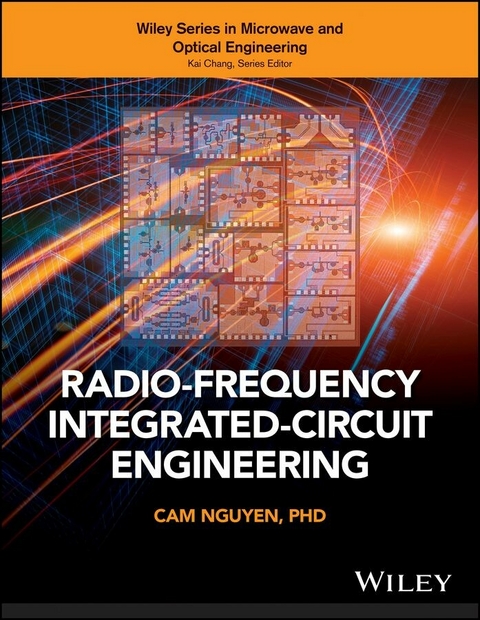
Radio-Frequency Integrated-Circuit Engineering addresses the theory, analysis and design of passive and active RFIC's using Si-based CMOS and Bi-CMOS technologies, and other non-silicon based technologies. The materials covered are self-contained and presented in such detail that allows readers with only undergraduate electrical engineering knowledge in EM, RF, and circuits to understand and design RFICs. Organized into sixteen chapters, blending analog and microwave engineering, Radio-Frequency Integrated-Circuit Engineering emphasizes the microwave engineering approach for RFICs.
• Provides essential knowledge in EM and microwave engineering, passive and active RFICs, RFIC analysis and design techniques, and RF systems vital for RFIC students and engineers
• Blends analog and microwave engineering approaches for RFIC design at high frequencies
• Includes problems at the end of each chapter
Cam Nguyen, PhD, IEEE Fellow, is the Texas Instruments Endowed Professor of Electrical and Computer Engineering at Texas A&M University. He was Program Director at the National Science Foundation during 2003-2004, responsible for research programs in RF and wireless technologies. Over the past 35 years, including 12 years at TRW, Martin Marietta, Aeroject ElectroSystems, Hughes Aircraft and ITT Gilfillan, Professor Nguyen has led numerous RF projects for wireless communications, radar and sensing; developed many RF integrated circuits and systems up to 220 GHz; published five books, six book chapters, over 255 papers; and given more than 160 conference presentations.
Radio-Frequency Integrated-Circuit Engineering addresses the theory, analysis and design of passive and active RFIC's using Si-based CMOS and Bi-CMOS technologies, and other non-silicon based technologies. The materials covered are self-contained and presented in such detail that allows readers with only undergraduate electrical engineering knowledge in EM, RF, and circuits to understand and design RFICs. Organized into sixteen chapters, blending analog and microwave engineering, Radio-Frequency Integrated-Circuit Engineering emphasizes the microwave engineering approach for RFICs. * Provides essential knowledge in EM and microwave engineering, passive and active RFICs, RFIC analysis and design techniques, and RF systems vital for RFIC students and engineers * Blends analog and microwave engineering approaches for RFIC design at high frequencies * Includes problems at the end of each chapter
Cam Nguyen, PhD, IEEE Fellow, is the Texas Instruments Endowed Professor of Electrical and Computer Engineering at Texas A&M University. He was Program Director at the National Science Foundation during 2003-2004, responsible for research programs in RF and wireless technologies. Over the past 35 years, including 12 years at TRW, Martin Marietta, Aeroject ElectroSystems, Hughes Aircraft and ITT Gilfillan, Professor Nguyen has led numerous RF projects for wireless communications, radar and sensing; developed many RF integrated circuits and systems up to 220 GHz; published five books, six book chapters, over 255 papers; and given more than 160 conference presentations.
Chapter 1
Introduction
Wireless systems, including communication, networking, and sensing systems, play a critical role in our information-age society in many areas, from public service and safety, consumer, industry, sports, gaming, and entertainment, asset and inventory management, medicine, banking to government and military operations. The key to enabling effective wireless communications, sensing and networking is radio-frequency (RF) integrated circuits (ICs).
Radio-frequency integrated circuits (RFICs) typically refer to RF monolithic ICs fabricated on silicon (Si) substrates using complementary metal oxide semiconductor (CMOS) or BiCMOS technology. From a general perspective, however, RFICs are not and should not be limited to only Si-based CMOS and BiCMOS circuits; others like microwave monolithic integrated circuits (MMICs) using III–V semiconductors such as GaAs MMICs can also be classified as RFICs. Nevertheless, in this book, to emphasize the main objective of the book and to distinguish Si-based RFICs from other non-Si based RFICs, we will use the term RFIC to indicate Si-based CMOS/BiCMOS RFIC. The readers should, however, keep in mind that the presented materials are not limited to Si-based RFICs; they are also applicable to non-Si based RFICs such as GaAs MMICs.
The frequencies used to indicate the RF range, in general, and for RFICs, in particular, are not strictly defined in practice. To some extent, particularly in the past, the frequencies in the RF range are known as a few kilohertz to a few gigahertz and, hence, RF is clearly distinct from microwave. Since the frequencies for radio waves are normally known as between 3 KHz and 300 GHz, to a broader extent, the frequencies in the RF range can be considered from 3 KHz to 300 GHz. As the name RF implies, however, these frequencies should not be limited to below 300 GHz. In this book, we will consider all the RFs in the electromagnetic (EM) spectrum up to terahertz (THz) as RF—in other words, we view the RF range as including all frequencies from 3 KHz to microwave, millimeter-wave and sub-millimeter-wave frequencies. Therefore, RF, as it is practiced or should be practiced now, is not different from microwave, millimeter-wave and sub-millimeter-wave frequencies. The boundary between RF and microwave, millimeter-wave and sub-millimeter-wave indeed no longer exists or should not exist. As the technologies for RFICs advance toward the terahertz region of the RF spectrum, it is expected that RFICs will find many useful applications in both the commercial and the defense sectors at terahertz—for instance, medical imaging or personal-health monitoring in the medical field and extremely wide bandwidth and ultrahigh data-rate for wireless communications.
Over the past several decades, RF components and systems in the microwave, millimeter-wave and sub-millimeter-wave ranges have been dominated with circuits employing III–V compound semiconductor devices, such as GaAs metal semiconductor field effect transistor (MESFET), high electron mobility transistor (HEMT), InP HEMT, GaAs heterojunction bipolar transistor (HBT), and InP HBT, etc. due to their superior performance as compared to Si-based technologies. RFICs based on III–V semiconductors, however, are expensive and have limited integration capability for single-ship systems. Exploding demand for low cost, low power, compactness, and high integration ability, far exceeding those provided by the III–V semiconductor technologies, has led the wireless industry to focus on better Si-based technologies capable of operating in the RF range. Si-based RF technologies have advanced significantly during the past few decades and are increasingly important for wireless communications, sensing, and networking due to their low cost, low power, and excellent integration ability, notably CMOS, that facilitates various applications requiring miniature, low cost, low power systems with high volume throughput. Presently, Si-based technologies can offer good performance up to the millimeter-wave regime with much lower cost and better integration capability than their non-silicon based counterparts, hence opening up many opportunities in wireless communications, sensing and networking.
Various RFICs, including single components and single-chip subsystems and systems, have been successfully developed with good performance up to millimeter-wave frequencies, demonstrating the potential capability of RFICs and their possible applications in the higher end of the RF spectrum. As an example, Figure 1.1 shows the schematic and microphotograph of a single-chip millimeter-wave RFIC transmitter operating concurrently in two frequency bands at 24.5 ± 0.5 GHz and 35 ± 0.5 GHz using a 0.18-µm SiGe BiCMOS process, showing the integration of several RF components. RFICs have played a significant role in advancing the state of the art of RF circuits and systems for various applications from sensing and imaging to communications across a few hundred MHz to millimeter-wave frequencies, and potentially beyond. It is foreseen that RFICs and systems with 3D (vertical and horizontal) integrations can perform at very high frequencies in the RF range in the future. RFIC is now inevitable in RF systems, and it is expected that it will dominate the RF territory, particularly for commercial applications, just like III–V semiconductors based MMICs have done, but with much lower costs and better abilities for direct integration with digital ICs. Although the performance of many Si-based RFICs still presently does not match that of RFICs implemented using III–V compound semiconductor devices, particularly in the higher frequency end of the RF spectrum such as millimeter-wave frequencies, due to lower and , higher substrate loss, more noise, and so on of current CMOS/BiCMOS devices, they have lower cost and better abilities for direct integration with digital ICs (and hence better potential for complete system-on-chip). RFICs are also small and low power, making them suitable for battery-operated wireless communication, sensing and networking devices and systems. RFICs are thus attractive for systems and, in fact, the principal choice for commercial wireless markets.
Figure 1.1 Schematic (a) and microphotograph (b) of a single-chip 0.18-µm SiGe BiCMOS millimeter-wave transmitter operating concurrently at two bands around 24.5 and 35 GHz. IRF: image-reject filter; BPF: band-pass filter; PA: power amplifier; TX: transmitter; RX: receiver; PRF: pulse repetition frequency; Clk: clock.
Typical RFIC design based on traditional analog design approach is not very suitable at high frequencies of the RF range that is currently practiced. As the RF spectrum moves toward the multi-GHz realm, the need of incorporating microwave design techniques into analog circuits and systems becomes increasingly important and is, in fact, inevitable. Consequently, the knowledge of EM and microwave engineering becomes vital for RFIC engineers in order to understand and design RFICs properly. This is a fact that is recognized by RF researchers and engineers in both academia and industry. High frequencies in the RF range, especially those approaching the frequency limits of CMOS/BiCMOS technology, make RFIC design challenging. The design of RFICs at high frequencies poses further challenging as circuits and devices become extremely small and the interactions between elements within a circuit or between circuits in an integrated system become so immense. Typical RFICs, especially those at low frequencies, use exclusively lumped elements. While lumped elements are useful for RF circuitry and, in some cases, mandatory (e.g., resistive terminations, bias bypass capacitors), it is difficult to realize a truly lumped element in lossy silicon substrates at high frequencies because of significant parasitics to ground associated with Si substrates and high frequency EM effects. At these frequencies, the need of incorporating transmission lines, distributed elements (e.g., transmission-line components) and microwave design techniques, besides lumped elements and (low frequency) analog design techniques, into RFICs becomes essential. Furthermore, besides circuit simulation, EM simulation needs to be effectively utilized to accurately model all effects occurring at these high frequencies. In view of these, it is crucial that the design of RFIC needs to be approached from the microwave design point of view. The design of Si-based RFICs is in general similar to the design of GaAs MMICs; the main difference is the use of Si instead of GaAs as the processing means. In other words, the design of RFICs is essentially executed using the microwave design principles in Si-based “analog” environment.
This book revolves around the philosophy that RFIC engineers need knowledge in EM and microwave engineering, passive RFICs, active RFICs, RFIC analysis and design techniques, and RF systems. To that end, the book is aimed to address the theory, analysis, and design of passive and active RFICs using Si-based CMOS and BiCMOS technologies, in particular, and other non-silicon based technologies, in general, at high frequencies beyond those in the traditionally considered RF range. It intends to provide a comprehensive coverage for RFICs from passive to active circuits with particular emphasis on using microwave analysis and design techniques, which distinguishes itself from other RFIC books. It attempts to present the materials in details with a self-contained concept to allow graduate students and engineers with basic knowledge in RF and circuits to understand RFICs and their design. The book also...
| Erscheint lt. Verlag | 3.3.2015 |
|---|---|
| Reihe/Serie | Wiley Series in Microwave and Optical Engineering |
| Wiley Series in Microwave and Optical Engineering | Wiley Series in Microwave and Optical Engineering |
| Sprache | englisch |
| Themenwelt | Technik ► Elektrotechnik / Energietechnik |
| Schlagworte | Active RF Components • Balanced Amplifiers • BICMOS • Bi-polar Complementary Metal-Oxide-Semiconductor • Broad-band Amplifiers • Capacitors • chain matrix • CMOS • CMOS Transistors • Communication technology • Complementary metal-oxide-semiconductor • Coplanar Strips • coplanar waveguide • De-embedding • Design process of RFICs • directional couplers • distributed resonators • Electrical & Electronics Engineering • electromagnetics • Elektrotechnik u. Elektronik • EM theory • Filters • FMCW Systems • GaAs RFICs • Homodyne Receivers • Impedance Matching • Inductors • Kommunikationstechnik • Low-Noise Amplifiers • Lumped-element resonators • Lumped Elements • microstrip line • Microwave Integrated Circuit (MIC) • Mikrowellen- u. Hochfrequenztechnik u. Theorie • millimeter-wave • Monolithic Microwave Integrated Circuit (MMIC) • MOSFET • MOSFET Models • Multi-Conductor Transmission Lines • Non-silicon RFICs • On-chip lumped elements • On-wafer Calibration • On-wafer Measurement • Passive RF components • phase noise • Power Amplifiers • Power Dividers • Printed-Circuit Transmission Lines • Pulsed Systems • Radio-Frequency Integrated-Circuit (RFIC) • resistors • Resonators • RFIC • RF / Microwave Theory & Techniques • scattering matrix • Scattering parameters • Si-based RFIC • Slot Line • SPDT Switches • SPICE Models • SPST Switches • Sub-millimeter-wave • Super-heterodyne Receivers • Synthetic Transmission Lines • Transmission Lines • T/R Switches • varactor diodes |
| ISBN-10 | 1-118-93648-5 / 1118936485 |
| ISBN-13 | 978-1-118-93648-1 / 9781118936481 |
| Informationen gemäß Produktsicherheitsverordnung (GPSR) | |
| Haben Sie eine Frage zum Produkt? |
 EPUB (Adobe DRM)
Kopierschutz: Adobe-DRM
Adobe-DRM ist ein Kopierschutz, der das eBook vor Mißbrauch schützen soll. Dabei wird das eBook bereits beim Download auf Ihre persönliche Adobe-ID autorisiert. Lesen können Sie das eBook dann nur auf den Geräten, welche ebenfalls auf Ihre Adobe-ID registriert sind.
Details zum Adobe-DRM
Dateiformat: EPUB (Electronic Publication)
EPUB ist ein offener Standard für eBooks und eignet sich besonders zur Darstellung von Belletristik und Sachbüchern. Der Fließtext wird dynamisch an die Display- und Schriftgröße angepasst. Auch für mobile Lesegeräte ist EPUB daher gut geeignet.
Systemvoraussetzungen:
PC/Mac: Mit einem PC oder Mac können Sie dieses eBook lesen. Sie benötigen eine
eReader: Dieses eBook kann mit (fast) allen eBook-Readern gelesen werden. Mit dem amazon-Kindle ist es aber nicht kompatibel.
Smartphone/Tablet: Egal ob Apple oder Android, dieses eBook können Sie lesen. Sie benötigen eine
Geräteliste und zusätzliche Hinweise
Buying eBooks from abroad
For tax law reasons we can sell eBooks just within Germany and Switzerland. Regrettably we cannot fulfill eBook-orders from other countries.
aus dem Bereich